What's inside
As an Amazon Associate I earn from qualifying purchases. This post may contain affiliate links at no extra cost to you.
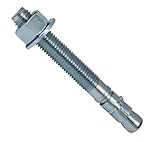
A wedge anchor is a practical choice for fastening stationary machinery to sound, uncracked concrete. It is a steel stud with an expansion clip at the embedded end: tightening the nut pulls the clip into the concrete and creates friction. That makes installation straightforward, but it also means anchor size, hole quality, slab condition, and edge distance all matter. A larger anchor is not automatically safer.
As an Amazon Associate we earn from qualifying purchases at no extra cost to you.



What we cover
Choose the anchor for the load and environment
For a dry indoor shop, a zinc-plated carbon-steel wedge anchor is often the economical choice. It can work well for equipment bases that stay dry and are not exposed to washdown or corrosive chemicals. For damp locations, choose stainless steel or a manufacturer-rated corrosion-resistant finish. Stainless costs more, and its strength and installation requirements can differ from carbon steel; check the product’s published data rather than assuming all anchors of the same diameter have the same capacity.
Start with the machine manufacturer’s anchoring instructions. They may specify anchor diameter, minimum embedment, number of anchors, and allowable loads. If the manual is silent, consider the machine’s operating weight, vibration, tipping forces, base-plate hole size, and consequences of movement. A small drill press and a high-speed compressor do not impose the same demands. For heavy equipment, seismic restraint, or uncertain concrete, get an engineer or qualified installer to size the anchors.
Common diameters include 3/8, 1/2, and 5/8 inch. The correct size must fit the machine’s mounting holes and provide the required capacity at the actual embedment and edge distance. Use a listed, documented product with installation instructions, such as zinc-plated concrete wedge anchors for a dry interior, or stainless-steel wedge anchors where corrosion resistance is needed.
Compare common wedge-anchor choices
| Type | Best fit | Main trade-off |
|---|---|---|
| Zinc-plated carbon steel | Dry indoor slab and ordinary shop equipment | Low cost; coating is not a substitute for corrosion-resistant material in wet or chemical exposure |
| Hot-dip galvanized | Some damp or outdoor applications, if approved for the exposure | Coating thickness may affect fit and compatibility; verify the product rating and hole requirements |
| Stainless steel | Wet or corrosive environments where the specified alloy is suitable | Higher cost; strength, galling risk, and allowable loads vary by alloy and product |
Do not substitute a sleeve anchor or concrete screw just because it is on hand. Those fasteners have different installation and load characteristics. A wedge anchor also needs enough solid concrete around it; it is a poor fix for a thin slab, a damaged edge, or a hole that lands in a crack. When the application calls for a specific anchor type, follow that specification.
Drill and install without weakening the connection
Use a rotary hammer with the bit diameter specified on the anchor packaging. A hammer drill may handle small anchors, but a rotary hammer usually drills faster and more consistently in concrete, especially for repeated holes. Match the bit to the anchor diameter—not the nut size—and use a sharp masonry bit. A quality SDS-plus masonry bit is a sensible purchase for common rotary hammers; check whether your tool takes SDS-plus, SDS-max, or a standard chuck.
Before drilling, locate embedded utilities and reinforcing steel where possible. Mark the machine’s footprint and check that each hole meets the anchor maker’s minimum edge and spacing distances. As a rough planning matter, many wedge-anchor designs need several inches from a slab edge, but the required distance varies with diameter, embedment, concrete strength, and load. Follow the manufacturer’s table, not a rule of thumb. Avoid drilling through a crack or placing anchors close together without checking the spacing limits.
Drill perpendicular to the slab to the specified depth. The hole must be deep enough for the required embedment and any dust at the bottom; drilling a little deeper than the minimum can help, but do not guess at embedment. Clean the hole as directed—dust left inside can keep the anchor from seating fully. Use eye and hearing protection, and control concrete dust with suitable extraction or other effective dust control.
Place the machine or base plate, insert the anchor through it, and tap the anchor until the washer and nut sit correctly. Keep enough thread exposed for the nut, washer, and full engagement. Tighten with a calibrated torque wrench to the manufacturer’s specified torque. Over-tightening can damage the concrete or anchor; under-tightening may leave the expansion clip inadequately set. Do not use an impact driver as a substitute for torque control unless the anchor maker explicitly allows that installation method.
Check for the problems that cause failures
A spinning anchor often points to an oversized or dusty hole, poor concrete, or an anchor that was not set correctly. Stop rather than tightening harder; that can enlarge the damage. Remove it if possible and assess whether a correctly sized replacement can be installed at a permitted distance. A nearby replacement hole may violate spacing rules or intersect the damaged concrete.
Cracked or spalled concrete, a slab too thin for the required embedment, and anchors placed too close to an edge can all reduce capacity or cause breakout. A wedge anchor generally exerts outward force as it expands, so it is not the right default for every cracked-concrete application. If the slab is unknown, visibly damaged, or thin, have the fastening method reviewed before anchoring expensive or hazardous machinery.
After installation, tighten the machine’s fasteners to the specified torque, check that the base sits flat, and inspect the anchors after the first period of operation for movement or loosening. Recheck them during routine maintenance, especially on vibrating equipment. If the machine shifts, a nut backs off repeatedly, or concrete cracks, stop using it until the cause is corrected; adding more anchors without diagnosing the problem can make it worse.