What's inside
As an Amazon Associate I earn from qualifying purchases. This post may contain affiliate links at no extra cost to you.
Melamine is a thin decorative resin coating bonded to particleboard or MDF. It looks hard and smooth, but the surface chips easily when a drill bit exits or the cutting edge drags across it. The best bit depends on the hole size and whether the hole will be visible. A sharp bit, moderate speed, and support behind the panel matter as much as the bit itself.
As an Amazon Associate we earn from qualifying purchases at no extra cost to you.

What we cover
Best bits by hole type
| Job | Best bit | Typical size | Main advantage | Trade-off |
|---|---|---|---|---|
| Screws and small hardware | Brad-point bit | 1/8 to 1/4 inch | Centers accurately and scores the surface | Can clog in particleboard |
| Large clean holes | Forstner bit | 1/2 to 2 inches | Clean rim and controlled cutting | Needs a steady drill and more pressure |
| Cable pass-throughs | Carbide-tipped hole saw | 1 to 3 inches | Efficient for larger openings | Greater risk of exit-side breakout |
| Long clearance holes | Sharp HSS twist bit | 1/8 to 1/2 inch | Inexpensive and widely available | More likely to chip the surface |
Brad-point bits for small holes
For holes up to about 1/2 inch, a sharp brad-point bit is usually the best general-purpose choice. Its center spur keeps the bit from wandering, while the outside spurs score the melamine before the main cutting edges remove material. That scoring action is what helps prevent a ragged white or gray chip around the hole.
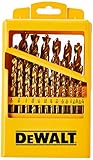
Choose a quality brad-point drill bit set with clearly ground spurs. Very cheap bits may have blunt spurs straight out of the package, and they tend to burn the coating instead of slicing it. A standard twist bit is fine for hidden pilot holes, but it is not the first choice for a visible shelf pin, hinge, or cabinet hardware hole.
Run a cordless drill in the high-speed range, generally around 1,000 to 2,000 rpm for small bits. Use light, even pressure. If the bit squeals, smokes, or stops making chips, withdraw it briefly to clear dust and reduce pressure.
Forstner bits for clean, large holes
Forstner bits are the strongest choice when the hole edge will be visible, especially for concealed-hinge cups, cable grommets, and shelf supports. The rim cuts the perimeter before the center removes material, producing a cleaner opening than a conventional twist bit.
For a 35 mm concealed-hinge cup, use a sharp 35 mm Forstner bit and drill from the melamine face. A drill press gives the best control, but a cordless drill works if you keep the bit square to the panel. Start slowly until the outer rim has established a track, then increase speed. Do not force a large Forstner bit at maximum speed; excessive heat can soften the resin surface and leave a burn ring.
Forstner bits also create less exit-side damage when you stop just before breaking through, turn the panel over, and finish from the opposite side. This takes longer but is safer than relying on a sacrificial board alone.
Hole saws for cable and pipe openings
For openings larger than about 1 inch, a hole saw is usually faster. A carbide-grit hole saw cuts melamine cleanly when it is sharp, while a bi-metal hole saw is a cheaper option for occasional work. Use a pilot bit and keep the drill straight. If the hole saw tilts, its teeth can grab the coating and pull off a crescent-shaped chip.
When both sides must look clean, mark the center and drill from the finished face until the pilot bit just appears on the back. Stop, move to the back, and finish using the pilot hole as a guide. For a single hidden cable opening, a standard bi-metal hole saw kit is usually sufficient. You do not need a premium carbide set for a few holes in the back of a cabinet.
Technique that prevents chipping
Put painter’s tape over the drilling mark, then mark the center on the tape. The tape supports loose surface fibers and makes the layout mark easier to see. It is helpful, but it cannot compensate for a dull bit or excessive feed pressure.
Clamp a flat scrap of plywood or MDF tightly against the exit side. This backing board supports the melamine as the bit breaks through. For the cleanest result, drill until the center spur or pilot has passed through, but before the cutting edges exit. Then unclamp the work, flip it, and finish the hole from the reverse side.
Secure the panel before drilling. A loose melamine shelf can vibrate, allowing the bit to catch and chip a wide section. Clamp workpieces to a bench, and keep both hands on the drill when using a large Forstner bit. A side handle is worthwhile for bits over roughly 1-1/4 inches.
Choosing the right drill or driver
Use a regular cordless drill or drill press for clean melamine holes. A hammer drill should have hammer action switched off; impact pulses can fracture the coating and make the bit jump. An impact driver is acceptable only with hex-shank bits rated for it, and even then it is not ideal for large Forstner bits or hole saws. The repeated impacts can damage the bit, the workpiece, or the driver’s chuck adapter.
For small pilot holes, a compact variable-speed cordless drill with a clutch is more useful than a high-torque impact driver. Set the clutch low enough that the bit does not stall and twist the panel. For large bits, use the drill’s low-speed range and maintain firm control.
Common failures and fixes
Chipped top edge: The bit was dull, the feed was too fast, or the work was unsupported. Replace or sharpen the bit, add backing, and let the cutting edges do the work.
Burn marks: Speed was too high, the bit was clogged, or pressure was excessive. Withdraw the bit periodically, clear dust, and use a sharper bit. Burning is especially common with large Forstner bits in MDF-core melamine.
Wandering hole: The bit lacked a center spur or the drill was started at an angle. Use a brad-point or Forstner bit and start at slow speed until the cutting rim is established.
Blown-out exit: The panel had no backing or the bit was pushed through too quickly. Clamp a scrap board behind the work, or drill from both faces.
For most cabinet and shelving work, buy a sharp brad-point set for small holes and add a quality Forstner bit for any large visible opening. If the job involves only one hidden cable hole, the cheaper bi-metal hole saw is usually fine. The cleanest results come from supporting both faces, drilling without hammer action, and stopping before the bit breaks through.