What's inside
As an Amazon Associate I earn from qualifying purchases. This post may contain affiliate links at no extra cost to you.
What we cover
Why use an impact driver on a door frame?
Hanging or rehanging a wooden door often means driving long screws through a hinge and into the jamb or framing. An impact driver is compact and delivers rotational bursts that help turn screws without the steady twisting force a drill applies to your wrist. It is useful for long screws, repeated fastening, and tight spots near the hinge leaf.
It is not automatically the best tool for every screw. Its high torque can strip a screw head, snap a fastener, or bury a hinge if you pull the trigger too hard. For short screws and careful hinge adjustments, a basic cordless drill or hand screwdriver may be easier to control.
As an Amazon Associate we earn from qualifying purchases at no extra cost to you.



What to buy
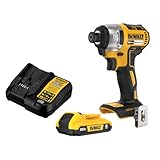
For occasional door work, a compact 18V or 20V-class cordless impact driver with a variable-speed trigger is a sensible choice. The voltage labels are not directly comparable between brands, so look at the tool’s size, speed control, battery availability, and whether you can buy it as a bare tool or kit. A smaller 12V driver can handle many hinge screws and is lighter in a confined doorway; it may be slower on long structural screws.
Choose a model with at least two speed or drive settings, or a selectable low-speed mode. The lower setting makes it easier to start screws and avoid damaging the hinge. A brushless motor can improve runtime and reduce wear, but it is not essential for a few doors a year. If you already own batteries from a tool platform, a compatible bare tool is often the economical choice.
Compare cordless impact drivers with variable speed for a general-purpose option. For lighter work, a 12V impact driver kit may be enough, especially if its batteries also fit other tools you use.
Impact driver, drill, or hand screwdriver?
| Tool | Best use on a door frame | Main trade-off |
|---|---|---|
| Impact driver | Driving long screws into framing; repeated fastening | Can overdrive or strip fasteners quickly |
| Cordless drill/driver | Starting screws, drilling pilot holes, short hinge screws | Can twist your wrist if a long screw binds |
| Hand screwdriver | Final snugging and small hinge adjustments | Slow for multiple long screws |
A drill/driver with a clutch is often the better choice if you have only short screws to install. The clutch can limit torque, while an impact driver usually has no equivalent mechanical clutch. A practical setup is to drill pilot holes with a drill and use the impact driver on a low setting for the longer screws, then finish by hand.
Bits and screws matter
Use a bit that matches the screw head exactly. A loose Phillips or square-drive bit cams out under impact, damaging the head and making the screw difficult to remove. For common hinge screws, a quality driver bit in the correct size is more useful than a large assortment of cheap bits. Keep the bit seated squarely and replace it if its tip is worn.
Door hinges are commonly secured with short screws into the jamb, but those may only bite into thin jamb material. Where the frame needs stronger attachment, a longer screw—often around 2½ to 3 inches—can reach the framing behind it. Check the door and wall conditions first; a long screw can hit wiring, plumbing, or other concealed materials. Do not assume every hinge hole is suitable for a long fastener.
For a long screw, make a pilot hole sized for the screw’s core, especially in dense wood or near the end of a narrow jamb. A pilot hole reduces splitting and helps the screw track straight. If the screw turns hard, stop and back it out rather than leaning harder on the trigger; the hole may be too small, the bit may be slipping, or the screw may be hitting an obstruction.
How to drive screws without damaging the frame
Support the door so it cannot sag while you work. Seat the hinge flat against the jamb and start each screw by hand or with a drill at low speed. Once the screw is engaged, hold the driver in line with it and use short trigger pulls. Reduce speed as the head approaches the hinge leaf. Stop when the head is flush; driving it below the surface can deform the hinge, pull the jamb out of position, or make the door bind.
When replacing a short hinge screw with a longer one, tighten it gradually and check the door swing before changing more screws. A long screw can draw the jamb toward the framing and correct a small gap, but too much tightening can move the jamb enough to create uneven reveals or latch problems. Adjust one screw at a time and inspect the result.
If the screw head strips, stop before the bit removes what remains of the drive recess. A fresh, correctly sized bit and firm pressure may still work; otherwise, a screw extractor or careful removal with locking pliers may be needed. If a screw breaks, do not simply drive another one beside it in the same damaged area. Move to sound wood or repair the hole with a suitable wood plug and redrill.
When a cheaper tool is fine
You do not need a premium impact driver to install a few hinge screws. A modest cordless drill/driver with a clutch, a sharp bit, and properly sized pilot holes can do the job at lower cost and with more control. A budget impact driver is reasonable if it has a predictable trigger and you already own compatible batteries. Spend more for a better tool mainly if you will use it regularly, need longer runtime, or value a smaller body and more controlled settings.
Also budget for the right bits and screws rather than chasing maximum torque. For door-frame work, control and correct fastener placement matter more than a headline torque number. If the door is badly out of square, the jamb is loose, or the frame is split, stronger driving will not fix the underlying problem; correct the frame or fastening point first.