What's inside
As an Amazon Associate I earn from qualifying purchases. This post may contain affiliate links at no extra cost to you.
Stair risers are thin boards, and the screws used to secure them can split the wood or poke through the front if you drive carelessly. An impact driver makes the job faster, especially when installing many screws, but it is not automatically the best choice for every stair. The right tool depends on the riser material, screw size, access, and how much control you need near finished surfaces.
As an Amazon Associate we earn from qualifying purchases at no extra cost to you.



What we cover
What the job demands
Most risers are roughly ¾ inch thick, though dimensions and materials vary. A screw driven from the back of a riser into a tread or framing can offer a clean front face, but the available screw length is limited by the thickness of the parts and the risk of breakthrough. For face fastening, short trim or finish screws are often a better fit than long construction screws.
Impact drivers deliver rotational blows that help turn screws with less reaction at your wrist. That is useful for long or numerous fasteners, but the blows can make it harder to stop at exactly the right depth. A screw that is overdriven can dimple or tear the wood; a screw that is too long can emerge through the visible face. Check the combined material thickness and screw length before driving.
Impact driver or drill?
For a small repair or a few short screws in softwood, a regular cordless drill is often the cheaper, more controlled choice. It can drive screws without impact blows, and a clutch gives you a repeatable starting point for limiting torque. You may need to press firmly and keep the bit seated, especially with a long screw.
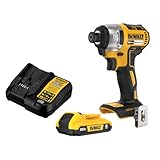
An impact driver is worth considering for a full set of risers, dense hardwood, or screws that are long enough to bog down a drill. Choose a model with variable-speed control; the trigger matters more here than maximum torque. If you are buying one mainly for stair work, a variable-speed cordless impact driver is a more useful search than simply looking for the highest torque rating.
Tool comparison
| Tool | Best fit | Main trade-off |
|---|---|---|
| Compact cordless drill | A few screws, softwood, or work close to a finished face | Slower on long screws; can stall in dense material |
| Impact driver | Many screws, harder wood, or longer fasteners | Easy to overdrive screws without a light trigger touch |
| Drill/driver with clutch | Repeatable depth control for short screws | May need more pressure and time as resistance rises |
A 12-volt drill is often enough for light stair work. An 18- or 20-volt tool is useful if you already own that battery platform or expect to drive longer fasteners regularly, but it is not a requirement. Battery capacity affects runtime and weight more than screw quality: a compact battery keeps the tool easier to handle in tight stair corners.
Bits and screws that fit the work
Use the bit type and size that match the screw head exactly. A loose Phillips bit is prone to cam-out—the bit climbs out of the recess and can damage both the screw and the wood. Torx or other star-drive screws generally hold the bit more securely, particularly with an impact driver. Keep a spare bit nearby; a worn tip is more likely to slip.
For visible fastening, look for trim-head or finish screws with a head suited to the appearance you want. For hidden fastening, a suitable wood or construction screw may be appropriate, provided its length and head style work for the joint. A star-drive trim-head screw can make clean, low-profile fastening easier, but it does not eliminate the need to choose the right length.
Pre-drill near board ends, in brittle material, or whenever a test screw causes splitting. Use a bit close to the screw’s root diameter—the solid core beneath the threads—and test on scrap if possible. The pilot should generally be smaller than the screw’s outside thread diameter so the threads still bite. A countersink or shallow clearance hole may help keep a head flush without crushing the surface.
Drive with control
Clamp or hold the riser firmly, then start each screw slowly and square to the surface. On an impact driver, use a light trigger until the screw is well engaged. Finish with short trigger pulls, stopping when the head is seated rather than continuing to hammer. If your tool has selectable modes, begin with its gentler setting and increase only if the screw stalls.
Work on a scrap piece of the same material first. Set the screw depth there, then repeat the technique on the stair. If the head sinks too far, reduce speed or use a drill clutch; if the screw stalls, check for a dull bit, a poor pilot hole, or a fastener that is too large before reaching for more power. Keep the bit aligned and apply steady pressure—leaning hard on the tool can make a slipping bit more damaging.
What to buy
For a homeowner who already has a drill, buying an impact driver solely for a handful of riser screws is usually unnecessary. Add one when the job involves repeated driving or you have other fastening work planned. A compact drill/driver with a clutch is the sensible budget pick for occasional, controlled fastening. If you already use a battery system and have many screws to install, an impact driver can save time; prioritize variable-speed control, a comfortable grip, and compatible batteries over headline torque.
Before starting, confirm the screw will not reach the visible face, test the bit fit, and make one trial fastening. Those checks prevent the common failures—split edges, stripped heads, proud screws, and accidental breakthrough—more reliably than buying a more powerful tool.