What's inside
As an Amazon Associate I earn from qualifying purchases. This post may contain affiliate links at no extra cost to you.
What we cover
Choosing a drill for LVL
Laminated veneer lumber (LVL) is dense, structural wood made from bonded layers of veneer. Drilling it is not exotic, but large or repeated holes can tax a cordless drill more than ordinary framing lumber. The right choice depends mainly on hole diameter, bit type, how many holes you need to make, and whether the drill has room to swing.
For occasional holes up to about 1/2 inch, a good 18V-class drill with a two-speed gearbox is usually enough. Larger holes, especially with an auger bit or hole saw, call for a strong drill with a side handle. If you are drilling many large holes, a corded drill or a dedicated right-angle drill may be a better fit than trying to force a compact cordless model through the job.
As an Amazon Associate we earn from qualifying purchases at no extra cost to you.
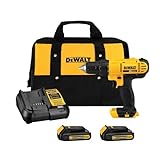


Quick comparison
| Drill type | Best suited to | Main trade-off |
|---|---|---|
| Compact 18V drill | Pilot holes and occasional holes up to roughly 1/2 inch | Light and easy to handle, but can bog down with large bits |
| Full-size 18V drill with side handle | Repeated medium or large holes with auger bits or hole saws | More capable, but heavier and harder to use overhead |
| Right-angle drill | Holes in tight framing or between obstructions | Access-focused; check its torque and chuck capacity before buying |
| Corded drill | Long runs of large holes where power access is practical | No battery changes, but a cord can snag and restrict movement |
What matters in the drill
Look for a two-speed gearbox, a 1/2-inch chuck, and a side handle on a full-size drill intended for larger holes. Low gear gives better control and torque; high gear is useful for small bits. A brushless motor can improve runtime and reduce heat under sustained work, but it is not a requirement for occasional drilling. A quality brushed drill can handle a short list of holes just fine.
Published torque numbers are not a reliable way to compare every brand because manufacturers test and report them differently. More useful clues are the drill’s size, whether it includes a side handle, and how it performs with the bit you plan to use. For a general-purpose option, compare 18V brushless drills with 1/2-inch chucks and side handles. A compact drill is a reasonable cheaper choice if your holes are small and infrequent.
Match the bit to the hole
Use a sharp, appropriate bit. A brad-point or standard twist bit works well for smaller holes; an auger bit removes wood quickly but its screw tip can pull the drill forward. A self-feed bit is efficient for larger holes, but it can grab hard and twist the tool suddenly. Hole saws suit larger, shallow openings, though packed sawdust increases resistance. For a few clean, modest-size holes, a sharp twist bit often makes more sense than buying a specialty bit.
Do not assume a larger bit is only a little harder to drive. Cutting resistance rises with bit diameter, and a dull bit makes the problem worse. If the drill slows sharply, the battery or motor gets hot, or the bit stops cutting, ease off the trigger and clear the chips rather than forcing it. For repeated large holes, consider a cordless right-angle drill with a side handle if access is tight, or a full-size drill if there is room to work.
Technique that prevents stalls and damage
Mark the hole carefully and check the project plans before drilling structural LVL. A hole that is mechanically easy to make can still weaken a beam or violate the manufacturer’s limits. LVL products do not all share the same allowable hole locations or dimensions. Follow the specific manufacturer’s guide and local building requirements; do not drill near an edge, notch, or support simply because the bit fits.
Clamp or brace the work where possible. Hold a full-size drill with both hands, using its side handle, and stand so a sudden stall will not pull you off balance. Set the drill to low gear for large bits, keep the bit square to the face, and apply steady pressure. Let the cutting edges do the work. For a through-hole, slow down as the tip approaches the far side to limit splintering; a backing board helps if you can reach the exit face.
With auger and self-feed bits, watch for the bit catching in a knot or grabbing as it breaks through. A drill with an adjustable clutch is useful for screws, but drilling is generally done with the clutch set to drill mode. If you cannot control the reaction torque with a firm two-handed grip, stop and use a smaller bit, a more suitable drill, or a safer setup.
Battery, runtime, and buying decision
For a handful of holes, one fully charged battery is often enough, and an existing battery platform can make a lower-cost bare tool the sensible buy. For a long run of large holes, keep a charged spare on hand. A higher-capacity battery can extend runtime, but it adds weight; that matters when drilling overhead or in cramped framing.
Choose a compact drill when portability and light work are the priority. Choose a full-size drill with a side handle when the bit is large enough to stall a smaller tool or you have many holes to make. A hammer drill’s hammer setting does not help in wood, so there is no reason to pay extra for that feature solely for LVL drilling. If you already own a capable hammer drill, switch it to ordinary drill mode and use it as a drill.
Before buying, check the chuck size against your largest bit, confirm the drill has a low-speed setting, and consider whether you can safely control it at the hole location. The best choice is not the drill with the biggest advertised number; it is the lightest tool that can turn your actual bit without repeated stalls, overheating, or loss of control.