What's inside
As an Amazon Associate I earn from qualifying purchases. This post may contain affiliate links at no extra cost to you.
Drilling into a concrete block lintel is harder than drilling into ordinary blockwork. A lintel carries load over a door or window opening, and it may contain steel reinforcement or prestressing wire. The right bit will make a clean hole, but it cannot make drilling into reinforcement safe. If you hit steel, stop rather than forcing the drill through it.
As an Amazon Associate we earn from qualifying purchases at no extra cost to you.


What we cover
Choose the right bit type
For most lintel work, use a masonry bit with a carbide tip. The best choice depends mainly on the drill and the hole size. A standard round-shank bit works in a normal cordless drill or hammer drill. An SDS-Plus bit is usually the better option for a rotary hammer, especially for holes larger than 10 mm (3/8 inch) or for several holes in a row.
| Bit type | Best use | Advantages | Limitations |
|---|---|---|---|
| Standard carbide masonry bit | Small holes in block or occasional lintel drilling | Cheap, widely available, works in ordinary chucks | Slower and more prone to overheating or slipping |
| SDS-Plus two-cutter bit | Common anchor holes, roughly 6–16 mm | Fast, straight, positive chuck engagement | Requires an SDS drill or rotary hammer |
| SDS-Plus four-cutter bit | Reinforced concrete and repeated drilling | More stable cutting and less likely to snag on steel | Costs more than a basic two-cutter bit |
| SDS-Max bit | Large holes and heavy demolition work | High removal rate and durability | Overkill for wall plugs; needs a larger rotary hammer |
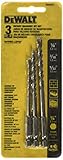
For a basic 6 mm or 8 mm wall plug, a decent carbide masonry bit is often enough. Buying a rotary hammer and premium SDS bits for two holes is unnecessary. If you are drilling many holes, working above 10 mm, or drilling dense concrete lintels, an SDS-Plus setup saves time and usually produces more consistent holes. A set of SDS-Plus masonry bits is the sensible starting point for most heavier jobs.
Two-cutter versus four-cutter bits
Two-cutter SDS bits have a pointed carbide tip with two main cutting edges. They are affordable and drill ordinary concrete, mortar, and block quickly. Their weakness is reinforcement. If the tip catches steel, a two-cutter bit can vibrate, lose its point, or become stuck.
Four-cutter bits use a cross-shaped carbide head. They cost more, but the tip stays centered better and is less likely to jam when it encounters occasional reinforcing steel. They are not permission to drill through reinforcement. The advantage is controlled cutting and a lower chance of catastrophic snagging while you withdraw the bit or move to another location.
For a single lintel-mounted curtain rail or bracket, two-cutter bits are generally fine if you can position the holes away from likely reinforcement. For several anchors, a heavy shelf, or repeated work in reinforced concrete, choose four-cutter SDS-Plus concrete bits.
Match the bit to the anchor
The bit diameter must match the anchor manufacturer’s specification, not merely the screw diameter. A typical plastic wall plug may require a 6 mm, 8 mm, or 10 mm hole. The hole should be slightly deeper than the plug—usually by 5 to 10 mm—so dust and debris do not prevent the plug from seating fully.
For concrete block lintels, avoid relying on a small plastic plug for a heavily loaded bracket. A suitable concrete screw, sleeve anchor, or resin fixing may be more appropriate, depending on the lintel and the load. Concrete screws commonly need a precisely sized pilot hole, while sleeve anchors require enough solid material behind the hole and can split weak masonry if over-tightened.
Do not use an impact-driver bit as a substitute for a masonry bit. Impact-rated hex bits are designed for driving screws, not grinding through concrete. There are compact hex-shank masonry bits for occasional drilling, but they are normally slower and less durable than SDS bits in a rotary hammer.
A reliable drilling method
First, check the area with a cable and pipe detector, and inspect both sides of the wall if possible. Keep holes away from the top and bottom edges of a lintel. Never drill blindly through a lintel that may be prestressed, and do not use a hole saw or large core bit without understanding the lintel’s construction.
Mark the hole with a pencil, then start slowly with the drill held square to the surface. On a normal hammer drill, use moderate pressure and let the carbide tip do the work. Excessive pressure can glaze the bit, overheat the chuck, and enlarge the entrance of the hole. Withdraw the bit every few seconds to clear dust, particularly in holes deeper than 50 mm.
With an SDS rotary hammer, use rotary hammer mode rather than hammer-only mode. Keep steady pressure, but do not lean your full body weight on the tool. If the bit stops advancing, withdraw it and clear the hole. A clogged flute can make a good bit appear blunt.
When you strike metal, the sound usually changes to a sharp ringing and progress stops abruptly. Do not switch to maximum power and push harder. Stop, remove the bit, and move the hole if the bracket allows. If the location cannot change, get advice from a structural professional before cutting reinforcement.
What to buy for the job
Look for a clearly stated carbide cutting head, accurate diameter markings, and a flute long enough to reach the required embedment. A bit with 110 mm overall length may have only 50 mm of useful drilling depth, so check the working length rather than the headline size.
For occasional 6–10 mm holes, a carbide-tip masonry bit set is the economical choice. For regular lintel and concrete work, buy individual SDS-Plus bits in the exact sizes you use instead of a huge mixed set. Premium bits make most sense when downtime, crooked holes, or damaged anchors cost more than the price difference.
Use eye protection, hearing protection, and a dust mask or vacuum attachment. Concrete dust is harmful, and drilling overhead can put debris directly in your face. The cheapest suitable bit is fine for a few small holes, but a sharp SDS-Plus bit, correct anchor diameter, and a cautious drilling technique matter more than a premium brand name.