What's inside
As an Amazon Associate I earn from qualifying purchases. This post may contain affiliate links at no extra cost to you.
Hard brick is unforgiving of dull bits, excess pressure and the wrong drill setting. A bit that rubs instead of cutting can polish the hole wall—a problem called glazing—then make progress even slower. The fix is usually a sharp, carbide-tipped masonry bit, a suitable hammer drill, and a steady technique that clears dust before it packs around the tip.
As an Amazon Associate we earn from qualifying purchases at no extra cost to you.


What we cover
Choose the right bit for the hole
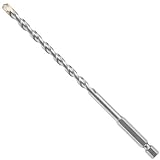
For occasional holes for picture hooks or light-duty wall plugs, a standard carbide-tipped masonry bit is usually the economical choice. Look for a carbide cutting tip and a shank that fits your drill. These bits are widely available and work well in brick when sharp, but inexpensive tips can wear or chip faster in very hard, abrasive material.
For repeated holes, larger diameters or especially hard brick, a four-cutter SDS-plus masonry bit is worth considering if you own a compatible rotary hammer. Its four cutting edges are less prone to catching on hard aggregate or reinforcing material than a basic two-edge tip. SDS bits do not fit a standard drill chuck without the correct tool or adapter, and they are unnecessary for a few small holes.
Match bit diameter to the anchor maker’s instructions—not just the screw size. A wall plug marked for a 6 mm hole needs a 6 mm bit; a hole that is too large can leave the plug spinning. For deep holes, check the specified depth and choose a bit long enough to reach it without burying the flutes.
Bit and tool options
| Option | Best for | Trade-off |
|---|---|---|
| Basic carbide masonry bit | A few small holes in brick | Low cost; wears sooner under heavy use |
| Premium two-cutter bit | Regular drilling with a hammer drill | Costs more; still depends on sharp carbide and dust clearing |
| Four-cutter SDS-plus bit | Frequent or larger holes with a rotary hammer | Needs SDS-plus equipment; overkill for occasional work |
| Diamond core bit | Large, clean openings where the bit and method are appropriate | Different setup and technique; not a substitute for an ordinary anchor bit |
Use a drill that can keep cutting
A cordless hammer drill with a proper masonry mode is enough for many small and medium holes. A rotary hammer delivers more impact energy and is generally faster for repeated drilling or larger holes in hard brick. A regular drill can sometimes manage a small hole in softer brick, but in hard brick it may just spin and heat the tip. An impact driver is not the right tool for drilling masonry: its rotational impacts are designed for driving fasteners, not for the controlled axial hammering masonry needs.
Do not judge performance by speed alone. For a conventional chuck bit, follow the bit and drill makers’ speed guidance; a common starting range for small masonry bits is around 600–1,000 rpm, adjusted for diameter and tool. Larger bits generally need slower speed. SDS rotary hammers use a different mechanism and are operated according to their instructions. If the bit squeals, smokes, turns blue, or stops advancing, release the trigger. Continuing to rub a hot, dull tip is a reliable way to glaze the hole.
Drill without glazing the hole
First check for electrical cables, plumbing and other services. Mark the location, then use a sharp bit with the correct diameter. Start with the drill square to the wall and a light touch so the tip does not skate across the brick. Once it has started, keep the drill straight and apply firm, steady pressure—not your full weight.
Use hammer mode for hard brick if the bit and drill are designed for it. If the brick is fragile or you need a clean start, begin in rotary-only mode for a short distance, then switch to hammer action. Do not use hammer mode on a bit that is not rated for it. Periodically withdraw the bit while it is still turning gently to clear dust from the flutes; for a deeper hole, clear it every few seconds rather than drilling continuously into packed powder.
Ease off as you approach the target depth. A simple depth mark made with tape helps, though a depth stop is more reliable. Avoid drilling into the mortar joint unless the anchor instructions allow it: mortar is often easier to drill, but it may not hold a load as well as sound brick. If the bit wanders, the hole crumbles, or you encounter an unusually hard spot, stop and reassess rather than forcing the tool.
Know when the bit is done
A sharp masonry bit cuts steadily and removes dust. Replace it if progress slows despite clearing the hole, the tip is visibly chipped or rounded, or the bit overheats quickly under moderate pressure. A dull bit can still spin, but it tends to polish the hole, overheat the carbide and leave an undersized or rough opening. Do not try to sharpen a carbide tip with an ordinary file; use a suitable sharpening method or replace the bit.
For one or two small holes, a budget bit is fine if it is sharp and correctly sized. If you have a run of anchors to install, buying a better bit—or using an SDS rotary hammer for a tool-compatible job—can save time and reduce wandering. The useful upgrade is the one that matches your hole size, brick and workload, not simply the most expensive bit on the shelf.