What's inside
As an Amazon Associate I earn from qualifying purchases. This post may contain affiliate links at no extra cost to you.
Thin stainless pipe is easy to dent, hard on cutting edges, and unforgiving of a wandering bit. For a few holes in ordinary 304 or 316 stainless, a sharp cobalt twist bit is usually the best buy. For repeated holes, a step bit can make a cleaner, more controlled opening—provided the pipe wall is thin enough for the tool’s cutting range.
As an Amazon Associate we earn from qualifying purchases at no extra cost to you.


What we cover
Which bit should you buy?
| Bit type | Best use | Trade-off |
|---|---|---|
| M35 cobalt twist bit | Small holes and occasional work in stainless | Good value; can grab or overheat if pushed too fast |
| M42 cobalt twist bit | Frequent drilling or tougher stainless work | More wear-resistant, but costs more and still needs careful technique |
| HSS step bit | Several larger hole sizes in thin-walled pipe | Convenient and often tidy, but limited by its diameter steps and wall thickness |
| Carbide-tipped bit | Specialized jobs or very hard material | Brittle and easy to damage on curved, flexible pipe; usually unnecessary for a few holes |
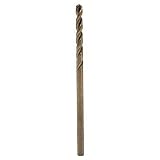
For most homeowners, a set of M35 cobalt drill bits is the sensible starting point. M35 contains 5% cobalt; M42 contains 8% and generally holds up better under heat, but technique matters more than the difference in cobalt content. A cheap, sharp bit used slowly can outperform an expensive bit run dry at high speed.
If you need a larger round hole in thin pipe, consider an HSS step drill bit. Check the manufacturer’s stated material and thickness limits before buying. A step bit is not automatically suitable for every stainless pipe, and the curved surface can make it skate unless you secure and mark the work carefully.
Why stainless needs a different approach
Stainless steel conducts heat away less effectively than ordinary mild steel. If the bit rubs rather than cuts, heat builds at its edge. The surface can harden locally, a process called work hardening, leaving the next attempt harder to drill. A glazed spot, squealing sound, smoke, or metal chips that turn blue are warnings to stop and reassess—not signs to press harder.
Choose a bit labeled cobalt or suitable for stainless steel, with a sharp cutting edge. A standard high-speed steel bit may work for one small hole in thin tubing, so the cheaper option is fine for a one-off job if it is sharp and you use proper speed and lubrication. Expect it to dull sooner, especially if the pipe is thick or you have many holes to make. Avoid using a masonry bit or an impact-driver bit; neither is designed to cut stainless pipe cleanly.
Set up the pipe before drilling
Thin pipe can collapse under a clamp or twist when the bit breaks through. Support it close to the drilling point, but do not crush it. A vise with soft jaws or wood blocks helps. If the pipe is already installed, confirm what is behind it and whether drilling could damage a wire, fluid line, coating, or structural part. Do not drill a pressurized pipe.
Mark the hole and use a center punch gently. A heavy strike can dent thin tubing; the goal is only a small starting dimple. On a curved surface, a short pilot hole can wander less than a large bit, but start with a small, sharp bit and keep the drill square. For larger holes, a step bit’s small tip can establish the opening before its wider steps cut.
Secure loose pipe so it cannot rotate. Keep hands away from the bit and do not hold the work by hand while drilling. A cordless drill with a variable-speed trigger is a better choice than an impact driver. Use its normal drill setting, not hammer mode; impact action can tear or distort thin metal.
Speed, pressure, and lubricant
Run a small bit slowly. For a roughly 1/8-inch (3 mm) bit, start around 500–800 rpm; for a 1/4-inch (6 mm) bit, about 300–500 rpm is a reasonable starting range. These are practical ranges, not universal specifications: follow the bit maker’s guidance and slow down as the diameter increases. If your drill has no speed display, use a low gear and a modest trigger pull.
Apply steady pressure so the bit makes chips instead of polishing the surface. Use a drop of cutting oil or a lubricant made for metal drilling. Pause if the bit or work gets hot, and clear chips before continuing. Do not let the flutes pack with swarf. A small spiral chip is usually a good sign; fine dust, squealing, or a shiny rubbed patch suggests the bit is not cutting.
As the bit breaks through, ease off the pressure. The breakthrough is when a small bit can grab the far edge and wrench the drill or deform the pipe. For a larger opening, drill a pilot hole first, then enlarge it with the step bit or a suitably sized sharp bit. Deburr both sides with a deburring tool or a larger bit turned by hand, and wear eye protection: stainless chips are sharp.
Common problems and fixes
If the bit skates, improve the mark and support, then restart with a smaller bit. If it stops cutting, stop rather than leaning harder; rubbing may have hardened the surface. Let the part cool, inspect the edge, and switch to a sharp bit if necessary. If the pipe dents, reduce clamping force and add internal support where practical. A snug-fitting wood dowel can help support some tubing, but do not force one into a pipe that must remain clear or cannot safely be accessed.
Buy a cobalt set for small holes and mixed household jobs. Choose a step bit for repeated, larger openings in thin-wall tubing when its size range fits. Pay for M42 or a specialist bit only when the workload justifies it; for one or two holes, a sharp M35 bit, a steady drill, and cutting oil are usually enough.