What's inside
As an Amazon Associate I earn from qualifying purchases. This post may contain affiliate links at no extra cost to you.
What we cover
Choosing an anchor for a small tool holder
A small wall-mounted tool holder can be a light load, but the tools go on and off repeatedly. That tugging can loosen a weak anchor, especially if the holder sticks several inches out from the wall. For a holder on drywall with no stud behind it, choose an anchor by the holder’s loaded weight, the number and spacing of its mounting holes, and how far the load projects from the wall—not just by the package’s biggest weight claim.
First, check whether a stud is available. A screw driven into a wood stud is usually the simplest, strongest choice. Use a stud finder, confirm the location with a small pilot hole if needed, and use a screw long enough to get roughly 1 to 1½ inches into the stud after passing through the holder and drywall. If the holes do not line up with a stud, anchors are appropriate.
As an Amazon Associate we earn from qualifying purchases at no extra cost to you.


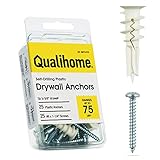
Drywall anchor options compared
| Anchor type | Best use | Advantages | Trade-offs |
|---|---|---|---|
| Self-drilling plastic | Light holder and a few small hand tools | Cheap, quick to install, no separate pilot hole for many types | Can strip or loosen in crumbly drywall; limited resistance to repeated pulling |
| Plastic expansion anchor | Very light loads in sound drywall | Inexpensive and easy to find | Requires a correctly sized pilot hole; generally a poor choice for a projecting, frequently loaded holder |
| Metal hollow-wall anchor | Moderate loads where the back of the wall is accessible only through the hole | Clamps drywall from behind; firmer hold than a basic plastic anchor | Installation tool may be needed; removal can damage the wall |
| Toggle bolt or strap toggle | Heavier or frequently used holder without a nearby stud | Broad bearing area behind drywall; good resistance to pull-out when installed correctly | Needs a larger hole and clear space behind the wall; straps or bolts must fit the holder |
Ratings on anchor packaging are not interchangeable. Some refer to a single anchor under ideal conditions, not a multi-anchor installation in worn drywall. They may also describe a static load, while taking a tool on and off adds movement and leverage. Treat the rating as a guide, leave a safety margin, and use all the mounting holes the holder provides.
What to buy for your load
For a holder carrying only a few light items—say, bits, a tape measure, or small screwdrivers—a quality self-drilling anchor may be adequate if the drywall is sound and the holder sits close to the wall. A set of self-drilling drywall anchors is a reasonable low-cost choice for that job. Do not use one just because the box claims a high capacity; the anchor must fit the holder’s screw and the actual wall thickness.
For heavier items such as a compact drill or a handful of tools, or for a holder that will be used daily, use metal hollow-wall anchors or toggles instead. A metal hollow-wall anchor kit works well when its installed sleeve can clamp behind the drywall and the holder accepts the supplied screw. Choose a strap toggle kit when a broad backing plate and higher pull-out resistance are useful, and there is enough room behind the wall for the toggle to open.
Anchor choice cannot make damaged drywall reliable. Avoid mounting into a patched area, a soft spot, or a hole left by an old fastener. If the loaded holder is heavy, projects far from the wall, or could injure someone if it falls, find a stud or add a plywood mounting strip secured to studs. That is more dependable than trying to solve a poor mounting location with increasingly large anchors.
Install it without damaging the wall
Weigh the tools you plan to store, then include the holder itself. Mark the holes level and check for wiring or plumbing before drilling; avoid areas directly above or below outlets and switches unless you know the wall route. Keep the holder’s center of load close to the wall and distribute fasteners across the mounting plate rather than relying on one anchor.
Follow the anchor maker’s hole-size and screw instructions. For a self-drilling anchor, turn it straight into the drywall with a screwdriver or a drill on low speed and light pressure. Stop when the flange is flush. Driving it fast with a cordless drill can overcut the gypsum, spin the anchor, or sink the flange below the surface. If it spins freely, the hole is compromised; move to fresh drywall rather than tightening harder.
For a metal hollow-wall anchor, drill the specified hole and use the setting tool if the package calls for one. The sleeve should expand behind the wall before you mount the holder. A toggle needs enough open space behind the drywall; insulation, a stud, or a pipe can prevent it from seating. Do not force a toggle that will not open—relocate the hole or use a different fastener.
Use the supplied screw when it is suitable for the holder. If substituting, match the diameter and length the anchor requires. A screw that is too short may not engage properly; one that is too long can bottom out or interfere with what is behind the wall. Tighten until the holder is secure, not until the plate crushes the drywall.
Check the mount before loading it
Pull gently down and outward on the empty holder. It should not rock, click, or leave a widening gap at the wall. Add tools gradually, then check again after a day or two of use. If the holder shifts, a screw backs out, or drywall dust appears, unload it and remount into a stud or sound, undamaged drywall with a more suitable anchor. A properly chosen fastener is less expensive than repairing a torn-out section of wall—or replacing a dropped tool.