What's inside
As an Amazon Associate I earn from qualifying purchases. This post may contain affiliate links at no extra cost to you.
What we cover
Choose the right drill for the slab
For a few anchor holes in a typical garage floor, a corded SDS-plus rotary hammer is usually the easiest tool to live with. Its hammering action breaks concrete efficiently, and its SDS bit shank transfers that action better than the round shank of a standard drill. If you already own a good hammer drill and need only a handful of small holes, that may be enough—but expect slower progress and more pressure on your hands.
First check what the anchor requires. Concrete screws, sleeve anchors and wedge anchors have different minimum hole diameters and depths. Follow the anchor maker’s instructions, not a general rule of thumb. A common 3/8-inch anchor may call for a 3/8-inch hole, while its required depth and embedment depend on the specific product.
As an Amazon Associate we earn from qualifying purchases at no extra cost to you.
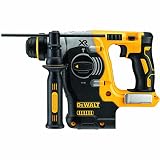


Rotary hammer vs. hammer drill
A conventional hammer drill makes its hammering action with toothed plates. It can drill small holes in concrete, but the action is less forceful and usually needs steady pushing. A rotary hammer uses a piston mechanism and is designed to drill masonry with less effort. It can also accept chisels on some models, though that feature is rarely needed for anchor holes.
For one or two holes in soft concrete, a standard hammer drill can be a sensible low-cost choice. For repeated holes, larger diameters, hard aggregate or overhead work, the rotary hammer is generally faster and less tiring. Don’t use an impact driver for drilling concrete: its rotational impacts are not a substitute for a drill’s hammer action.
What to buy for the job
| Tool type | Best fit | Trade-off | Typical setup |
|---|---|---|---|
| Cordless hammer drill | A few small holes, especially if you already own the battery platform | Slower in hard concrete; battery and user effort matter | Quality masonry bit, hammer mode, fully charged battery |
| Corded SDS-plus rotary hammer | Several anchor holes or tougher concrete | Needs an outlet and extension cord; heavier than a basic drill | SDS-plus bit matched to the anchor diameter |
| Cordless SDS-plus rotary hammer | Frequent work away from outlets | Higher tool and battery cost; runtime falls with larger holes | Compatible high-capacity batteries and SDS-plus bits |
If you need to buy a tool mainly for this task, compare a corded SDS-plus rotary hammer with a cordless hammer drill. For a small one-time job, renting a rotary hammer may cost less than buying one. Check rental rates and bit charges before deciding.
Match the bit and set the depth
Use a masonry bit with a carbide tip, or an SDS-plus bit if your rotary hammer takes SDS-plus shanks. The bit diameter must match the anchor instructions. A loose or worn bit can leave an oversized hole, so the anchor may spin instead of gripping. A bit that is too small can bind the anchor or make installation damage likely.
Mark the required hole depth on the bit with tape, or use the tool’s depth stop. Drill slightly deeper only if the anchor instructions allow it and you need room for dust at the bottom; don’t guess, since excess depth can reduce the concrete left beneath an anchor. Keep the hole clear of the slab edge and other holes by the distances specified for the anchor. Concrete can crack or spall if anchors are too close to an edge or to one another.
Drill clean, straight holes
Before drilling, confirm the slab is thick enough and that there are no embedded pipes, conduit or radiant-heat lines where the holes will go. Avoid drilling near visible cracks or a damaged edge. If the location is uncertain, stop and investigate rather than relying on a stronger drill to solve the problem.
Mark each hole, hold the drill square to the floor, and start at low speed until the bit has a stable purchase. Let the hammer mechanism work; pressing hard can overheat the bit, slow the cut and make the hole wander. Pull the bit out occasionally to clear dust, especially in deeper holes. Wear safety glasses and hearing protection, and use dust extraction or a suitable vacuum attachment where possible. Concrete dust contains respirable silica, so don’t blow it into the air or clean it up dry.
If progress suddenly stops, don’t keep leaning on the tool. The bit may have hit hard aggregate, become dull, or encountered metal. Switch off and inspect. A metal strike can damage a masonry bit; do not assume it is safe to drill through reinforcing steel without checking the slab and the project requirements.
Clean and install the anchor
Dust left in the hole can prevent an anchor from seating or reduce its holding strength. Clean the hole using the method specified by the anchor maker—often brushing and vacuuming, sometimes with a dedicated blow-and-brush procedure. Wear respiratory protection suitable for the dust if cleaning could release fine particles.
Install the anchor with the specified tool and tightening method. For wedge and sleeve anchors, overtightening can strip threads, damage the concrete or make the anchor spin. If an anchor turns freely, sits proud, or pulls out under light loading, stop: the hole may be oversized, dusty, too shallow, or in unsound concrete. Don’t treat a loose anchor as fixed by applying more torque. Move the fastening point only if the required spacing and edge distances remain valid.
For a small number of modest holes, the cheaper drill you already own is fine if it has hammer mode and the correct bit. Step up to an SDS-plus rotary hammer when speed, repeated holes or hard concrete makes the basic tool frustrating. The anchor’s instructions, a sharp correctly sized bit and a clean hole matter as much as the drill.