What's inside
As an Amazon Associate I earn from qualifying purchases. This post may contain affiliate links at no extra cost to you.
What we cover
What you need for anchor holes in concrete
A garage floor is usually a concrete slab, but its hardness, aggregate and age vary. For occasional holes for a wall-track foot, shelving, or a small threshold, a quality cordless hammer drill can do the job. The right choice depends less on headline torque than on hole diameter, depth, and how many holes you need to drill.
For common concrete screw anchors, holes are often around 3/16 to 1/4 inch wide and roughly 1 to 2 inches deep; check the anchor maker’s instructions for the exact diameter and depth. A hammer drill drives the bit forward with a rapid pulsing action while it rotates. That is different from an SDS rotary hammer, which uses a heavier piston mechanism and is much faster in concrete, especially for repeated or larger holes.
As an Amazon Associate we earn from qualifying purchases at no extra cost to you.
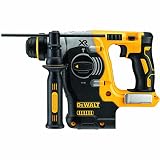


Hammer drill or rotary hammer?
A cordless hammer drill is the sensible buy if you already own compatible batteries, expect only a handful of small holes, and are willing to work at a steady pace. It is also useful for ordinary drilling and screwdriving, so it earns its space in a home workshop. Look for a model with a selectable hammer mode, a side handle, and a clutch that can be used in regular drilling mode.
If the job involves dozens of holes, holes larger than about 3/8 inch, or concrete that makes a hammer drill stall and overheat, choose a cordless SDS-plus rotary hammer instead. It typically drills masonry faster and with less pressure from the operator. Its trade-offs are cost, bulk, and less usefulness as a general-purpose driver. Do not buy a rotary hammer just because its impact-energy number looks impressive; match the tool to the work.
For a basic hammer drill, compare cordless hammer drills that fit the battery platform you already own. If you are outfitting a shop from scratch, compare the price of a kit with battery and charger against a bare tool. A cheaper drill is fine for a few small anchors, provided it has a real hammer mode and accepts a suitable masonry bit.
Compare the options
| Tool | Best use | Main trade-off |
|---|---|---|
| Compact cordless hammer drill | A few small anchor holes; occasional household use | Slower in hard concrete; battery and motor can heat up |
| Full-size cordless hammer drill | More frequent small holes and general drilling | Heavier; still slower than an SDS rotary hammer |
| Cordless SDS-plus rotary hammer | Repeated holes, larger diameters, tougher concrete | Higher cost and less convenient for driving screws |
Bits, batteries and useful features
Use a carbide-tipped masonry bit rated for hammer drilling, in the diameter specified by the anchor manufacturer. A worn or undersized bit can make installation difficult: the anchor may bind, fail to seat, or damage the hole. A bit that is too large can leave the anchor loose. For a hammer drill, the bit must fit the drill’s chuck; SDS-plus bits require an SDS-plus tool or a suitable adapter, and an adapter does not turn a standard drill into a rotary hammer.
A 1/2-inch chuck gives more flexibility than a 3/8-inch chuck, but the chuck size alone does not tell you how well a drill will perform in concrete. A side handle matters because a bit can catch on aggregate or reinforcing steel and twist the tool. A battery around 4 to 5 amp-hours gives useful runtime, though a smaller battery may be perfectly adequate for a few holes. A second battery saves downtime if you are drilling a larger batch.
For frequent work, compare cordless SDS-plus rotary hammers with a depth stop and a side handle. A depth stop helps keep holes consistent; it does not replace measuring the anchor’s required embedment. Avoid choosing solely by advertised maximum drilling diameter, which is usually an upper limit rather than a promise of fast drilling.
How to drill clean, consistent holes
Before drilling, confirm what is under the slab and where utilities may run. Check the anchor instructions and mark each hole. If the anchor needs a 2-inch hole, do not drill only 1 inch and expect it to hold properly. Keep the bit perpendicular to the floor, start at low speed until it has a purchase, then let the hammer action work. Press firmly enough to keep the bit engaged, but do not lean your full weight on the drill.
Clear concrete dust as you drill, especially in deeper holes. Pulling the bit out briefly helps remove debris; a clogged hole slows progress and can prevent an anchor from seating. Use eye protection and hearing protection, and manage the dust with a suitable vacuum or dust-control setup. Concrete dust contains respirable silica, so do not treat it like harmless household dirt.
Stop if the drill repeatedly stalls, the bit gets unusually hot, or progress drops sharply. Let the tool cool and check the bit. If the concrete is still resisting, switch to an SDS-plus rotary hammer rather than forcing the drill until the motor or battery overheats. If the bit hits metal, do not assume it is safe to keep drilling: it could be reinforcing steel or an unknown embedded item.
Make the buying decision
For four or five small anchor holes, a battery-powered hammer drill you already own may be all you need. Buy a suitable new hammer drill when you also want a general-purpose tool or expect similar light masonry jobs. For a long row of anchors, repeated installations, or larger holes, rent or buy an SDS-plus rotary hammer; the faster drilling and reduced strain can outweigh its higher price.
Choose anchors only after checking the intended load, concrete condition and required spacing. Drilling a clean hole is not a substitute for using the right anchor or installing it to the manufacturer’s depth and cleaning requirements.