What's inside
As an Amazon Associate I earn from qualifying purchases. This post may contain affiliate links at no extra cost to you.
Concrete block cores are hollow, but that does not make them easy to drill. The face shell is hard masonry; behind it may be an empty cell, a web, grout, or rebar. For a few small holes, a regular cordless drill with a masonry bit can be enough. For repeated holes, larger diameters, or tougher block, a hammer drill saves time and effort. The right choice depends on hole size, quantity, and whether the bit needs to pass through a web or reinforced section.
As an Amazon Associate we earn from qualifying purchases at no extra cost to you.


What we cover
Choose the tool for the hole
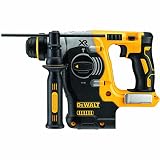
A standard rotary hammer drill uses a pulsing hammer mechanism and is generally the best fit for frequent concrete drilling. A hammer drill adds a faster, lighter percussion action and suits occasional holes for anchors or small services. A plain drill has no hammer action, but can still work in soft block with a sharp masonry bit and patience.
For typical wall anchors, a 3/16- to 1/2-inch hole is common. Check the anchor packaging rather than guessing: the bit diameter and minimum embedment matter. Larger holes, such as those for pipe or cable, call for a hole saw or core bit, not repeated small holes joined together. If the job involves many holes or holes over about 1/2 inch in hard block, look at a cordless SDS-Plus rotary hammer. For occasional smaller holes, a cordless hammer drill is usually the less expensive, more versatile buy.
Which drill makes sense?
| Tool | Best use | Trade-off |
|---|---|---|
| Plain cordless drill | One or two small holes in softer block | Slow in dense masonry; bit can overheat if forced |
| Hammer drill | Occasional anchor holes, usually up to about 1/2 inch | More vibration than a plain drill; less efficient than SDS for sustained work |
| SDS-Plus rotary hammer | Repeated holes, larger diameters, dense block or concrete | Costs more and is bulkier; SDS bits need a compatible chuck |
| Diamond or carbide core bit | Large, clean openings for services | Requires the right tool, controlled feed, and sometimes water cooling |
Tool specifications can be misleading. “Impact rate” alone does not tell you how quickly a drill will bore a hole. For a cordless tool, check battery voltage and capacity, but also whether it has a proper hammer mode and a clutch or side handle that helps control reaction. SDS-Plus tools use bits that lock into the chuck and move axially; they are not interchangeable with ordinary round-shank bits.
Pick the right bit and set up carefully
Use a carbide-tipped masonry bit for ordinary anchor holes, matched to the required diameter. SDS-Plus masonry bits are a good choice for an SDS rotary hammer. For a hammer drill with a standard chuck, use a round-shank masonry bit rated for hammer drilling. Do not use an ordinary wood or metal bit, and do not use a hammer setting with a hole saw unless its manufacturer permits it.
Mark the hole and check for wiring, plumbing, and other hazards before drilling. A detector helps, but is not a guarantee, particularly around block cavities and repairs. Wear safety glasses and hearing protection; masonry dust is harmful, so use a suitable respirator and vacuum or dust-collection attachment where practical. Keep the hole clear of the block edge and mortar joint when the anchor instructions call for solid material.
Start slowly to keep the bit from wandering, then use steady pressure. Let the hammer mechanism do the work; leaning hard on the drill can stall it, overheat the bit, or chip the face shell. Pull the bit out periodically to clear dust. If the drill suddenly speeds up, you may have entered a hollow cell. If it slows sharply or stops, you may have hit a web, grout, or steel. Stop and reassess rather than forcing the tool.
Avoid common drilling failures
Block cores create a support problem as well as a drilling one. An anchor placed in a hollow cell may not hold the load expected from a solid-wall anchor. Choose an anchor designed for hollow masonry, or locate a grouted cell if the installation requires stronger support. Follow the anchor’s hole diameter, depth, and cleaning instructions. Dust left in the hole can reduce holding power, especially for adhesive anchors.
For a small number of holes, renting or borrowing a rotary hammer may be cheaper than buying one. A basic hammer drill is fine for light work if you use a sharp bit, keep the hole modest in size, and accept slower progress. For routine masonry work, consider a set of SDS-Plus masonry bits matched to the drill. If the opening is large, use a purpose-built diamond core bit for block rather than trying to enlarge a small hole by wobbling the drill.
One final check: if the block is old, cracked, or part of a load-bearing wall, drilling may need more care than the tool choice alone suggests. Avoid cutting reinforcement or enlarging openings without understanding what the wall supports. For ordinary anchor holes, a sharp bit, the correct drill mode, and an anchor rated for the block condition matter more than buying the most powerful tool.