What's inside
As an Amazon Associate I earn from qualifying purchases. This post may contain affiliate links at no extra cost to you.
A self-centering bit keeps a pilot hole aligned with the screw opening in a cabinet hinge or mounting plate. That matters because even a small sideways error can pull a hinge out of position, leave a screw sitting crooked, or make a door bind. For most cabinet work, a basic replaceable-bit hinge drill is the sensible buy; the right size and careful setup matter more than premium branding.
As an Amazon Associate we earn from qualifying purchases at no extra cost to you.



What we cover
What to buy
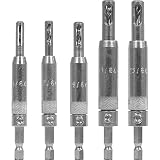
Look for a spring-loaded self-centering bit sized for the hinge’s screw holes. Common cabinet hinge screws use pilot holes around 3 mm, but screw diameter and wood hardness vary. Check the hinge instructions or measure a matching screw before choosing. The bit’s outer sleeve should fit into the countersunk or shaped hole in the hinge plate, while the smaller drill inside makes the pilot hole.
A self-centering hinge drill bit set is useful if you install several hinge types or want spare sizes. If you are fitting one kitchen, a single correctly sized bit is often enough. Avoid buying a set just because it has more pieces: confirm that its sizes match your hinges and that replacement bits are available.
Bit types compared
| Type | Best for | Trade-off |
|---|---|---|
| Basic replaceable-bit hinge drill | Occasional cabinet installation | Affordable; included bits may be soft or dull |
| Higher-quality replaceable-bit tool | Repeated installations and cleaner work | Costs more; still needs the right size bit |
| Fixed-size self-centering bit | One common hinge screw size | Simple, but less flexible if the hinge changes |
| Plain pilot drill bit | Use with a jig or careful marking | Cheapest, but does not center itself in the hinge hole |
Features worth paying for
Check that the spring-loaded sleeve moves smoothly and returns without sticking. It should sit squarely in the hinge hole, not wobble around it. A worn or poorly fitted sleeve can produce an off-center hole even when the bit is sharp. Replaceable drill bits are a practical advantage: a dull cutting edge burns wood, wanders, and makes you push harder. A replaceable-bit self-centering hinge bit lets you swap the cutter without replacing the whole tool.
For a single job, an inexpensive bit can do fine if it fits the hinge and cuts cleanly. A pricier tool is more justified when you are installing multiple doors, working with hard maple or other dense wood, or need consistent results across many holes. Do not assume a longer bit is better: excess length can make it easier to drill too deep.
Use the right drill and speed
A cordless drill is the better tool for this job. Set it to low gear if it has two speeds, and use a moderate trigger speed. An impact driver can accept a hex-shank bit, but its hammering action is unnecessary for hinge pilot holes and can make it harder to control depth. If an impact driver is all you have, use a compatible bit and a gentle trigger; stop as soon as the pilot hole is cut.
Do not use hammer mode. A small pilot hole needs rotation, not impact. Keep the drill square to the hinge plate, and let the bit cut rather than forcing it. Excess pressure can compress the sleeve, damage the finish, or drive the bit deeper than intended.
How to drill accurate pilot holes
First, clamp or firmly hold the hinge in its final position. Mark the hinge location and verify the door’s orientation before drilling; a correctly centered hole in the wrong location is still a mistake. If the hinge has a separate mounting plate, check its spacing and alignment against the cabinet or door instructions.
Fit the self-centering bit into the drill and test the sleeve in a hinge hole. Place the sleeve fully into the hole, hold the drill perpendicular to the surface, and start slowly. Drill only deep enough for the screw’s unthreaded section and threaded tip to enter the wood—often about 10 to 12 mm for a typical cabinet hinge screw, but use the screw and hinge guidance rather than treating that as universal. A depth stop or a strip of tape on the bit can help, though tape is only a visual marker, not a hard stop.
Back the bit out while it is still turning slowly, then clear chips from the hole. Drive the screw by hand or with a drill at low torque. Stop when the head is seated; overtightening can strip the pilot hole, especially in particleboard or MDF. If a screw spins without tightening, do not keep driving. The hole may be too large, too deep, or stripped. A suitable repair may require a wood plug and fresh pilot hole; particleboard repairs are less dependable than solid-wood repairs.
Common problems and fixes
The hole is off-center: The sleeve may not have seated fully, may not match the hinge hole, or the drill may have tilted. Test the fit before drilling and keep the bit square. If the hole has already wandered, do not enlarge it casually; the screw may still pull the hinge out of alignment.
The bit skates or burns: Check for a dull or damaged cutter, reduce pressure, and clear packed chips. Dense wood may cut more slowly than softwood. A sharp replacement bit is a better fix than forcing the drill.
The screw splits the wood: The pilot may be too small, too close to an edge, or too shallow. Match the pilot size to the screw and material. For a very hard wood, a slightly larger pilot may be appropriate, but follow the hinge maker’s guidance when available.
For a one-off installation, spend first on a bit that fits your hinge, not the largest kit. If you regularly fit cabinet hardware, choose a durable, replaceable-bit tool and keep the cutters sharp. Accurate positioning, a controlled drill, and restrained screw torque will prevent more hinge problems than an expensive bit alone.