What's inside
As an Amazon Associate I earn from qualifying purchases. This post may contain affiliate links at no extra cost to you.
For most aluminum extrusions, a sharp high-speed steel (HSS) twist bit is the sensible first choice. Aluminum is soft, but it can grab a dull bit, clog its flutes, or leave a ragged exit hole if you rush. Pick the bit for the hole size and finish you need, clamp the extrusion, and use a steady, moderate speed with cutting fluid or a little lubricant.
As an Amazon Associate we earn from qualifying purchases at no extra cost to you.



What we cover
Choose the bit for the job
A general-purpose HSS bit handles most holes in aluminum profiles. A standard 118-degree point is widely available and works well when the work is held securely. A 135-degree split point tends to start more reliably on flat material and needs less pressure, but it is not essential for ordinary shop work. For a few holes, an inexpensive, sharp bit is usually adequate; replace it when it starts rubbing instead of cutting.
If you drill aluminum often, consider a bit with a polished flute or a coating intended for nonferrous metals. Aluminum can stick to cutting edges, and smoother flutes help clear chips. A premium bit can last longer in repeated work, but coating alone does not compensate for dullness, poor alignment, or excessive speed.
For holes larger than about 1/2 inch, a step bit can make clean holes in thin extrusion walls without the chatter of a large twist bit. It is a poor fit for thick sections or deep holes because its stepped cutting edge is designed for sheet and thin-wall material. For larger openings in thicker stock, use a sharp, appropriately sized twist bit or a hole-making tool rated for the material and thickness.
Bit options at a glance
| Bit type | Best use | Trade-off |
|---|---|---|
| HSS twist bit | General holes and occasional DIY work | Affordable; dull or rough bits may grab and leave burrs |
| Polished or aluminum-focused HSS bit | Frequent drilling and cleaner chip removal | Costs more; technique still matters more than coating |
| Step bit | Round holes in thin extrusion walls | Clean enlargement in thin material; not for thick sections |
| Cobalt HSS bit | Repeated work where extra wear resistance is useful | Often unnecessary for aluminum; not automatically sharper or cleaner |
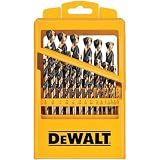
For a basic kit, compare HSS twist drill bit sets. If you regularly make larger holes in thin walls, a step drill bit may be a more useful addition than buying an oversized set of twist bits.
Set up the drill and extrusion
A regular cordless drill is usually the right tool. Use its standard drill mode, not hammer mode; hammering can distort thin walls and make the bit wander. An impact driver is a poor first choice for precision holes because its impacts can make the bit jump or bind. It can drive suitable hex-shank bits in a pinch, but a drill gives better control. A drill press is helpful for repeatable, perpendicular holes, not required for a few fasteners.
Clamp the extrusion to a bench or support it close to the hole. Do not hold a small profile in one hand while drilling: if the bit catches, the aluminum can spin. Mark the center with a punch or a sharp awl, using a light tap so you do not dent a thin wall. For hollow profiles, place scrap wood behind the wall where possible; backing supports the exit and reduces burrs.
Check the extrusion’s internal webs before choosing a hole location. A hole through a hollow chamber may be easy, but drilling into a thick rib takes more pressure and can pull the bit off line. If the hole is for a bolt, size it for the fastener and fit. A clearance hole for a 1/4-inch bolt is commonly around 9/32 inch, but check the hardware and whether you need a close or loose fit.
Speed, pressure, and lubrication
Use a moderate speed and let the cutting edge do the work. As a practical starting point for common small bits, roughly 1,000–2,000 rpm is reasonable; use the lower end as the bit gets larger, the wall gets thicker, or the setup becomes harder to control. Manufacturer speed charts are better when available. Keep the drill square, apply steady pressure, and ease off as the bit breaks through.
Aluminum chips should come off as distinct curls or short chips. If the bit squeals, polishes the surface, or produces fine dust instead of cutting, stop. The bit may be dull, the speed too high, or the feed too light. Clear packed chips from the flutes rather than forcing the bit deeper. A drop of cutting fluid or light oil can reduce friction and help prevent aluminum from welding to the cutting edge; avoid flooding a handheld setup.
Do not use a hammer drill setting to compensate for a slow cut. Excessive speed and pressure are more likely to cause a grab, an oversized hole, or a damaged bit. Aluminum does not need the hard push often used on steel.
Prevent burrs, grabbing, and oversized holes
Thin extrusion walls are easy to deform. Clamp close to the drilling point, use a sharp bit, and reduce pressure just before breakthrough. A small burr on the back is normal; remove it with a deburring tool, a countersink turned by hand, or a fine file. Avoid leaning on a powered countersink, which can quickly make a thin hole too large.
If the bit grabs, stop the drill and free it without twisting the extrusion in your hands. Common causes are a loose workpiece, a dull edge, or breaking through too aggressively. For a hole that must be accurate, drill a small pilot hole first—around 1/8 inch is a useful starting size for many larger holes—then enlarge it with the final bit. A pilot hole is not always necessary for small holes, and it adds a step, but it can improve control in thicker sections.
Wear eye protection and remove chips with a brush, not bare fingers. Aluminum chips can be sharp, and hot chips are common after repeated drilling. For occasional holes in ordinary profiles, a sharp standard HSS bit, a clamp, and careful technique are usually enough; spend more on specialized bits only when cleaner repeatability or frequent use justifies it.