What's inside
As an Amazon Associate I earn from qualifying purchases. This post may contain affiliate links at no extra cost to you.
A countersink bit cuts a conical recess so a flat-head wood screw can sit flush with the surface. The right bit makes that recess cleanly without splitting the board, leaving a ragged rim, or burying the screw head too deep. For most home projects, a basic countersink with an adjustable depth stop is enough; the best choice depends on screw size, wood hardness, and whether you need a pilot hole at the same time.
As an Amazon Associate we earn from qualifying purchases at no extra cost to you.



What we cover
Choose the bit for the screw, not just the drill
Match the countersink to the angle and diameter of the screw head. Most flat-head wood screws use an 82-degree head, while some imported screws and specialty fasteners use 90 degrees. A mismatched angle can leave the head supported only at the rim, so it may sit proud or crush the wood when tightened. Check the screw packaging or measure the head if the angle is unclear.
The countersink’s widest cutting diameter should be just large enough to accept the screw head. A recess that is too small leaves the head sticking up; one that is too large removes useful surface material and can look sloppy. If the head diameter is around 8 mm, for example, aim for a countersink opening close to that size rather than choosing the largest bit on the shelf.
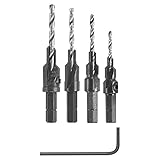
For a straightforward purchase, look for an 82-degree wood countersink bit sized for the screws you use most. A single-size bit is inexpensive and works well when the screw size stays consistent. A set offers more flexibility for mixed projects, but check that its stated size range actually covers your fasteners.
Pick the style that suits the job
| Bit type | Best for | Trade-off |
|---|---|---|
| Single-flute countersink | Occasional work and softer wood | Low cost, but can chatter or leave a rougher cut in hard wood |
| Multi-flute countersink | Cleaner, steadier recesses in a range of woods | Usually costs more; still needs a light feed to avoid burning |
| Combination pilot-and-countersink bit | Repeated screw installation and production work | Convenient, but the pilot size may not suit every screw or wood species |
| Adjustable-depth countersink | Consistent flush depth across multiple holes | Depth collars can slip if they are not tightened and checked |
A countersink bit with an adjustable depth stop is useful when a row of screws needs to look uniform. It reduces guesswork, but it does not replace a test hole: the stop controls depth, not the fit between the screw head and the cone. A combination bit can save time by drilling a pilot hole and countersink in one operation, but it is less adaptable if you change screw diameters often.
Pilot holes and wood type matter
A countersink does not automatically prevent splitting. The pilot hole should be sized for the screw’s shank and the wood’s density. In softwood, a smaller pilot may work; hardwood generally needs a larger one, especially near an edge. As a practical starting point, keep screw holes at least 1 inch from an end and about 1/2 inch from an edge for common small-to-medium wood screws, then increase those distances for larger fasteners or brittle stock.
If your countersink has a pilot drill, confirm its diameter against the screw before using it. Too-small pilots can split oak or maple and make the drill work hard; too-large pilots weaken the threads’ grip. With separate bits, drill the pilot first, then countersink. For thin stock, clamp a scrap board underneath to reduce breakout when the bit exits.
Cut a clean, repeatable recess
Use a standard drill or cordless drill on a low-to-medium speed setting. A countersink does not need hammer action; never use a hammer drill in hammer mode for this work. Start the bit square to the surface and apply steady, light pressure. In hardwood, pause to clear chips and avoid holding a high speed in one spot, which can burn the wood and dull the cutting edges.
Make a test recess in offcut material of the same thickness and species. Drive a screw by hand or with a drill at low clutch torque. The head should finish level with the surface, not below it. If the screw sits proud, deepen the countersink in small increments. If it sinks too far, stop and adjust the depth rather than trying to compensate by backing the screw out; the oversized cone remains visible.
For a flush finish, set the drill clutch low enough to stop before the head strips or crushes the fibers. A countersink can guide the head, but it cannot prevent overdriving. On painted or visible surfaces, lightly ease the rim with a fine abrasive after drilling, taking care not to widen the recess.
What to check before buying
Confirm the countersink angle, cutting diameter, shank size, and whether a pilot drill is included. A 1/4-inch hex shank can be convenient in an impact driver, but countersinking is usually more controlled in a drill; impact action can chatter and damage the rim. If you do use an impact driver, select a low-speed setting and keep the bit aligned. For frequent work, a set of 82-degree wood countersink bits gives you options for different head sizes, while a single bit is the cheaper, sensible choice for one recurring screw size.
Replace or sharpen a bit when it starts cutting unevenly, needs excessive pressure, or leaves burn marks despite a clean, controlled cut. Dull cutters encourage wobble and make it harder to repeat depth. Keep the bit clean of resin, and store it so the cutting edges do not knock against other steel tools.
For a small number of screws in softwood, a basic single-flute bit and a separate pilot drill are usually all you need. Choose a multi-flute or depth-stop style when clean edges and consistent depth matter across many holes. Either way, a matched screw angle, a sensible pilot hole, and a test cut will do more for a flush result than buying the most elaborate bit.