What's inside
As an Amazon Associate I earn from qualifying purchases. This post may contain affiliate links at no extra cost to you.
What we cover
Choosing a hammer drill for concrete block
Concrete block is less demanding than poured concrete, but it is still hard on ordinary drills and bits. For a few small holes in hollow block, a decent 18V cordless hammer drill is usually enough. For repeated holes, larger anchors, or dense, grouted sections, a rotary hammer is faster and easier on your hands.
The key distinction is the hammer mechanism. A hammer drill uses a fast, light tapping action and standard round-shank masonry bits. A rotary hammer uses a piston to deliver stronger blows and accepts SDS-plus bits. Don’t buy a rotary hammer just because it sounds tougher: for occasional 1/4-inch anchor holes, it costs more and can be awkward to control. But don’t expect a compact drill to make repeated 1/2-inch holes in hard block without slowing down.
As an Amazon Associate we earn from qualifying purchases at no extra cost to you.
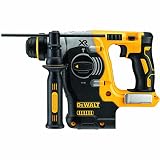


Match the tool to the job
| Tool | Good fit | Trade-off |
|---|---|---|
| 18V cordless hammer drill | A handful of holes up to about 3/8 inch in hollow block | Slower in dense material; requires a hammer-drill mode and masonry bits |
| Compact rotary hammer | Frequent holes, larger anchors, or block with hard webs and grout | More cost and weight; SDS-plus bits are a separate purchase |
| Corded rotary hammer | Long sessions where runtime matters | Needs an outlet and cord management; less convenient on a ladder |
If you’re shopping for the occasional repair, compare a 18V cordless hammer drill with a compact SDS-plus rotary hammer. Tool-only prices can look appealing, but include the cost of a battery and charger if you don’t already own that platform.
What to look for before buying
For a hammer drill, check that it has a clearly marked hammer mode, a side handle, and a clutch or adjustable speed. A side handle matters once the bit catches on aggregate or a block web; it gives you control and helps prevent a wrist-twisting stall. A 1/2-inch chuck is useful if you’ll also use larger wood or metal bits, though it doesn’t mean the drill is suited to every 1/2-inch masonry hole.
For a rotary hammer, SDS-plus is the common size for home and light trade work. Look for a tool with a depth stop and a switchable rotation-only mode if you’ll use it for occasional non-masonry tasks. Some models also offer chipping mode, but that feature isn’t necessary just to drill anchor holes. Check the tool’s rated drilling capacity and follow the maker’s limit for the bit type you plan to use.
Battery size is a trade-off, not a simple “bigger is better” rule. A 2Ah pack keeps a drill lighter; a 4Ah or larger pack typically runs longer but adds weight. For several holes, one charged pack may be sufficient. For a full day of drilling, have a spare ready or choose a corded tool.
Bits, holes, and anchors
Use a carbide-tipped masonry bit with a hammer drill, or an SDS-plus masonry bit with a rotary hammer. A worn bit drills slowly, wanders, and can overheat. Match the bit diameter to the anchor maker’s instructions rather than guessing from the screw size. For example, a sleeve anchor may specify a 3/8-inch hole, while a plastic masonry plug may call for a smaller bit.
In hollow block, the location of the hole matters. Anchoring into a face shell is different from anchoring into a solid, grouted section. Follow the anchor’s stated base-material requirements and load rating; a fastener rated for solid concrete may not carry the same load in hollow block. For a heavy shelf, gate, or handrail, don’t assume an ordinary plastic plug is adequate. Choose an anchor designed for the block condition, and avoid placing holes too near an edge or mortar joint unless the anchor instructions allow it.
Some jobs are better served by a carbide masonry bit set or an anchor made for masonry block. Buy the specific bit size you need rather than relying on an oversized assortment with no clear grade or fit.
Drill without damaging the block
Mark the hole and start slowly, holding the drill square to the surface. Use hammer mode only with a masonry bit. Let the tool do the work; pressing hard can stall a cordless drill, make the hole run off line, or chip the block face. If the bit skates on a smooth surface, begin at low speed with light pressure, then increase speed once it has a shallow seat.
Set a depth stop or mark the bit with tape so you don’t drill deeper than the anchor needs. Pull the bit out occasionally to clear dust, especially in a deep hole. After drilling, remove dust with a suitable brush or vacuum. Debris left in the hole can stop an anchor seating fully and reduce its holding power. Wear eye protection, hearing protection, and a dust mask; masonry dust is not something to breathe.
Stop if the bit suddenly breaks through into a hollow cell or hits something unexpected. Don’t keep forcing it. Check that you’re not drilling near wiring, plumbing, or the edge of a block, and reassess the anchor location if the hole crumbles or becomes oversized.
Common mistakes and when to spend more
A basic hammer drill is the sensible buy for a few small holes in ordinary hollow block, especially if you already own compatible batteries. The cheaper option is fine when the holes are shallow, the bit is sharp, and you can take your time. A rotary hammer earns its cost when you’re making many holes, drilling larger diameters, or repeatedly meeting dense webs or grout. The faster impact also means you need a firm grip and careful control near fragile block edges.
Common failures are using a wood bit, drilling in rotation-only mode, leaning too hard, and choosing an anchor before confirming whether the block is hollow or solid at the fixing point. If drilling is painfully slow, first check the mode, bit condition, and battery charge. If those are right and the material is still resisting, a rotary hammer is a better fix than pushing harder.