What's inside
As an Amazon Associate I earn from qualifying purchases. This post may contain affiliate links at no extra cost to you.
Hardwood makes small differences in a countersink bit easy to see. A dull cutter can burn the hole, a coarse cutter can leave torn fibers around the rim, and a countersink that is too deep can let a flat-head screw pull below the surface. For most furniture, cabinetry, and trim work, a sharp, adjustable countersink bit set is more useful than a large assortment of fixed-purpose bits.
As an Amazon Associate we earn from qualifying purchases at no extra cost to you.


What we cover
What to look for in a set
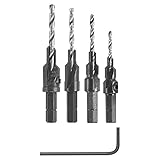
Start with the screw sizes you actually use. A set with bits for common wood-screw diameters is more useful than one packed with sizes you will rarely reach for. Check whether each bit has an adjustable depth stop or a pilot drill that can be changed. A depth stop helps make a row of holes consistent; a replaceable pilot is helpful if it breaks or you need a different pilot diameter.
For hardwood, look for a sharp, ground cutting edge and a pilot drill made for wood. High-speed steel is adequate for occasional work. A set with more durable coatings or carbide cutting edges can be worthwhile for repeated use, but it is not a substitute for correct speed and a sharp cutter. Hex shanks fit many quick-change holders, while round shanks are fine in a drill chuck and may offer better compatibility with older tools.
A basic adjustable countersink bit set for wood is a sensible starting point for general woodworking. If you already own pilot drills and only need to bevel screw holes, a countersink-only set may cost less and do the job.
Comparing common set types
| Set type | Best for | Main trade-off |
|---|---|---|
| Adjustable pilot countersinks | Repeatable pilot holes and countersinks for screw installation | More parts to adjust and keep tight |
| Fixed pilot countersinks | Quick work with one common screw size | Less flexible if the screw or stock changes |
| Countersink-only bits | Beveling predrilled holes or working with separate pilot drills | Does not drill the pilot hole |
| Combination countersink and plug-cutter sets | Projects where screw heads will be concealed with wood plugs | Costs more and takes more setup; unnecessary for exposed screws |
A combination set is useful when you regularly plug screw holes in visible hardwood, but it is not the default choice. For ordinary face-frame or shelf construction, a simple adjustable set usually covers the job. A countersink set with a depth stop can be especially helpful when many screws need to sit at the same height.
Choose the cutter for the finish you need
Fluted countersinks remove material quickly, but a coarse or dull cutter can leave a rough rim in oak, maple, or cherry. A multi-flute cutter often leaves a cleaner surface, though it still needs to be sharp and used without excessive pressure. For a painted project, a minor mark may disappear under filler and paint. For clear-finished hardwood, clean edges matter more, so buy a better-ground cutter or test on an offcut before drilling the workpiece.
Match the countersink angle to the screw head. Many wood screws use a head around 82 degrees, while some specialty screws and fasteners use different angles. A mismatched angle can make the head bear on only a narrow ring, leaving it proud or encouraging the wood to split. If the screw package lists a head angle, use that information rather than assuming every flat-head screw is identical.
Drill clean holes in hardwood
Secure the board and mark the hole accurately. Set the pilot drill to suit the screw and wood: as a practical starting point, the pilot should be close to the screw’s solid core diameter, not the full diameter across the threads. Dense hardwood may need a slightly larger pilot than softwood. When in doubt, test the screw in scrap of the same species and thickness.
Use a drill, not an impact driver, for cutting the pilot and countersink. An impact driver can work in a pinch, but its repeated blows make it harder to control the cut and can chatter or damage the rim. Set a cordless drill to a moderate speed, keep it square to the surface, and let the cutter remove the wood rather than forcing it. Back the bit out occasionally to clear chips, especially in deep holes.
Make the countersink just deep enough for the head to sit flush or slightly below the surface, according to the finish and screw instructions. A depth stop or tape marker helps, but check the first hole with the actual screw. Countersink too little and the head stands proud; too much and the head can disappear below the surface, reduce the material supporting it, or split thin stock. On a 3/4-inch board, even a shallow overcut can be noticeable on a narrow edge.
Common problems and fixes
Burning usually means the cutter is dull, the drill speed is too high, or you are pressing hard without clearing chips. Stop and inspect the edge; extra force rarely improves a dull bit. Tear-out around the hole often comes from a rough cutter or a bit that wanders. Mark the center with an awl, clamp the work, and start at a controlled speed. On delicate faces, a small sacrificial backing board can support the exit side of a through-hole, though it does not prevent damage at the countersink itself.
If an adjustable pilot keeps slipping, tighten its retaining screw and check that the pilot is seated in the correct position. Replace a bent or damaged pilot rather than trying to force it straight. For a small number of holes in inexpensive stock, a lower-cost set is fine if the bits are sharp and the fit is tested first. For repeated work in expensive hardwood, better cutters and replaceable pilots are easier to justify than reworking burned or chipped holes.
A practical buying decision
Choose an adjustable set with a stop if you need consistent holes for several screw sizes. Choose a fixed-pilot bit if one screw size covers the whole job and speed matters more than flexibility. Buy countersink-only bits if your pilot holes are already handled. Before starting the project, test the bit, screw, and depth on scrap hardwood from the same board. That short test catches an incorrect pilot size, a mismatched screw angle, and a depth setting that would otherwise spoil the visible face.