What's inside
- Magnetic, locking, and pivoting at a glance
- Magnetic holders: the cheap, slim default
- Locking holders: the one most people should buy
- Pivoting holders: for the last 20 degrees of a job
- Which bits actually fit — and which never will
- Pick by situation
- Ownership realities: wear, runout, and clearance math
- FAQ
- Magnetic, locking, and pivoting at a glance
- Magnetic holders: the cheap, slim default
- Locking holders: the one most people should buy
- Pivoting holders: for the last 20 degrees of a job
- Which bits actually fit — and which never will
- Pick by situation
- Ownership realities: wear, runout, and clearance math
- FAQ
As an Amazon Associate I earn from qualifying purchases. This post may contain affiliate links at no extra cost to you.
If you only buy one, buy the locking version: a 3-inch DeWalt quick-release bit holder accepts every standard 1/4-inch hex-shank bit, stops the bit pulling out inside screw heads when you back the drill away, and usually costs only a few pounds/dollars more than a plain magnetic holder. The magnetic type is still the right call for tight budgets and slim profiles, while the pivoting holder earns its place the moment you have to drive screws near a wall, inside a cabinet, or into a car interior.
As an Amazon Associate we earn from qualifying purchases at no extra cost to you.

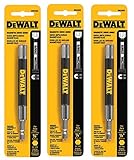

What we cover
- Magnetic, locking, and pivoting at a glance
- Magnetic holders: the cheap, slim default
- Locking holders: the one most people should buy
- Pivoting holders: for the last 20 degrees of a job
- Which bits actually fit — and which never will
- Pick by situation
- Ownership realities: wear, runout, and clearance math
- FAQ
Magnetic, locking, and pivoting at a glance
| Type | Typical DeWalt models | How it holds the bit | Common lengths | Bit wobble | Typical street price |
|---|---|---|---|---|---|
| Magnetic | DW2045B 3-in holder; compact magnetic drive guide | Internal magnet (plus C-ring on drive guides) | 2–6 in (50–150 mm) | Low to moderate | ~$6–12 / £5–10 |
| Locking (quick-release) | Rapid Load and Impact Ready locking holders; FlexTorq line | Spring sleeve + ball detent that clicks into the bit’s groove | 3–6 in (75–150 mm) | Lowest of the three | ~$8–15 / £8–14 |
| Pivoting | Pivoting bit tip holder DWPVTHLD | Locking collar on a hinged head, pivots up to 20° | ~3.5 in (~90 mm) | Moderate when angled | ~$12–20 / £10–18 |
Magnetic holders: the cheap, slim default
A magnetic holder is a magnetized steel sleeve on a 1/4-inch hex shank. Push a 1-inch insert bit or a longer power bit in and it stays; pull it out to swap. There’s no collar to fumble with, the outer diameter is the slimmest of the three types (handy around countersunk holes), and the magnet lends enough residual magnetism to the bit to help a steel screw cling on for one-handed starts.
The two real drawbacks show up in use, not on the spec sheet. First, magnetism alone often loses to a stubborn screw: back the drill away from a tight or painted screw head and the bit can stay behind in the screw — you’ll pluck it out with fingers or pliers several times per project. Second, the magnet collects metal swarf, so an occasional wipe keeps bits seating fully. DeWalt’s compact drive guide variant adds a sliding barrel that surrounds the screw itself, which is genuinely useful for holding screws straight while you start them overhead.
Locking holders: the one most people should buy
Locking holders — sold by DeWalt under the Rapid Load name historically, and now across the Impact Ready and FlexTorq lines — use a spring-loaded sleeve. The bit clicks past a ball detent that seats into the groove near the bit’s base; pull the sleeve forward to eject it. Because the bit is mechanically captured, it physically cannot stay behind in the screw head. On a 600-screw decking job that single difference removes the most common annoyance in driving.
Trade-offs: the sleeve makes the body roughly half an inch in diameter, so it’s slightly bulkier than a magnetic holder, and the spring collar is the part that eventually wears. If you drive with an impact driver rather than a drill, buy one of the impact-rated locking holders — impact tools pulse well into the 1,000–2,000 in-lb range, which chews up the detent and can crack the shank on a holder never designed for it.
Pivoting holders: for the last 20 degrees of a job
The DeWalt pivoting bit tip holder (DWPVTHLD) hinges just behind the tip and locks at any angle up to about 20°. That sounds modest, but it covers the geometry that actually defeats a straight holder: driving close to an adjacent wall, inside face-frame cabinets, under toe-kicks, or around car door cards where you can’t get the drill body square to the screw. At 20° the bit axis shifts roughly 15–20 mm to the side at the tip — often exactly the clearance you needed.
Know the limits: it is not a right-angle attachment (those reach a full 90°), and runout increases as the angle grows, so drop the drill’s speed and let the bit find the screw head before pulling the trigger fully. For everyday flat work, a straight holder is quicker and truer.
Which bits actually fit — and which never will
All three holders accept the universal 1/4-inch hex format: 1-inch insert bits, longer power bits, nut setters, and the contents of any DeWalt impact drill bit set (FlexTorq or Impact Ready driver bits). A DeWalt hex drill bit set will also click straight in — though see the runout note below before drilling precision holes through a holder.
Just as important is what doesn’t fit. Anything with a round shank belongs in the drill’s three-jaw chuck, not a holder: DeWalt Black and Gold drill bits (oxide-coated HSS general-purpose twists), DeWalt Pilot Point drill bits (whose tip geometry starts cutting on contact without walking), and DeWalt diamond drill bits for porcelain and glass — which you want chucked anyway, since they run slow and wet. And a DeWalt SDS drill bit set fits nothing here at all: SDS-plus shanks only enter a rotary hammer’s chuck. In the UK, much of this lineup sits under the DeWalt Extreme badge — a DeWalt Extreme drill bit set or driver set is the same 1/4-inch-hex-versus-round-shank logic, and these are the lines you’ll find stocked at trade retailers such as Screwfix.
Pick by situation
| Your situation | Best DeWalt holder | Why |
|---|---|---|
| Flat-pack, decking, general DIY with a combi drill | 3-in locking | Bit can’t abandon ship inside a screw head |
| Occasional use, lowest spend | 3-in magnetic | Simplest, slimmest, fine at drill-level torque |
| Inside cabinets, near walls, vehicle interiors | Pivoting | 20° reaches where a straight holder can’t |
| Daily impact-driver work | Impact-rated locking (FlexTorq/Impact Ready) | Hardened for repeated high-torque pulses |
| Reaching over obstacles or deep recesses | 6-in locking or magnetic | Adds ~150 mm reach — watch for wobble |
| Drilling accurate holes with hex-shank bits | None — use the chuck | Holder runout wanders and oversizes holes |
Ownership realities: wear, runout, and clearance math
- What wears first: on locking holders it’s the collar spring — after heavy use the sleeve stops snapping back firmly and retention weakens. On magnetic holders it’s the C-ring’s grip on insert bits. Magnets themselves essentially never die; they just get fuzzy with swarf, so blow or wipe the bore clean.
- Runout stacks: a 6-inch holder plus a 2-inch bit turns small chuck runout into visible tip wander. Fine for screws, but for holes that must be round and on-size — dowel holes, hinge pilots — put a hex-shank drill bit directly in the chuck.
- Check your stick-out: a 75 mm holder plus a 50 mm power bit leaves roughly 110 mm protruding past the chuck jaws once the bit seats ~13 mm into the sleeve. Add that to your drill’s length before assuming you’ll fit inside a 300 mm-deep cabinet — this is precisely where the pivoting holder pays for itself.
- Common mistakes: running a non-impact holder in an impact driver, forcing the pivoting head past its stop, and expecting the magnet to hold screws (it holds the bit — the drive guide’s barrel is the screw-holding solution).
- Cost per use: a $12 locking holder across even a dozen projects works out near $1 per project — cheap insurance against digging a stuck bit out of a half-driven screw.
FAQ
Will a DeWalt bit holder fit my impact driver?
Yes — the holder’s 1/4-inch hex shank clicks straight into an impact driver’s quick-change chuck just as it grips inside a drill’s jaws. Choose an impact-rated holder (FlexTorq/Impact Ready) for regular impact use.
Do locking holders grip plain 1-inch insert bits?
Most do, via the ball detent, but the lock is most positive on power bits carrying the retaining groove near the shank. If you run mostly short insert bits, test the retention or lean toward a magnetic drive guide.
Magnetic or locking — which loses fewer bits?
Locking, decisively. Magnetic retention works fine at light torque but routinely leaves the bit behind in tight screws; the ball detent on a locking holder makes that impossible until you pull the sleeve.
Can I drill holes through a bit holder?
Physically yes with hex-shank drill bits, and it’s convenient for rough work. But the holder’s extra length and joints add runout, so expect slightly oversized or wandering holes — chuck the bit directly for anything precise.