What's inside
As an Amazon Associate I earn from qualifying purchases. This post may contain affiliate links at no extra cost to you.
What we cover
Which DeWalt SDS drill should you buy?
Choose a DeWalt SDS-Plus drill for holes up to about 1 inch in concrete and routine anchor or masonry work; choose SDS-Max when the job calls for larger bits, heavier chiseling, or repeated drilling near the upper end of SDS-Plus capacity. The chuck system determines which bits fit, so a larger-capacity drill is not useful unless your work—and your bit collection—needs it.
For most homeowners, remodelers, and installers, SDS-Plus is the practical starting point. A DeWalt SDS-Max rotary hammer is aimed at demanding construction and demolition work, where larger holes and sustained impact matter more than low weight and compact handling.
As an Amazon Associate we earn from qualifying purchases at no extra cost to you.

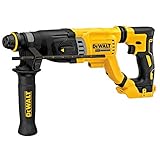
SDS-Plus vs. SDS-Max: the difference that affects your choice
Both systems use slotted shanks that lock into the tool while allowing the bit to move back and forth under impact. SDS-Plus is the smaller, lighter system; SDS-Max uses a larger shank and is built for higher-impact work. Their bits are not interchangeable: an SDS-Plus bit will not fit an SDS-Max chuck, or vice versa, unless you use an adapter—and an adapter does not turn a smaller hammer into a larger-capacity one.
Capacity figures vary by model and by whether the manufacturer gives an optimum drilling range or a maximum. For ordinary work, use the model’s recommended range as your guide, not just its headline maximum. Oversized holes take longer, put more load on the tool, and may call for a different drilling method or a core bit.
| DeWalt drill | Chuck system | Listed maximum concrete capacity | Approx. tool weight | Best fit |
|---|---|---|---|---|
| DCH273 (20V MAX) | SDS-Plus | 1 in. (25 mm) | 6.4 lb | Frequent anchor holes and overhead work where lower weight matters |
| DCH263 (20V MAX) | SDS-Plus | 1-1/8 in. (28 mm) | 7.5 lb | Heavier SDS-Plus drilling and occasional chiseling |
| DCH481 (60V MAX) | SDS-Max | 1-7/8 in. (48 mm) | About 13 lb | Large holes and demanding drilling or chiseling without a cord |
| D25773 (corded) | SDS-Max | 2-9/16 in. (65 mm) | About 20 lb | Heavy-duty drilling and demolition with access to mains power |
Figures are approximate; weight can vary with configuration, and published capacity may differ by region or model revision. Check the current DeWalt manual or product specification for the exact version you are considering. The table compares representative tools, not every drill in the lineup.
Pick by the holes you actually need to make
Small anchors, fixings, and occasional home repairs
For holes roughly 1/4 to 1/2 inch (6–13 mm) in concrete or brick, an SDS-Plus drill is usually the sensible choice. A compact model such as the DCH273 is easier to control for repeated small holes and less tiring when drilling above shoulder height. If your work is occasional, renting an SDS drill can make more sense than buying one; a standard hammer drill may suffice for a small number of modest holes in softer masonry.
Frequent drilling or larger SDS-Plus holes
If you regularly install services, anchors, or fixings and need holes approaching 1 inch (25 mm), look at an SDS-Plus model whose rated capacity covers that size. The DCH263 offers a listed maximum of 1-1/8 inches (28 mm), giving somewhat more headroom than a 1-inch model. That does not mean every job at the maximum will be quick: concrete hardness, aggregate, bit condition, hole depth, and reinforcement all affect progress.
Large penetrations, heavy chiseling, and site work
When the job repeatedly needs holes larger than about 1 inch, or involves substantial chiseling, consider SDS-Max. The cordless DCH481 suits users who need SDS-Max capacity away from an outlet; the corded D25773 is a heavier option for demanding work where continuous power is available. SDS-Max bits are larger and generally cost more, and the drills are substantially heavier than SDS-Plus models. Buying one for occasional small anchor holes adds weight and cost without improving that everyday task.
A quick sizing check before you buy
Suppose a project needs twelve 3/8-inch (10 mm) anchor holes and two 1-1/4-inch (32 mm) service openings. The anchor holes are comfortably within SDS-Plus territory. The 1-1/4-inch openings exceed the listed maximum for the DCH273 and DCH263, so do not assume those models are suitable just because they can drill the smaller holes. Check the specified capacity and bit type for a suitable larger tool, or ask whether a core-drilling method is more appropriate. If the large openings are rare, renting the right equipment may be cheaper than owning an SDS-Max drill and a separate set of large bits.
Buying details that are easy to overlook
- Drilling modes: Many SDS rotary hammers offer rotary hammer, hammer-only, and rotation-only modes, but features vary. Hammer-only mode is useful for light chiseling; it is not a substitute for a dedicated demolition hammer on extensive breaking work.
- Power platform: A cordless tool may be convenient if you already own compatible DeWalt batteries. For long, demanding work, factor in spare batteries and charging time. Corded tools avoid battery changes but need a suitable power supply and cable management.
- Tool weight and reach: Compare the bare-tool weight with how you will hold it. A heavy SDS-Max drill may be tiring for wall work, while a compact SDS-Plus model is easier to position for overhead holes.
- Bit availability: Check that the shank system, diameter, and length you need are readily available. A long bit or large diameter may fall outside the tool’s recommended range even if it physically fits the chuck.
- Price: Market prices vary by region, battery bundle, and promotions. SDS-Plus kits generally cost less than SDS-Max setups, while large SDS-Max bits add to the ownership cost. Compare the complete setup—tool, batteries if needed, and bits—not just the bare tool.
Keep the hammer drilling clean and within its limits
Dust and worn accessories are common reasons a rotary hammer performs poorly. Use sharp bits suited to the material, clear dust from deep holes as the bit maker recommends, and avoid forcing the tool when the bit stops advancing. If drilling into a wall, check for hidden wiring, plumbing, and other services before starting. For large or deep holes, follow the tool and bit instructions, including any limits on diameter and duty cycle.
After use, wipe the tool and bits clean and inspect the bit shank for damage. Keep the chuck area free of grit, and apply shank lubricant if the manual calls for it. A bit that no longer locks securely, a damaged cord, unusual vibration, or declining impact performance deserves attention before the next job. Replace worn bits rather than leaning harder on the drill; extra force adds strain without restoring a cutting edge.
The bottom line
For routine holes up to about 1 inch in concrete, choose a DeWalt SDS-Plus drill based on weight, battery platform, and how often you work. Step up to SDS-Max when larger bit capacity or sustained heavy chiseling is part of the regular workload—not simply because the bigger tool sounds more capable. Match the chuck to your bits, confirm the model’s specified concrete capacity, and let the largest hole you actually need determine the class.