What's inside
As an Amazon Associate I earn from qualifying purchases. This post may contain affiliate links at no extra cost to you.
Aluminum is soft enough to drill quickly, but that softness is exactly why ordinary bits can grab, pack with chips, and jam. For most home and shop jobs, a sharp high-speed steel twist bit with a conventional point is the practical choice. The right diameter, steady feed, and chip clearing matter at least as much as the bit coating.
As an Amazon Associate we earn from qualifying purchases at no extra cost to you.



What we cover
Choose the right bit
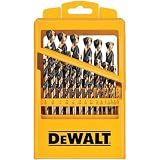
For common holes in sheet, angle, or plate, start with a high-speed steel (HSS) twist-bit set. HSS is inexpensive, easy to find, and plenty tough for aluminum. A 118-degree point works well when the bit is sharp and the work is supported. A 135-degree split point is less prone to wandering on flat stock and usually needs less pressure to start.
Titanium-nitride-coated HSS bits can reduce friction when the coating is intact, but they are not a magic upgrade. Once the coating wears through at the cutting edges, the underlying steel does the work. Cobalt bits are mainly worth the extra cost for harder metals or frequent production use; they are not necessary for occasional aluminum holes.
For thin sheet, a step bit can make clean holes without the sudden grab a large twist bit may cause as it breaks through. It costs more than a basic twist bit and is limited to the hole diameters printed on its steps. For larger holes in thicker stock, use a sharp twist bit or a hole saw rated for metal, and secure the work firmly.
Bit options at a glance
| Bit type | Best use | Trade-off |
|---|---|---|
| HSS twist bit | General holes in aluminum plate and sections | Can grab at breakthrough if the work is loose or feed is heavy |
| Split-point HSS bit | Starting holes accurately on flat stock | Costs a little more; still needs a sharp edge |
| Step bit | Round holes in thin sheet | Limited diameter range and poor fit for thick material |
| Hole saw for metal | Large holes through thicker aluminum | Needs firm clamping and careful chip clearing |
Set speed and feed to control chips
Use a variable-speed drill and avoid starting at full trigger. A useful starting range for common HSS bits is about 1,000–2,000 rpm for a 1/8-inch bit, 500–1,000 rpm for a 1/4-inch bit, and 250–500 rpm for a 1/2-inch bit. These are practical starting points, not strict limits; bit geometry, alloy, and drill power all affect the result. Larger bits generally need slower speed.
Apply steady, moderate pressure so the bit cuts a continuous chip. Too little pressure lets the cutting edges rub and heat up; too much can bind the bit or break it, especially as it exits. If you hear squealing or see aluminum smearing onto the flutes, stop, retract the bit, and clear the chips. Do not keep pushing a clogged bit deeper.
A drop of cutting fluid made for metal can help on deeper holes or repeated drilling. For a small occasional hole, a sharp bit and sensible speed are often enough. Avoid relying on an improvised lubricant without checking that it is suitable for the material and the job.
Drill without jamming
Clamp the aluminum to a bench or secure it in a vise. Thin sheet can spin violently when a bit catches, so never hold it by hand. Put a scrap board beneath sheet metal to support it and reduce burrs at the exit. Mark the hole, then use a center punch lightly on thicker stock; a deep punch mark can distort thin sheet.
For a hole deeper than roughly one bit diameter, drill in short passes. Withdraw the bit periodically to clear the flutes, especially with larger diameters or soft, gummy aluminum. Keep the drill straight and let the flutes carry chips out. If a bit starts to bind, release the trigger, hold the drill securely, and back the bit out gently; do not wrench a powered drill against a stuck bit.
Breakthrough is a common trouble spot: the remaining material gets thin, resistance drops, and the bit can pull itself through. Ease off pressure just before the tip exits. On thin sheet, use a step bit or backer board. On thick stock, a pilot hole can help with larger holes, but it does not replace clamping or chip clearing.
Use the drill’s settings correctly
A standard cordless drill is usually the right tool. Set it to the drill symbol rather than a low clutch number, select low gear for larger bits, and keep the side handle fitted if your drill has one. A 1/2-inch chuck accepts larger bits; a 3/8-inch chuck is fine for many small and medium holes but limits bit-shank options.
Do not use a hammer-drill setting on aluminum. The hammering action is intended for masonry and can make the bit chatter, enlarge the hole, or damage the work. An impact driver is also a poor first choice for ordinary twist bits: its pulsing torque can make the bit catch unpredictably. Use a drill chuck instead, or a dedicated impact-rated bit only where the manufacturer specifies it.
If you need a basic selection for household repairs, a fractional HSS bit set is usually cheaper and more useful than buying premium coated bits one at a time. For thin panels with several different hole sizes, a step bit for metal can be the cleaner purchase.
Check the hole and the bit
After drilling, remove the burr with a deburring tool, countersink, or a larger bit turned slowly by hand. Inspect the cutting edges if the bit began to squeal, wander, or leave a ragged hole. Aluminum welded onto the edge is a sign of heat and chip buildup; clean it carefully and sharpen or replace the bit before the next hole.
For one or two holes in thin aluminum, a basic sharp HSS bit is enough. Spend more on a split point, step bit, or metal-rated hole saw only when the job benefits from easier starting, cleaner sheet-metal holes, or a larger diameter. A secure workpiece, cleared flutes, and reduced pressure at breakthrough prevent more jams than an expensive coating.