Key takeaways
- DeWalt sells too many drills that look alike. Here is the difference between the entry DCD777, ATOMIC and XR, and which one to actually buy.
What's inside
- The Short Version: The DeWalt Drill Families
- The Criteria That Actually Decide This
- What Good and Bad Look Like at Each Price Band
- DCD777: the value pick
- ATOMIC: when length matters more than power
- XR: the one that earns money
- FlexVolt: the one to walk past
- Mistakes I See Most Often
- What I like about DeWalt drills
- What I do not
- Which to buy
- FAQ
- Related Guides
- The Short Version: The DeWalt Drill Families
- The Criteria That Actually Decide This
- What Good and Bad Look Like at Each Price Band
- DCD777: the value pick
- ATOMIC: when length matters more than power
- XR: the one that earns money
- FlexVolt: the one to walk past
- Mistakes I See Most Often
- What I like about DeWalt drills
- What I do not
- Which to buy
- FAQ
- Related Guides
As an Amazon Associate I earn from qualifying purchases. This post may contain affiliate links at no extra cost to you.
DeWalt’s yellow wall is confusing on purpose. There are entry drills, ATOMIC drills, XR drills, hammer versions of each and combo kits that mix them. Having used most of them on real jobs, here is the short map.
The awkward part of writing a DeWalt cordless drill review is that almost nothing in the brushless range is bad. A bad purchase here is rarely a bad tool. It is the right tool bought a tier too high or a tier too low, and you pay for that either in money or in a drill that will not fit where the work is.
As an Amazon Associate we earn from qualifying purchases at no extra cost to you. Product prices and availability are accurate as of the date shown and are subject to change.


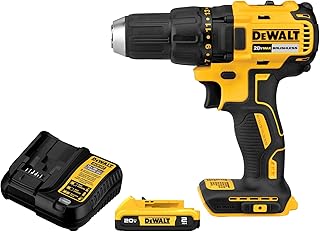


So treat what follows as sorting, not ranking. Answer three questions honestly — how often a drill is actually in your hand, how tight the spaces are, and whether you ever drill brick or block — and a dozen options collapse into one.
The Short Version: The DeWalt Drill Families
Everything in the table below is brushless, which is the first filter worth applying. DeWalt still sells brushed drills, and they are the only genuinely skippable thing in the range.
| Model family | Motor | Size | Who it suits | Notes |
|---|---|---|---|---|
| DCD777 (entry brushless) | Brushless | Compact | Homeowners | Best value in the range |
| ATOMIC | Brushless | Very compact | Tight spaces, DIY | Shortest head length |
| XR | Brushless | Full size | Daily trade | More torque, better electronics |
| XR hammer drill | Brushless | Full size | Masonry + trade | Adds hammer mode |
| FlexVolt | Brushless | Large | Heavy drilling | Overkill for most |
What that table deliberately lacks is a torque column. Torque is the number the marketing leans on and the number that decides the fewest purchases. Physical size, the batteries in the box and hammer mode are what you actually notice on the job.

The Criteria That Actually Decide This
Battery capacity, first and loudest
The packs in the box change the tool more than the tool does. A tiny battery on a full-size drill turns a professional machine into something that sags halfway through the task and runs warm doing it. A mid-size pack on the entry drill makes it feel like a much more expensive tool. Read the kit contents before you read any review, and prefer two mid-size packs to one large one — charging time is the real bottleneck.
Head length and weight
Head length is the dimension nobody checks and plenty of people regret. It decides whether you can get a bit square between joists, inside a cabinet carcass, or beside a wall in a stud bay. Weight decides whether you are still accurate overhead on the thirtieth hole. Both get worse as you climb the range.
Speeds, clutch and chuck
Two speeds cover wood and fasteners. A third range only earns its keep if your work swings between big holes in timber and small bits in steel. What matters more is a clutch that releases predictably at low settings, so you can seat a hinge screw without stripping it, and a chuck that grips a small bit dead straight.
Hammer mode
Hammer mode adds cost, a little length and a little weight, and does nothing for wood. Set anchors in brick or block even a few times a year and it is worth having. Never touch masonry and it is dead weight you paid for.
Weighing these against each other: batteries first, size second, hammer mode third if masonry features at all, speeds fourth, torque last. Invert that order and you get the drill people regret most — a big hammer drill on undersized packs that will not fit inside the cabinet you are hanging.
What Good and Bad Look Like at Each Price Band
The bottom band
The cheapest kits pair a brushed drill with one small battery, a slow charger and a bag. Skip them. The spare pack you inevitably buy costs a serious fraction of a better kit. The good pick down here is an entry brushless drill with two compact packs, or a bare tool if you already own DeWalt batteries.
The middle band
This is where the range is most honest: a two-piece combo, drill and impact driver, two batteries, charger, bag. The bad pick is a five- or six-tool kit padded with a light and a saw you will use twice, riding on the smallest batteries in the catalogue.
The top band
Full-size XR, usually the hammer version, with mid or large packs and a side handle included. Worth every penny if the drill earns money. The bad version of this purchase is buying it for a dozen holes a year because someone online said buy once, cry once.
DCD777: the value pick
Brushless, compact, two-speed, and frequently bundled in a combo kit with an impact driver for a price that embarrasses the rest of the range. For a homeowner or a light-duty woodworker, this is the drill I recommend most often. It will not out-torque an XR, but the number of people who genuinely need more torque than this is smaller than DeWalt’s marketing suggests.
Who should skip it: anyone drilling masonry regularly, and anyone whose drill is in hand every working day, where XR’s electronics and heat tolerance pay for themselves. Shelves, furniture, flat pack, light renovation — this is already more drill than that work needs.
DeWalt DCD777 combo kits
Drill plus impact driver, two batteries, charger and bag. If you are entering the DeWalt platform and do not build for a living, start exactly here.
ATOMIC: when length matters more than power
ATOMIC exists because job sites are full of places a full-size drill will not fit. Between joists, inside cabinets, in an electrical box. It is brushless, light, and it fits. What it will not do is drive lag bolts all afternoon without getting warm.
Two things people get wrong. ATOMIC is not a cheaper XR, it is a different shape, so do not expect a discounted professional drill. And hanging a large battery off it throws away the reason you bought it — keep compact packs on this one. Skip it if it is your only drill and your work includes masonry or big holes.
DeWalt ATOMIC compact drill
The one you reach for more than you expect. Ideal as a second drill, and a genuinely good only-drill for cabinet and electrical work.
XR: the one that earns money
XR is the professional tier. More torque, three-speed transmissions on some models, better electronics, and hammer-drill versions that handle brick and block properly. If the drill is in your hands every working day, buy XR and stop reading reviews.
What you are paying for is margin. It stays composed when a bit binds, it takes a side handle so a stall does not twist your wrist, and it tolerates heat that would have a smaller drill asking for a break. Skip it if you drill occasionally, or if most of your work happens inside cabinets, where the length will annoy you daily.
DeWalt XR hammer drill kits
Full-size, brushless, hammer mode for masonry. This is the DeWalt drill most trades end up on, and it holds up.
FlexVolt: the one to walk past
FlexVolt is built for large-diameter work — augers, big hole saws, mixing — and it is heavy before you fit the large pack it wants. If your work needs it, you already know. Everyone else is buying weight.
Mistakes I See Most Often
- Choosing on torque figures instead of head length, weight and battery capacity
- Buying the kit with the most tools in it rather than the best batteries
- Expecting hammer mode to replace a rotary hammer in poured concrete
- Owning two similar drills instead of a drill and an impact driver
- Fitting cheap blunt bits to a good drill, then blaming the drill for wandering holes
What I like about DeWalt drills
- ✔ All-metal chucks across the brushless range hold bits properly
- ✔ Belt hooks that are actually usable
- ✔ The 20V MAX platform has more tools than anything else on the market
- ✔ Constant discounting — patience genuinely saves money
What I do not
- ✘ Too many near-identical models with unhelpful numbers
- ✘ Cheap kits ship with tiny 1.3Ah batteries that spoil the tool
- ✘ Three-year warranty trails Milwaukee’s five
- ✘ LED placement casts a shadow of the chuck on some models
Which to buy
Homeowner: DCD777 combo kit. Tight-space or cabinet work: ATOMIC. Daily trade or masonry: XR hammer drill. Ignore FlexVolt unless you are drilling large holes with augers or hole saws. And if you already own a working drill on another battery platform, the honest answer is to keep it and spend the money on bits.
FAQ
Are the cheap DeWalt kits at big-box stores worth it? The tools usually are; the batteries often are not. Check the amp-hours before buying.
Is the hammer function any good on concrete? Fine for anchors in brick and block. For real concrete, get a rotary hammer instead.
Do I need the impact driver in the combo kit? Yes, and it is why combos are such good value. Once you drive fasteners with one you will stop abusing the drill for that job, which is also how drills last longer.
Do older 20V batteries still work? Yes. Every 20V MAX pack since 2011 fits every 20V MAX tool.
Check DeWalt drill prices →