What's inside
As an Amazon Associate I earn from qualifying purchases. This post may contain affiliate links at no extra cost to you.
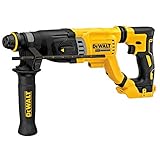
For most concrete anchor holes, the DeWalt DCH273 is the best-balanced DeWalt rotary hammer drill; choose the lighter DCH172 for occasional small anchors, the DCH293 for faster 1-inch-class drilling, and the DCH773 when heavy structural concrete work demands SDS-Max power.
As an Amazon Associate we earn from qualifying purchases at no extra cost to you.


What we cover
Quick comparison of DeWalt rotary hammer drills
All four models below use a dedicated SDS chuck rather than a conventional three-jaw chuck. That means they accept slotted SDS bits that slide in and out quickly while allowing the bit to move axially for hammering. The published figures are useful for comparison, but exact package weight can change with the battery, side handle, depth rod, and dust-collection equipment.
| Model | Chuck type | Impact energy | Approx. tool weight | Maximum concrete capacity | Best fit |
|---|---|---|---|---|---|
| DeWalt DCH172B | SDS-Plus | 1.4 joules | 4.3 lb bare | 5/8 in. | Small anchors, overhead work, light masonry |
| DeWalt DCH273B | SDS-Plus | 2.1 joules | 6.4 lb bare | 3/4 in. | General anchors and repetitive drilling |
| DeWalt DCH293B | SDS-Plus | 3.5 joules | 7.2 lb bare | 1-1/4 in. | Larger holes and demanding masonry work |
| DeWalt DCH773X2 | SDS-Max | 13.3 joules | About 20 lb with battery | 2-9/16 in. | Heavy concrete drilling, coring, and demolition |
“Maximum capacity” is not a recommendation for every hole. A rotary hammer reaches its best speed and battery efficiency when the bit is well below its maximum diameter. For example, a 3/8-inch anchor hole is a natural job for the DCH172 or DCH273, while repeatedly drilling 1-inch holes is a better reason to step up to the DCH293.
Best DeWalt model by concrete job
Best for ordinary anchor holes: DCH273
The DCH273 is the most versatile choice for electricians, remodelers, and homeowners who regularly install concrete anchors, Tapcon-style fasteners, conduit supports, and small equipment mounts. Its 2.1-joule impact rating gives it more reserve than compact entry-level models without the size and fatigue of an SDS-Max machine.
It has hammer-drill, rotary-only, and hammer-only modes, so it can drill concrete, drill masonry, and perform light chiseling with the appropriate SDS-Plus accessory. Its brushless motor and anti-rotation control are useful ownership features, particularly when a bit binds. The practical limit is not the advertised 3/4-inch capacity but how often you expect to drill near that size. For occasional 1/2-inch and 5/8-inch holes, it is a strong middle ground.
Best lightweight option: DCH172
The DCH172 is the sensible pick when low weight matters more than maximum speed. At roughly 4.3 pounds before the battery, it is easier to control overhead and less tiring during installations involving many small holes. Its 5/8-inch concrete capacity covers common sleeve anchors, cable clips, light brackets, and masonry fasteners.
The trade-off is its 1.4-joule impact energy. Large bits progress more slowly, and the tool has less reserve when drilling hard reinforced concrete. A compact hammer drill is also not a substitute for an SDS-Plus rotary hammer when you need to remove tile, chase mortar, or drill dozens of holes in one day.
Best for larger SDS-Plus holes: DCH293
The DCH293 is the high-output SDS-Plus choice. Its 3.5 joules of impact energy and listed 1-1/4-inch concrete capacity make it better suited to larger penetrations, deep holes, and dense masonry than the DCH172 or DCH273. It is still considerably easier to carry and maneuver than an SDS-Max tool.
Choose it when your work regularly includes holes around 3/4 to 1 inch, not merely because the extra power sounds attractive. The additional weight can become a disadvantage for a day of small overhead anchors, and larger batteries make the complete tool heavier still.
Best for heavy concrete: DCH773X2
The DCH773 is in a different class. Its SDS-Max chuck accepts larger, more robust bits and chisels, while its approximately 13.3-joule impact energy is intended for major concrete drilling and demolition. It is appropriate for large penetrations, dowel holes, concrete repair, and sustained work where an SDS-Plus machine would be slow or overloaded.
This power comes with meaningful costs: greater weight, more expensive consumables, harder handling, and a higher purchase price. A DCH773 package commonly falls in the general market range of roughly $700 to $1,000, while bare SDS-Plus tools are often approximately $150 to $350 depending on the model and kit. Battery and charger bundles can change the total substantially.
How chuck type changes the buying decision
- SDS-Plus: Best for small and medium anchor holes, masonry drilling, tile removal, and light chiseling. Bits are widely available and usually less expensive.
- SDS-Max: Best for large-diameter drilling, heavy chisels, concrete demolition, and demanding commercial work. Bits cost more and the tool requires more space and control.
- Conventional keyed or keyless chuck: Useful for ordinary twist drills, but it does not provide the same hammering performance as an SDS system. A chuck adapter can expand compatibility, though it is not ideal for sustained concrete drilling.
Do not confuse SDS-Plus and SDS-Max accessories. They are different shank systems and are not interchangeable. An SDS-Plus bit cannot be used in the DCH773, and an SDS-Max bit cannot be fitted to a DCH172, DCH273, or DCH293.
Decision matrix: which DeWalt rotary hammer drill makes sense?
| Your situation | Recommended model | Why | What to avoid |
|---|---|---|---|
| Occasional homeowner, holes up to 1/2 in. | DCH172 | Lowest weight and adequate SDS-Plus performance | Paying for SDS-Max capacity you will not use |
| Frequent anchors, renovation, electrical or plumbing work | DCH273 | Good balance of power, control, and accessory availability | Using a compact model for constant large holes |
| Regular 3/4- to 1-inch holes | DCH293 | Higher impact energy and larger working capacity | Choosing by weight alone |
| Large penetrations or demolition | DCH773 | SDS-Max tooling and substantially greater impact energy | Expecting easy one-handed or overhead use |
Match the bit to the hole, not just the tool
For a concrete anchor, first identify the anchor’s required diameter and embedment depth. The bit diameter should match the anchor manufacturer’s specification, while the hole should normally be slightly deeper than the required embedment so dust has room to collect below the fastener. A useful rule is to add about 1/4 inch of extra depth, then clean the hole thoroughly.
For example, suppose you need twenty 1/2-inch holes that are 3 inches deep. The theoretical drilling distance is 60 inches, or 5 linear feet. That calculation does not predict runtime because concrete hardness, reinforcement, bit sharpness, operator pressure, and battery size matter more than distance alone. It does show why a larger DCH293 may be worthwhile if the same job becomes 100 holes: the faster drilling and greater reserve can outweigh its extra weight.
Use a carbide SDS masonry bit for ordinary holes. For larger diameters, a core bit may be more appropriate than a solid bit, but check the tool’s permitted accessory range and use the correct operating mode. Never force a dull bit with excessive body weight; it increases heat, vibration, and the chance of binding.
Ownership realities: what wears first
- Bits wear before the machine: Blunt carbide edges make drilling slower and hotter. Replace or resharpen compatible bits rather than compensating with excessive pressure.
- Chuck seals collect dust: Wipe the SDS shank and apply the manufacturer-approved bit lubricant. Keep concrete dust out of the chuck and do not leave a bit installed during dusty storage.
- Filters and vents need attention: Brush or blow dust away from cooling openings according to the manual. Blocked vents can increase motor and battery temperature.
- Batteries affect handling: A high-capacity battery extends working time but can make a compact rotary hammer feel top-heavy. For overhead anchors, a smaller compatible pack may be more comfortable.
- Binding is a warning: Keep both hands on the tool, use the side handle, and let anti-rotation protection work. Do not twist the housing to free a stuck bit.
Bottom line
Buy the DCH273 if you want one DeWalt rotary hammer drill for the widest range of routine concrete and masonry work. Select the DCH172 when small holes and low fatigue are the priority, the DCH293 when larger SDS-Plus holes are common, and the DCH773 only when your work genuinely requires SDS-Max power. The best choice is the smallest model that can complete your typical hole size and workload without operating at its limit all day.