What's inside
- Best Circular Saw Attachments for Drills: What Actually Works
- What actually works by blade size
- Three realistic choices
- Decision matrix: which route fits your situation?
- Features worth paying for
- Worked capacity and cost calculation
- Safe setup for a drill circular saw attachment
- What wears out first?
- Bottom line
- Related Guides
- Best Circular Saw Attachments for Drills: What Actually Works
- What actually works by blade size
- Three realistic choices
- Decision matrix: which route fits your situation?
- Features worth paying for
- Worked capacity and cost calculation
- Safe setup for a drill circular saw attachment
- What wears out first?
- Bottom line
- Related Guides
As an Amazon Associate I earn from qualifying purchases. This post may contain affiliate links at no extra cost to you.
What we cover
- Best Circular Saw Attachments for Drills: What Actually Works
- What actually works by blade size
- Three realistic choices
- Decision matrix: which route fits your situation?
- Features worth paying for
- Worked capacity and cost calculation
- Safe setup for a drill circular saw attachment
- What wears out first?
- Bottom line
- Related Guides
Best Circular Saw Attachments for Drills: What Actually Works
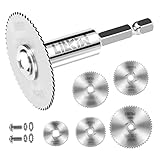
The best “circular saw for drill” option is a small, guarded rotary-saw attachment for light sheet material—not a full-size circular saw head driven by an ordinary drill. Drill-powered saw attachments can be useful for thin plywood, plastic, cardboard, and occasional trim work, but they cannot match the stability, cutting depth, braking, or safety controls of a dedicated circular saw.
That distinction matters because many listings make a drill circular saw look like a compact substitute for a cordless saw. In practice, the drill supplies rotation but usually lacks the saw’s controlled trigger, spindle brake, rigid base plate, side handle, and dust management. The attachment is only as safe and capable as the drill, chuck, arbor connection, guard, and operator technique.
As an Amazon Associate we earn from qualifying purchases at no extra cost to you.


What actually works by blade size
| Attachment type | Typical blade diameter | Practical cutting depth | Suitable materials | Best use |
|---|---|---|---|---|
| Mini rotary-saw attachment | 50–85 mm (2–3.35 in) | 8–22 mm (5/16–7/8 in) | Cardboard, vinyl, thin plywood, plastic, softwood trim | Small repairs and occasional cuts where portability matters |
| Compact guarded saw attachment | 85–115 mm (3.35–4.5 in) | 15–32 mm (9/16–1 1/4 in) | Thin plywood, battens, laminate, light softwood | Short, straight cuts with a powerful drill and firm work support |
| Large drill-powered saw head | Over 115 mm (4.5 in) | 25–40 mm (1–1 9/16 in), advertised | Often overstated; limited by torque and stability | Generally not recommended |
| Dedicated compact circular saw | 85–165 mm (3.35–6.5 in) | 20–55 mm (3/4–2 1/8 in) | Plywood, dimensional lumber, panels, some metal with the correct blade | Repeatable cutting and regular woodworking |
Blade diameter alone does not determine cutting capacity. The attachment must leave clearance for the guard and mounting hardware, and the drill must maintain speed under load. A 3-inch blade cutting 18 mm plywood may work acceptably. The same attachment can stall or twist when pushed through 25 mm lumber, even if the listing claims a greater maximum depth.
Three realistic choices
1. A guarded 2-inch to 3-inch drill attachment for light work
This is the only category that makes sense for most buyers specifically seeking a drill circular saw. Look for a metal arbor, a transparent or enclosed blade guard, a small base plate, and a second grip or stabilizing handle. A 10.8V or 12V drill may handle cardboard, plastic sheet, and very thin plywood; an 18V or 20V brushless drill is a better minimum for occasional softwood cuts.
Expect a narrow working envelope. These tools are awkward for long rip cuts because the drill sits above or behind the blade and can pull sideways as the blade enters the material. They are better for short openings, notching thin boards, cutting laminate, or trimming material already fixed securely to a bench.
2. A larger “drill powered circular saw” head
Large attachments with 4-inch or larger blades look more capable but create a poor mechanical compromise. A drill chuck is not designed to act like a circular saw’s rigid arbor. Side loading can loosen the chuck, the shaft can flex, and the drill’s clutch may slip at exactly the moment the blade binds. A large blade also has greater rotational inertia and more severe kickback potential.
Unless the attachment has a rigid arbor, a complete lower guard, a proper base, and clear speed requirements that match the drill, treat it as a novelty rather than a dependable saw. Do not remove the guard to gain extra depth.
3. A compact dedicated circular saw
If you need to cut 18 mm plywood, 2-by stock, flooring, or panels more than a few times per year, a dedicated compact circular saw is the better drill and circular saw combo. It normally provides a stable shoe, blade-depth adjustment, bevel adjustment, a spindle lock, a purpose-built trigger, and better control during kickback.
A compact saw also separates the jobs of drilling and cutting. That costs more initially, but it avoids buying replacement arbors, bent shafts, damaged drill chucks, and extra blades after an attachment is overloaded.
Decision matrix: which route fits your situation?
| Your situation | Best choice | Why | What to avoid |
|---|---|---|---|
| Under $40, fewer than 10 light cuts per year | Small guarded attachment | Lowest entry cost for thin materials | Large unguarded heads and masonry-style discs |
| Beginner with limited tool experience | Dedicated compact circular saw | Better shoe and safer control layout | Any attachment requiring two-handed improvisation |
| Small apartment or workshop | 2–3 inch attachment or compact saw | Lower storage footprint; choose based on material thickness | Attachment with no base plate |
| Weekly woodworking | Dedicated circular saw | Designed for repeated cutting and consumable changes | Using the drill’s clutch as a substitute for a saw safety system |
| Cutting 2-by lumber or sheet goods | 5–7 inch dedicated saw | Stable depth, torque, and guidance | Any drill circular saw attachment claiming full-size performance |
Features worth paying for
- Enclosed lower and upper guards: A partial shield is not enough when the blade can contact the workpiece at changing angles.
- Rigid base plate: The shoe should remain flat instead of hanging from the drill body. A useful plate is generally at least 90 mm wide and 120 mm long on a mini attachment.
- Mechanical arbor connection: Prefer a keyed or hex-compatible arbor with a positive locking method over a smooth shaft held only by a loose set screw.
- Clear speed range: Match the attachment’s rated revolutions per minute to the drill’s actual no-load speed. Do not assume maximum drill speed is suitable.
- Auxiliary handle: Two points of control are much safer than gripping the drill alone.
- Thin-kerf, material-specific blades: A fine-tooth wood blade is different from an abrasive disc or a plastic-cutting blade. Never substitute a blade simply because its diameter fits.
A drill’s clutch is useful for preventing some overload, but it is not a blade brake. A variable-speed trigger can help with controlled entry, yet low speed may reduce cooling and increase stalling. Follow the attachment’s speed instructions rather than operating at maximum speed by default.
Worked capacity and cost calculation
Suppose a small attachment has a 3-inch blade with a stated maximum depth of 22 mm, while your plywood is 18 mm thick. The nominal clearance is only 4 mm. That leaves little room for a tilted base, surface irregularity, or a blade that is not perfectly centered. In practical use, setting the depth around 19–20 mm is safer, provided the attachment allows depth adjustment.
Now compare ownership. A $30 attachment plus two replacement blades at $8 each costs about $46. If it makes 20 useful cuts before the arbor or guard becomes troublesome, the attachment cost is roughly $2.30 per useful cut. A $100 compact saw used for 200 cuts costs about $0.50 per cut before blades. The attachment can still be the sensible choice for a one-off repair, but frequent use changes the calculation quickly.
Safe setup for a drill circular saw attachment
- Inspect the drill and attachment. Check for chuck runout, a bent arbor, loose screws, cracked guards, and a blade with missing or damaged teeth.
- Set the drill correctly. Use the manufacturer’s recommended gear and speed. Lock the chuck firmly and remove the clutch setting from the cutting equation if the instructions require direct drive.
- Secure the workpiece. Clamp both sides of the cut where possible. Never hold a small board in one hand while guiding a rotating blade with the other.
- Mark a short cut line. Keep the cut within the attachment’s base-plate support. Long cuts invite wandering and twisting.
- Start clear of the material. Let the blade reach its intended speed before entering, then advance slowly without forcing the drill.
- Stop at the first sign of binding. Release the trigger, wait for the blade to stop, and find the cause. Do not pull the spinning attachment backward.
- Clean after use. Brush dust from the guard, arbor, chuck, and ventilation openings. Resin and fine dust can restrict guard movement and cause overheating.
Wear eye protection and hearing protection, keep both hands away from the blade path, and avoid loose sleeves, gloves near the rotating arbor, and unsupported offcuts. A dust mask may be appropriate for dusty materials, but it does not make cutting treated wood, unknown plastics, or composite panels automatically safe.
What wears out first?
On inexpensive attachments, the first weak points are usually the set screw, chuck-mounted arbor, plastic guard hinge, and small base plate—not the blade itself. Blades dull quickly when they contact screws, grit, laminate adhesive, or hidden fasteners. A dull blade requires more feed pressure, which increases twisting and heat.
Replace a blade when teeth are chipped, the cut begins wandering, or the drill must be forced to maintain progress. Replace the attachment if the arbor has visible wobble, the guard sticks, or the base no longer stays square to the blade. Do not compensate for runout by tightening the chuck harder; that can damage the drill and still leave the blade unstable.
Bottom line
A circular saw drill attachment is practical only as a light-duty mini saw for thin, manageable materials and short cuts. Choose the smallest guarded model that meets your actual thickness, use it with a powerful compatible drill and a firmly supported workpiece, and regard advertised cutting depth as a ceiling rather than a normal target.
For lumber, plywood sheets, repeated cuts, bevels, or work where a straight line matters, buy a dedicated compact circular saw. It is more stable, easier to control, and usually cheaper over the life of the tool than forcing a drill circular saw combo to perform a job it was never designed to do.