What's inside
As an Amazon Associate I earn from qualifying purchases. This post may contain affiliate links at no extra cost to you.
What we cover
Best DeWalt 20V Hammer Drills for Home and Jobsite Use
The best DeWalt 20V hammer drill for most people is the DCD805: it combines a compact body with strong drilling performance, a three-mode selector, and enough capacity for common wood, metal, and masonry work. Choose the lighter DCD799 for frequent overhead or tight-space work, the DCD996 for larger holes and sustained heavy-duty drilling, or the DCD796 when a lower-cost older XR model is available with a suitable battery kit.
These are cordless hammer drills in DeWalt’s 20V MAX XR lineup. Their hammer action is intended for drilling into brick, block, and similar masonry—not for chiseling or replacing a rotary hammer when drilling many large holes in concrete. The “20V MAX” label is DeWalt’s nominal battery-platform name; it does not mean these drills need a special 20-volt battery.
As an Amazon Associate we earn from qualifying purchases at no extra cost to you.

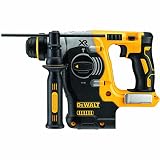


XR models compared
Specifications can vary slightly by region and kit configuration. Weights below are approximate tool-only figures; adding a battery changes the handling noticeably. Check the exact model and included accessories before buying.
| Model | Speed and impact rate | Max rated capacity | Approx. tool-only weight | Best fit |
|---|---|---|---|---|
| DCD799 | Up to 1,650 rpm; up to 28,050 bpm | Wood: 1 in; metal: 1/2 in; masonry: 5/8 in | About 2.5 lb | Compact, lighter drilling and occasional masonry |
| DCD805 | Up to 2,000 rpm; up to 34,000 bpm | Wood: 1-1/2 in; metal: 1/2 in; masonry: 1/2 in | About 2.0 lb | Balanced home and jobsite use |
| DCD796 | Up to 2,000 rpm; up to 34,000 bpm | Wood: 1-1/2 in; metal: 1/2 in; masonry: 1/2 in | About 3.4 lb | Value when discounted; general-purpose drilling |
| DCD996 | Up to 2,000 rpm; up to 38,250 bpm | Wood: 2 in; metal: 1/2 in; masonry: 5/8 in | About 4.7 lb | Large holes, tougher work, and longer drilling sessions |
Maximum capacity is not a promise of equal speed in every material. Hole-saw diameter, bit sharpness, masonry hardness, battery size, and how firmly the operator controls the tool all affect the result. In particular, drilling near a published maximum is slower and more demanding than making small pilot holes.
Which one should you buy?
For one drill that handles most household projects: DCD805
The DCD805 is the most balanced choice in this group. Its two speed ranges cover ordinary screwdriving and drilling, while its compact form is easier to manage than the older, heavier DCD996. Use drill mode for wood and metal, hammer mode for masonry, and the clutch setting for driving fasteners. It is a strong candidate if you want one of the best DeWalt drills cordless 20V has to offer without carrying a full-size heavy-duty tool for routine work.
For overhead work and cramped spaces: DCD799
Choose the DCD799 when weight and length matter more than maximum hole size. It suits cabinet installation, light framing, fixture mounting, and occasional anchor holes. Its published wood capacity is smaller than the DCD805’s, so it is not the first choice for frequent large-bore drilling. A compact drill also does not eliminate kickback: keep both hands positioned securely when using larger bits.
For larger holes and demanding drilling: DCD996
The DCD996 has the largest listed wood capacity and the highest impact rate of these four models, but it is also the heaviest. That tradeoff makes sense for a carpenter or remodeler who regularly drills larger holes and can benefit from its heavier-duty design. For occasional home repairs, the added weight may be more burden than benefit. If you expect repeated large holes in concrete, consider a rotary hammer instead; a hammer drill’s percussion action is less suited to that workload.
For a deal on an older XR drill: DCD796
The DCD796 remains a capable option for general drilling and light masonry when sold at a meaningful discount. Its listed capacities and speed are similar to the DCD805’s, but it is an older, heavier design. Compare the complete kit rather than the bare-tool price: a lower-cost drill can be poor value if you must also buy batteries, charger, and case.
Compare the whole kit, not just the drill
Battery capacity affects runtime and balance. A compact battery keeps the tool lighter for overhead work; a larger-capacity pack generally lasts longer between changes but adds weight. The drill model alone cannot tell you how many holes a charge will make: a small bit in softwood and a masonry bit in hard brick place very different loads on the battery.
When comparing kits, check whether they include a battery, charger, belt hook, and case, and note the battery’s amp-hour rating. If you already own compatible DeWalt 20V MAX batteries and a charger, a bare tool may be economical. If you are starting from scratch, compare the price of a complete kit with the cost of buying those items separately. Market prices vary by bundle and promotions, so use broad ranges rather than assuming the same model always costs the same amount.
| Your situation | Practical choice | Why |
|---|---|---|
| Occasional repairs, little masonry | DCD799 or discounted DCD796 | Pay for enough capacity without prioritizing heavy-duty features |
| Mixed home projects and regular installation work | DCD805 | Useful balance of size, speed, and drilling capacity |
| Large holes or frequent demanding drilling | DCD996 | Greater listed wood capacity and a more substantial build |
| Long sessions above shoulder height | DCD799 with a compact battery | Lower tool weight helps reduce fatigue |
| Repeated large-diameter concrete holes | Rotary hammer rather than any of these | Better matched to sustained concrete drilling |
Get better results and extend service life
For masonry, use a sharp, correctly sized masonry bit and select hammer mode. Start square to the surface, apply steady pressure, and ease off if the bit overheats or stops clearing dust. A dull bit encourages excessive force, slows drilling, and increases strain on the tool and battery. For wood or metal, turn hammer mode off; percussion is unnecessary and can damage the work or bit.
Clean dust from the chuck and vents with a dry brush or compressed air used cautiously, and remove the battery before changing bits or cleaning. Avoid storing the drill with a bit clamped in the chuck if it could be knocked or bent. Inspect bits for wear and chuck jaws for debris: worn bits are among the first consumables to undermine drilling speed and accuracy. Do not use the drill as a substitute for a wrench, and avoid forcing a large bit through a bind; release the trigger and reset your grip before continuing.
For a single versatile pick, get the DCD805. Choose the DCD799 if compact handling is the priority, the DCD996 if larger and more frequent drilling justifies its weight, and the DCD796 only when its kit or price makes it the better-value buy. Match the battery and bit to the job, and step up to a rotary hammer for sustained concrete work.