What's inside
- Quick picks by situation
- Concrete fasteners compared
- Concrete screws: lowest total cost for light and medium work
- Sleeve anchors: better tolerance for heavier brackets
- When a wedge anchor is worth the extra cost
- Decision matrix: match the anchor to the job
- Worked cost comparison
- Installation practices that protect holding power
- Durability and ownership costs
- Related Guides
- Quick picks by situation
- Concrete fasteners compared
- Concrete screws: lowest total cost for light and medium work
- Sleeve anchors: better tolerance for heavier brackets
- When a wedge anchor is worth the extra cost
- Decision matrix: match the anchor to the job
- Worked cost comparison
- Installation practices that protect holding power
- Durability and ownership costs
- Related Guides
As an Amazon Associate I earn from qualifying purchases. This post may contain affiliate links at no extra cost to you.
The best budget concrete anchors and fasteners for most household projects are blue-coated concrete screws for speed and low installed cost, while sleeve anchors are the better value when you need a larger, more forgiving connection or a through-bolt-style installation.
Choose by the load, concrete condition, hole access, and how often you will install them—not by package price alone. A cheap anchor that spins in a soft hole, rusts outdoors, or requires a second trip is rarely the lowest-cost option.
As an Amazon Associate we earn from qualifying purchases at no extra cost to you.


What we cover
- Quick picks by situation
- Concrete fasteners compared
- Concrete screws: lowest total cost for light and medium work
- Sleeve anchors: better tolerance for heavier brackets
- When a wedge anchor is worth the extra cost
- Decision matrix: match the anchor to the job
- Worked cost comparison
- Installation practices that protect holding power
- Durability and ownership costs
- Related Guides
Quick picks by situation
- Light shelves, conduit, brackets, and wood cleats: 1/4-inch concrete screws, usually 1-3/4 to 2-3/4 inches long.
- Frequent installations: a 1/4-inch hex-head concrete screw with a compatible SDS-plus or carbide masonry bit.
- Outdoor fixtures in ordinary weather: stainless-steel concrete screws, accepting their higher purchase price.
- Heavier static brackets and equipment bases: zinc-plated or mechanically galvanized sleeve anchors, typically 3/8 inch or 1/2 inch in diameter.
- Cracked concrete or safety-critical loads: a listed expansion or adhesive anchoring system selected from the manufacturer’s load tables; the cheapest fastener is not appropriate.
Concrete fasteners compared
The figures below are practical comparison ranges, not universal ratings. Capacity depends on concrete strength, edge distance, spacing, embedment, hole cleanliness, installation torque, and whether the load pulls straight out or applies a sideways force. Always use the specific manufacturer’s published allowable loads for structural work.
| Fastener type | Common size | Typical working load range* | Hole size | Installation | Typical cost per installed anchor | Corrosion resistance |
|---|---|---|---|---|---|---|
| Concrete screw | 1/4 in. diameter, 1-3/4 to 3-1/2 in. long | About 100–400 lb tension or shear in sound concrete | Usually 3/16 in. | Drill, clean hole, drive screw | About $0.35–$1.25 | Blue-coated steel; stainless versions resist corrosion better |
| Sleeve anchor | 3/8 in. diameter, 2-1/2 to 4 in. long | About 300–900 lb, depending strongly on embedment | Matching diameter, usually 3/8 in. | Drill, clean hole, insert, tighten nut | About $0.70–$2.00 | Zinc-plated for dry interiors; galvanized or stainless for damp areas |
| Wedge anchor | 1/2 in. diameter, 3-3/4 in. or longer | About 800–2,000 lb in suitable concrete | Matching diameter, usually 1/2 in. | Drill, clean hole, hammer in, torque nut | About $1.50–$4.00 | Zinc-plated, hot-dip galvanized, or stainless steel |
| Hammer-drive pin anchor | 1/4 in. diameter, 1-1/4 to 2-1/2 in. long | About 50–200 lb | Usually 1/4 in. | Drill, place, hammer pin | About $0.20–$0.75 | Usually zinc-plated; limited adjustment and removal |
*Illustrative ranges for light-duty design in normal, uncracked concrete. Do not use them as engineering values or for overhead, life-safety, guardrail, vehicle-lift, or code-regulated applications.
Concrete screws: lowest total cost for light and medium work
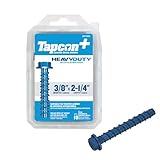
Concrete screws, including widely available products such as Tapcon and similar threaded masonry screws, generally have the lowest cost per completed attachment. They need only a drilled pilot hole and a driver, and they can often be removed and replaced. A hex-head version is usually easier to install than a Phillips-head version because it is less likely to cam out when the hole is deep or dusty.
The main limitation is installation discipline. The pilot hole must be the specified diameter and deeper than the embedment. If the hole is too small, the screw can break or strip; if it is too large, the threads cannot develop sufficient holding power. Do not repeatedly drive a screw into the same damaged hole. Move to a new location or use a larger approved fastener.
For a typical indoor bracket, a 1/4-inch screw with at least 1 inch of effective embedment is a sensible starting point. Calculate length as:
Fastener length = fixture thickness + washer or spacer thickness + required embedment.
For example, a 1/2-inch wood cleat, a 1/8-inch washer, and 1-3/4 inches of embedment require at least 2-3/8 inches. Choose the next available length, while ensuring the screw will not hit reinforcement, a conduit, or the far face of a thin slab.
Sleeve anchors: better tolerance for heavier brackets
Sleeve anchors spread force through an expansion sleeve and are more tolerant of thicker fixtures than concrete screws. A 3/8-inch sleeve anchor is a practical budget choice for handrails that are not safety-critical, storage brackets, small machinery stands, and similar static loads when the manufacturer permits that use.
They cost more per hole and require a correctly sized bit, a wrench, and careful tightening. Over-tightening can damage the sleeve or crush weak concrete; under-tightening reduces expansion. Sleeve anchors also need sufficient distance from corners because expansion pressure can split the edge.
For an ordinary indoor project, zinc-plated steel is usually adequate. In garages, unheated workshops, and exterior locations, mechanically galvanized or hot-dip galvanized anchors offer better protection. Stainless steel is preferable near salt, fertilizer, pool chemicals, or persistent moisture, but compare the manufacturer’s strength data because some stainless grades are not as strong as hardened carbon steel.
When a wedge anchor is worth the extra cost
Wedge anchors, such as the Titen-style and other listed concrete anchoring systems sold by major manufacturers, provide high capacity when installed in suitable concrete with adequate embedment. They make sense for equipment bases, structural steel plates, and substantial brackets where failure would be expensive or dangerous.
They are not automatically the best budget option. A 1/2-inch wedge anchor may require a large rotary hammer bit, more drilling time, deeper holes, and a torque wrench. It also has limited usefulness in thin slabs and near edges. If the load is light enough for a concrete screw, choosing a wedge anchor may increase the installed cost without improving the finished connection.
Decision matrix: match the anchor to the job
| Situation | Best budget choice | Why | Trade-off |
|---|---|---|---|
| First-time installer, fewer than 10 holes | Hex-head concrete screws | Simple layout and no nut or torque procedure | Requires accurate pilot-hole drilling |
| Dozens of holes in a workshop | Concrete screws with a dedicated masonry bit | Fast, inexpensive, and easy to replace | Bits wear and must be kept sharp |
| Bracket has slotted holes or variable thickness | Sleeve anchors | Nut and washer accommodate thicker assemblies | More clearance and a wrench are required |
| Outdoor or damp location | Stainless screws or galvanized expansion anchors | Improved resistance to rust | Higher cost; verify the rating for the selected material |
| High load, structural connection, or safety barrier | Manufacturer-specified wedge or adhesive system | Published design data and controlled installation | Not a casual budget installation |
Worked cost comparison
Suppose you need eight holes for an indoor storage cleat. A box of concrete screws might cost $10–$16, or roughly $1.25–$2.00 per installed anchor if the drill bit is already available. If one compatible bit costs $5–$10 and survives the job, the total becomes approximately $1.90–$3.25 per hole.
Eight sleeve anchors might cost $8–$16, or $1.00–$2.00 each, but the required bit may cost $8–$15. The installed total is therefore about $2.00–$3.90 per hole. Screws usually win for this small, light-duty job, while sleeve anchors become more attractive when the fixture is thick, the load is higher, or the holes will be reused.
Installation practices that protect holding power
- Locate the hole carefully. Avoid edges, joints, visible cracks, and suspected wiring or plumbing. Maintain the manufacturer’s minimum spacing.
- Use the specified bit. A worn bit makes an oversized or irregular hole, particularly in hard aggregate.
- Drill deeper than the required embedment. Leave room for dust and the tip of the fastener. Do not count the fixture thickness as embedment.
- Clean the hole. Vacuum or blow out dust, then brush where the anchor instructions require it. Dust is especially harmful to expansion and adhesive systems.
- Install without impact damage. Use the recommended driver setting and stop when the head or nut seats. Spinning a screw after it has lost resistance is a warning that the hole may be ruined.
- Inspect the finished connection. The fixture should sit flat, the fastener should be centered, and there should be no cracking or visible movement.
Durability and ownership costs
The first consumable to wear out is often the masonry bit, not the anchor. Hard aggregate can dull inexpensive bits quickly, while a rotary hammer bit may last much longer when drilling many holes. Keep the bit cool enough to avoid damaging its carbide tip, and clear dust regularly.
Concrete screws are convenient to remove, but their threads can become damaged after several installation cycles. Sleeve and wedge anchors are less reusable: once expanded, removal can damage the hole, and a replacement anchor may need a new location. For exterior work, corrosion often begins at cut edges, damaged coatings, washers, or places where water remains trapped against the fixture.
For the lowest overall cost, use concrete screws for light indoor attachments, step up to sleeve anchors when load and fixture thickness justify them, and reserve wedge or engineered adhesive systems for connections where published capacity and installation control matter more than the lowest purchase price.