What's inside
As an Amazon Associate I earn from qualifying purchases. This post may contain affiliate links at no extra cost to you.
Flat-pack furniture is usually held together with small screws, cam locks and short fasteners driven into particleboard or MDF. The challenge is not getting more power; it is stopping before the screw head or soft panel gives way. For most assembly jobs, a compact drill with a low-speed setting, a clutch and a 1/4-inch hex driver bit is a better choice than a high-torque impact driver.
As an Amazon Associate we earn from qualifying purchases at no extra cost to you.


What we cover
What to look for in a cordless drill
Prioritize a variable-speed trigger, a two-speed gearbox and an adjustable clutch. The clutch slips when resistance reaches the selected level, helping prevent overdriving. Start at a low setting, then raise it only if the screw stops short. Clutch numbers are not standardized across brands, so a setting of 5 on one drill does not necessarily match 5 on another.
A compact 12V drill is often enough for furniture assembly and is lighter in cramped spaces. An 18V or 20V drill offers more capacity for larger holes and general home projects, but can feel bulky on a cabinet interior. Battery voltage alone does not tell you how gently a drill can drive a screw: trigger control and clutch behavior matter more for this job.
A drill with a 3/8-inch chuck is adequate for most furniture bits; a 1/2-inch chuck is useful if you also plan to drill larger holes. A belt clip, work light and brushless motor are conveniences, not requirements. If you need a dedicated assembly tool, compare compact 12V cordless drills with a clutch.
Tool choices for flat-pack assembly
| Tool | Best use | Trade-off |
|---|---|---|
| Compact cordless drill/driver | Most screws and pilot holes; clutch helps limit torque | Still possible to strip a screw if driven too fast or with the wrong bit |
| Manual screwdriver | Final snugging, delicate hardware and occasional screws | Slower and tiring over a large assembly |
| Impact driver | Long or stubborn fasteners in suitable materials | High torque and hammering action make small furniture screws easier to damage |
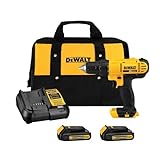
For a first tool, a basic drill/driver is the sensible buy. A cheaper brushed model is fine if you assemble furniture occasionally; you do not need a premium brushless kit for a few bookcases a year. If you already own a drill, a manual screwdriver can handle the final turns without buying another tool. Consider an adjustable-clutch cordless drill/driver kit if you also expect to drill pilot holes or do routine household repairs.
How to avoid stripping screws
Use the exact bit type and size specified by the instructions. A Phillips bit that looks close but is too small can ride out of the recess, chewing up the head. Furniture kits often use Pozidriv or proprietary bits that resemble Phillips; inspect the screw and instructions rather than forcing a near match. Keep the bit straight and press firmly into the screw while driving.
Set the drill to its lowest speed range and squeeze the trigger gently. Let the bit turn slowly enough that you can stop as soon as the head seats. A practical starting point is the lowest clutch setting that will move the screw, increasing it one step at a time if needed. Stop when the head is flush or the joint is snug. Driving until the clutch repeatedly clicks can still crush particleboard or pull a fastener through a thin panel.
For a screw going into a panel without a prepared hole, drill a pilot hole first when the instructions allow it. For small furniture screws, a pilot around 2–3 mm may help, but choose the size based on the screw’s core diameter and the material; the hole should not be so wide that the threads lose their grip. Clamp or support loose pieces if practical. Do not use a drill to force misaligned panels together—the screw can wander, split an edge or strip its hole.
Use the drill’s clutch for driving, not drilling: select the drill symbol or appropriate mode for pilot holes. Keep your other hand clear of the bit and avoid leaning hard on the tool. If a screw binds, back it out, check alignment and clear debris rather than raising the clutch until it powers through.
Bits, batteries and accessories
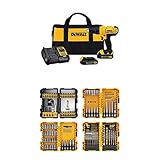
A short driver bit gives better control than a long extension in most cabinet joints. A small assortment of quality Phillips, Pozidriv, square and hex bits is more useful than a large box of obscure sizes. Hex keys included with furniture can be slow but provide good feel; a hex bit in the drill saves time, then finish by hand if the fastener is delicate. A driver-bit set with common Phillips, Pozidriv and hex sizes can prevent the poor fit that starts many stripped heads.
One small battery is usually enough for a room’s worth of assembly, though an extra battery is convenient if the drill will also be used around the house. Do not choose a heavier high-capacity battery just for furniture work; it adds weight without improving control. A fully charged battery helps the motor run consistently, but it does not make a high clutch setting safe.
When an impact driver is the wrong tool
Impact drivers deliver rotational blows as resistance rises. That helps drive long screws into framing, but the repeated impacts can cam a bit out of a small furniture screw before you can react. They are not inherently unusable for assembly, but require a light trigger, a well-fitting bit and restraint. For a single delicate bookcase, use a drill/driver or screwdriver instead. If you already own only an impact driver, set it to its lowest mode if available and finish each screw by hand rather than relying on it to sense when the joint is tight.
Whichever tool you buy, the best safeguard is a well-fitting bit, low speed and a stop before the joint is crushed. Power saves time; control saves the furniture.