What's inside
As an Amazon Associate I earn from qualifying purchases. This post may contain affiliate links at no extra cost to you.
The best grappling dummies for most home users are a 5–6 foot, 70–100 lb filled dummy with reinforced seams and articulated arms; choose a lighter 4–5 foot model for children or limited storage, and a heavier 100–140 lb dummy if you regularly drill takedowns, pins, and ground-and-pound transitions.
A grappling dummy is useful for repeating movement without needing a training partner, but the right choice depends less on its appearance than on dimensions, weight distribution, joint position, and how easily you can store and clean it. A dummy that is too light slides during a takedown. One that is too stiff may not accept realistic guard or passing positions. Before buying, match the dummy to your body size, training frequency, and available floor space.
As an Amazon Associate we earn from qualifying purchases at no extra cost to you.


What we cover
Our Top Picks
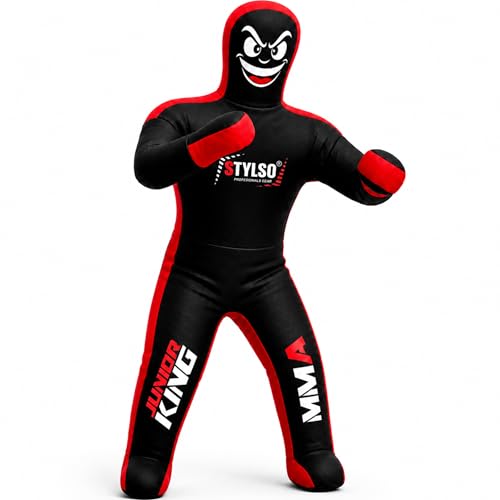
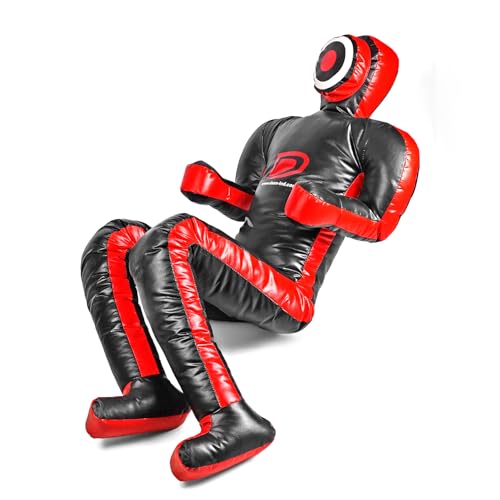
Best grappling dummies by training situation
| Home-training situation | Recommended specification | Why it fits |
|---|---|---|
| Beginner learning positions | 4–5 ft, 30–60 lb, flexible arms and legs | Easier to move, lift, and reposition while learning mount, side control, and basic escapes |
| Adult BJJ drilling | 5–6 ft, 70–100 lb, seated or supine configuration | Provides useful resistance for passing, pins, back takes, and submission entries |
| MMA striking and ground work | 5–6 ft, 80–120 lb, dense torso and reinforced head area | Stays more stable for controlled punches, elbows, knees, and transitions |
| Frequent takedown practice | 6 ft or larger, 100–140 lb, durable lifting handles | Reduces sliding and better approximates the effort of lifting an adult partner |
| Small apartment or shared room | 4–5 ft, 30–70 lb, compressible textile fill | Can fit in a closet or under a bed more easily than a rigid freestanding dummy |
What to compare before choosing
Size and body proportions
Adult dummies around 5 feet 6 inches to 6 feet are the most versatile for adult BJJ and MMA practice. They offer enough length to work leg entanglements, half guard, knee-on-belly, and rear-control drills. A 4-foot or 4-foot 6-inch dummy is more manageable for children, lighter athletes, and beginners, but its shorter limbs can make certain grips and passing angles feel artificial.
Height alone does not guarantee realism. Check the shoulder width, torso thickness, and limb length. Some inexpensive dummies have long, narrow legs and a small torso, while others are built with a broad chest that better represents an adult opponent. If you are over about 6 feet tall or have long limbs, prioritize a full-size model with extended arms and legs rather than simply adding more fill.
Weight and balance
Weight affects both realism and safety. A 30–50 lb dummy is convenient for drilling arm bars, triangles, and transitions, but it may move across a smooth floor during sprawls or takedowns. Around 70–100 lb is a practical range for many adults training on mats. Models above 100 lb are more stable, but they are harder to carry, store, and reposition without straining your back.
Ask where the weight is located. A dummy with most of its fill in the torso can be stable when lying down but awkward to lift. A well-balanced model distributes material through the chest, hips, and limbs, allowing you to practice changing levels and carrying positions without the body folding unpredictably.
Fill materials
- Textile scraps: Common in filled grappling dummies. They provide a forgiving, slightly compressible body and usually become denser over time as the material settles.
- Shredded foam: Lighter and more resilient than many textile fills. It can feel springier and may be easier to handle, but the dummy can lose volume if the fill compacts.
- Mixed textile and foam fill: A useful compromise for home practice, combining weight with some compression around the joints.
- Unfilled shell: The lowest-shipping-cost option, but the final weight and feel depend on how carefully you fill it. Uneven packing can create hard lumps or loose limbs.
For an unfilled shell, avoid packing the material tightly in one session. Add fill in layers, alternate between limbs and torso, and periodically stand the dummy upright to identify gaps. A finished 5–6 foot dummy commonly requires roughly 50–100 lb of textile or foam material, depending on the shell and desired firmness. Confirm the manufacturer’s capacity before buying fill; overstuffing can stress the stitching and make the arms too rigid for realistic drilling.
Joint positioning and range of motion
Joint configuration determines which techniques the dummy can accept. A permanently seated dummy is convenient for guard passing, posture, and leg-entry drills. A supine dummy is better for mount, side control, knee-on-belly, and ground-and-pound sequences. Some articulated models allow the arms and legs to fold into more than one position, making them the most adaptable but often more expensive.
Look for arms that can cross the chest and legs that can bend toward the torso. Those features support arm-bar, triangle, kimura, and guard-retention practice. Straight, rigid limbs are adequate for striking combinations but limiting for submission grappling. Hands with molded or sewn grip points can help with sleeve and wrist-control drills, although they do not reproduce the feel of fingers.
Head-to-head: filled dummy versus unfilled shell
| Factor | Pre-filled dummy | Unfilled shell |
|---|---|---|
| Typical market range | About $120–$350 | About $70–$220, plus fill |
| Setup time | Ready after inspection and light reshaping | Usually 1–3 hours, depending on filling material |
| Final weight | Specified by the manufacturer | Controlled by the buyer, commonly 40–120 lb |
| Feel and consistency | Usually more uniform | Depends on packing technique and material |
| Storage | Full-size volume immediately | Ships and stores compactly before filling |
| Best for | Frequent users who want predictable setup | Buyers with limited budgets or custom weight requirements |
Pre-filled models from established martial-arts equipment makers such as Century, Ring to Cage, and Revgear are convenient when you want a known finished weight and no filling project. A shell is more flexible and may be the better value if you already have clean textile scraps, but the apparent savings shrink once you account for fill, labor, and the possibility of needing additional material later.
Durability: what wears out first
On a frequently used dummy, the first failure points are usually the crotch seam, shoulder seams, handles, and fabric around the neck. These areas receive concentrated pulling forces during carries, sprawls, and submission drills. Examine double- or box-stitched handles, reinforced seam tape, and a thick vinyl, canvas, or coated synthetic outer shell. A soft leather-like surface may feel comfortable, but the important question is whether the seams are designed for repeated dragging.
Do not use a grappling dummy as a substitute for a heavy bag unless the manufacturer permits striking. Repeated full-power blows can damage the head, neck, or internal stitching, especially on a dummy intended primarily for BJJ. For MMA practice, use controlled contact and inspect the shell after each session. If the outer material begins to split, stop using the damaged area until it is professionally or securely repaired.
Storage and maintenance at home
Measure more than the closet. A 6-foot dummy needs clear floor space for its full length plus room to circle, shoot, and step around it. A practical training area is often at least 8 by 10 feet, with additional clearance if you practice sprawls or controlled striking. Store the dummy off damp concrete and away from direct sunlight, which can stiffen or degrade synthetic coverings.
- Remove sweat after each session. Wipe the shell with a lightly damp cloth and a mild soap solution, then dry it completely.
- Check seams and handles weekly. Catching a loose stitch early is cheaper than replacing a torn panel.
- Reshape settled fill monthly. Rotate the dummy, knead compressed areas, and add small amounts of compatible fill if necessary.
- Keep it ventilated. Do not seal a damp dummy in a plastic bag; use a breathable cover or leave air space around it.
For example, if a $180 dummy lasts two years and you use it three times per week, it receives about 312 sessions. The equipment cost is approximately 58 cents per session before repairs. That calculation favors a durable, appropriately sized dummy over a cheaper model that becomes unusable after a few months.
Bottom line
Choose a 5–6 foot, 70–100 lb filled dummy if you want one versatile tool for adult BJJ and moderate MMA drilling. Select a smaller 30–60 lb model when storage, portability, or junior training matters more than takedown realism. For frequent throwing, lifting, and striking practice, spend more on reinforced construction, a dense torso, and a weight above 100 lb. Whatever the size, inspect the seams, keep the fill dry, and use the dummy to repeat movement patterns—not to replace coaching or live training with qualified partners.