What's inside
- Quick picks by situation
- What makes a kneeling chair suitable for long sessions?
- Head-to-head comparison of the main designs
- Seat angle, knee pressure, and comfort
- Desk compatibility: measure before buying
- Decision matrix: which type fits your situation?
- Casters: useful feature or stability problem?
- Durability and ownership costs
- How to set up a kneeling chair
- Quick picks by situation
- What makes a kneeling chair suitable for long sessions?
- Head-to-head comparison of the main designs
- Seat angle, knee pressure, and comfort
- Desk compatibility: measure before buying
- Decision matrix: which type fits your situation?
- Casters: useful feature or stability problem?
- Durability and ownership costs
- How to set up a kneeling chair
As an Amazon Associate I earn from qualifying purchases. This post may contain affiliate links at no extra cost to you.
The best kneeling chairs for long desk sessions are adjustable models with a roughly 20–25° seat angle, thick but supportive knee padding, a height range that matches your desk, and a weight rating comfortably above your body weight; for most people, the Varier Variable Balans is the premium ergonomic choice, while an adjustable rolling model is more practical for moving between tasks.
As an Amazon Associate we earn from qualifying purchases at no extra cost to you.



What we cover
- Quick picks by situation
- What makes a kneeling chair suitable for long sessions?
- Head-to-head comparison of the main designs
- Seat angle, knee pressure, and comfort
- Desk compatibility: measure before buying
- Decision matrix: which type fits your situation?
- Casters: useful feature or stability problem?
- Durability and ownership costs
- How to set up a kneeling chair
Our Top Picks
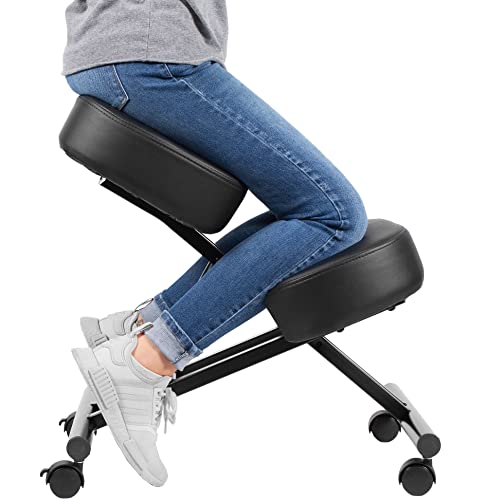 DRAGONN by VIVO Ergonomic Kneeling Chair for Home26.2D x 18.7W x 8H in26.2 x 18.7 x 8 inches18.4 poundsCheck on Amazon
 Kneeling Chair with Backrest Ergonomic Adjustable Office Kneel24.6x18.3x34 inches22.5 x 18.3 x 40.5 inches22.27 PoundsCheck on Amazon

Quick picks by situation
- Best overall for posture experimentation: Varier Variable Balans, a well-known fixed-frame design with a balanced forward tilt and replaceable-style upholstery components.
- Best for moving around a workstation: An adjustable kneeling chair with locking casters, provided the wheels can be locked before you settle into a typing position.
- Best for a tight budget: A basic steel-frame kneeling chair with a fixed angle and at least 3-inch foam cushions. Expect fewer adjustment options and faster cushion wear.
- Best for alternating between sitting positions: A height-adjustable model with a separate knee platform, rather than a compact one-piece chair with a fixed geometry.
- Best for a tall desk: A model with at least 3 inches of seat-height adjustment or a compatible desk that can be lowered. A kneeling chair that is too low can make your forearms angle upward toward the keyboard.
What makes a kneeling chair suitable for long sessions?
A kneeling chair shifts some body weight from the pelvis to the shins and changes the angle between your torso and thighs. The goal is not to force an extreme kneeling position. It is to create an open hip angle while keeping your shoulders relaxed and your elbows close to desk height.
For extended computer work, prioritize these characteristics:
- Seat angle: Approximately 20–25° forward tilt is a useful starting range. A steeper angle can encourage an upright torso but may increase pressure on the shins or make sliding forward more likely.
- Separate knee support: Two independently padded knee bars usually allow more positioning freedom than one narrow pad.
- Firm, resilient padding: Very soft foam feels comfortable initially but can compress under the knees and create pressure points. Medium-firm foam, molded foam, or layered foam usually holds its shape better.
- Height adjustment: Look for a seat height range of about 18–24 inches, depending on the design. The correct setting matters more than having the maximum number of adjustment holes.
- Stable base: A broad wooden or steel frame is preferable for a fixed chair. Casters are useful in some offices but can undermine stability if they do not lock.
- Weight capacity: Choose a rated capacity at least 25–50 pounds above your body weight. That margin accounts for shifting, leaning, and everyday mechanical stress.
Head-to-head comparison of the main designs
| Design | Typical seat angle | Typical height range | Typical weight rating | Casters | Best use |
|---|---|---|---|---|---|
| Fixed wooden kneeling chair | 20–25° | 16–20 in. | 220–265 lb | Usually no | Stable, focused desk work |
| Adjustable steel-frame chair | 15–30° | 18–24 in. | 250–330 lb | Optional | Shared workstations and varied users |
| Rolling kneeling chair | 15–25° | 18–23 in. | 220–300 lb | Usually included | Short movements around a desk |
| Compact budget chair | 20–25° | 17–20 in. | 200–250 lb | Sometimes | Occasional use and smaller rooms |
| Rocking kneeling chair | Variable with movement | Usually 17–21 in. | 220–265 lb | No | Users who dislike a completely fixed posture |
These are typical market specifications rather than a guarantee for every model. Always verify the manufacturer’s current dimensions, capacity, and adjustment method before ordering. A chair rated for 250 pounds, for example, is a poor choice for a 235-pound user who expects to lean heavily into the desk.
Seat angle, knee pressure, and comfort
Seat angle is the most important difference between kneeling chairs. A shallow angle keeps the chair closer to a conventional seat and may be easier to adapt to. A steeper angle brings the hips higher relative to the knees and can make upright sitting feel more natural, but it also increases the need for good shin padding.
Padding should support the shins without concentrating pressure on a small strip just below the kneecap. A knee cushion around 12–16 inches wide is generally easier to use than a very narrow pad, especially if you change leg position during the day. Thickness alone is not a quality measure: 2.5 inches of dense foam may remain supportive longer than 4 inches of low-density foam.
If you are new to kneeling chairs, begin with 20–30 minutes at a time. Alternate with a conventional chair rather than trying to work a full day immediately. Stop using the chair if you develop persistent pain, numbness, tingling, or unusual swelling, and consult a qualified health professional for individualized advice.
Desk compatibility: measure before buying
Many disappointing purchases are caused by the desk rather than the chair. Measure from the floor to the underside of the desktop, not just to the top surface. Then check whether your thighs, forearms, and keyboard can fit without raising your shoulders.
- Standard fixed desk: A 28–30-inch desktop often works with a low kneeling chair, but your keyboard may still be too high if the chair places your elbows below the desk.
- Height-adjustable desk: The easiest pairing. Lower the desk until your elbows are approximately level with the keyboard and your shoulders are relaxed.
- Keyboard tray: Useful when the desktop cannot be lowered, but confirm that the tray does not collide with the chair frame or your knees.
- Monitor height: When your seat position changes, your eye level changes too. A monitor arm or riser can prevent you from bending your neck toward the screen.
- Under-desk clearance: Allow at least 24 inches of usable width for the chair and enough depth for the knee platform to avoid striking the desk pedestal.
Decision matrix: which type fits your situation?
| Your situation | Recommended choice | Why | Trade-off |
|---|---|---|---|
| Using it 1–2 hours per day | Basic fixed-frame model | Lower cost and fewer parts to maintain | Less flexibility if the angle does not suit you |
| Using it 6+ hours with position changes | Adjustable model with separate knee pads | More control over angle, height, and pressure | Usually larger and more expensive |
| Small office or shared room | Compact fixed model or lockable rolling model | Easier to store or move | Compact frames may provide less legroom |
| Multiple users | Tool-free height-adjustable model | Fast changes without removing hardware | More mechanisms can loosen over time |
| Above-average body weight | Steel-frame model rated at least 300 lb | Provides a useful capacity margin | Often heavier and less portable |
Casters: useful feature or stability problem?
Casters make it easier to pull the chair toward a desk, reach a filing cabinet, or change position during a meeting. They are less useful when you need a firmly planted base for typing. Prioritize locking casters, wide wheels, and a five-point base if you choose a rolling model. Small hard wheels can catch on carpet edges and may let the chair drift while you type.
For a stationary workstation, a non-rolling frame is usually the safer default. If you want movement, a rocking base can provide controlled motion without allowing the entire chair to roll away from the desk.
Durability and ownership costs
The first parts to show wear are usually the knee cushion cover, foam edges, caster wheels, and adjustment hardware. Upholstery near the front edge receives repeated friction from clothing and may flatten before the seat cushion does. Check whether replacement covers or cushions are available before buying a budget model; a slightly higher purchase price can be worthwhile if it extends the usable life.
General market pricing ranges from roughly $60–$120 for simple budget chairs, $120–$250 for better-adjusted steel or rolling models, and $300–$600 or more for premium designs such as the Varier Variable Balans. These are broad ranges because upholstery, shipping, adjustment systems, and regional pricing vary.
For maintenance, tighten frame bolts after the first few weeks and then every few months, vacuum fabric seams, wipe vinyl with a lightly damp cloth, and keep caster axles free of hair and thread. Do not soak foam cushions or use harsh solvents on upholstery. A common mistake is tightening every adjustment as much as possible; over-tightening can damage threads and make future height changes difficult.
How to set up a kneeling chair
- Set the seat so your hips are slightly higher than your knees, without feeling as though you are sliding forward.
- Place the shins on the padded support with pressure distributed across the lower legs, not directly on the kneecaps.
- Lower or raise the desk until your elbows are near 90 degrees while typing and your shoulders remain relaxed.
- Position the monitor so you can view it without leaning your head forward.
- Start with short sessions and change position regularly. A kneeling chair is a posture option, not a reason to stay motionless.
For most buyers, the best kneeling chairs are not the ones with the softest cushions or the most dramatic forward tilt. Choose the model that fits your desk, supports your weight with margin, lets you adjust the seat to your body, and makes it easy to alternate positions throughout the workday.