What's inside
As an Amazon Associate I earn from qualifying purchases. This post may contain affiliate links at no extra cost to you.
Plaster walls can hold heavy loads, but they punish rushed drilling. The hard surface may chip, the plaster can crumble behind the paint, and a hollow cavity or wood lath may change which anchor works. The best anchor depends on the wall construction, the load, and whether you can hit a stud.
As an Amazon Associate we earn from qualifying purchases at no extra cost to you.

What we cover
Check the Wall Before Buying Anchors
Most older plaster walls are not the same as modern drywall. Plaster may be spread over wood lath, metal lath, or a masonry backing. The surface is harder than drywall, but it is also more brittle. A drill bit that catches suddenly can create a crater around the hole.
First, use a stud finder and confirm likely stud locations with a small test hole. If you can fasten into a wood stud, do that instead of relying on a hollow-wall anchor. A properly sized wood screw driven at least 1 1/2 inches into solid framing is usually stronger and less likely to damage the wall.
Use a cable detector or inspect the area before drilling. Avoid locations directly above or below outlets and switches unless you know where the wiring runs. Keep holes at least several inches from existing cracks, loose plaster, and corners, where the surface is more likely to break away.
Best Anchors for Plaster Walls
| Anchor type | Best use | Main advantage | Main weakness |
|---|---|---|---|
| Wood screw into stud | Heavy shelves, cabinets, TVs | Highest reliable strength | Requires accurate stud location |
| Plastic expansion plug | Light loads in solid plaster or masonry | Cheap and easy to remove | Unreliable in crumbly hollow cavities |
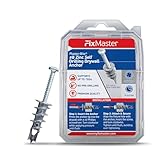
| Self-drilling drywall anchor | Light items in relatively sound plaster | Fast installation | Can crack plaster or spin in weak material |
| Threaded hollow-wall anchor | Medium loads with a cavity behind plaster | Strong clamping action | Needs a larger, clean hole |
| Toggle bolt | Heavy loads where no stud is available | Excellent pull-out resistance | Large hole and difficult removal |
For light objects such as small frames, smoke alarms, and cable clips, a small plastic expansion plug can be adequate when the plaster is sound and there is solid backing. Choose a plug matched to the screw diameter, not simply the largest one that fits the package. A 1/4-inch or 6 mm plug is often enough for a light load, while larger plugs are not automatically safer if the surrounding plaster is weak.
For medium loads, such as curtain brackets, towel bars, and small shelves, use a hollow-wall anchor that spreads behind the wall. Metal hollow-wall anchors generally grip more consistently than cheap plastic versions, but they still require careful installation. A metal hollow-wall anchor kit is a useful choice when there is no stud and the cavity is accessible.
Toggle bolts provide the best capacity in a hollow wall, especially for brackets that experience pulling or repeated movement. They are suitable for heavier shelves and grab-bar-like loads only when the plaster and lath around the hole are sound. A toggle does not repair weak plaster. If the surface crumbles while drilling, move to a stud or repair the area first.
When Plastic Anchors Are Enough
Plastic expansion plugs are the cheaper option, and they are perfectly reasonable for light, static loads. Use them for objects under roughly 10 to 15 pounds per anchor when the hole is tight and the plaster does not flex. Do not use them for a shelf that will be repeatedly loaded, a coat hook in a busy hallway, or anything that could injure someone if it falls.
Self-drilling anchors are convenient in drywall but are not my first choice for old plaster. Their sharp threads can wedge against hard material and chip the face. They also tend to spin if they encounter a void or loose lath. If you use one, choose a metal version, keep the load modest, and drill a small pilot hole rather than forcing the anchor through the surface.
How to Drill Without Cracking Plaster
Mark the hole with painter’s tape. The tape supports the paint film and makes it easier to see whether the bit is wandering. Start with a small masonry or carbide-tipped bit, around 1/8 inch or 3 mm, and drill slowly. Use normal drill mode—not hammer mode—for the plaster face.
A carbide-tipped masonry bit set works well for plaster and brick-like backing. Keep the drill square to the wall and use light pressure. Let the bit cut instead of leaning hard on the tool. Hammer action can speed up drilling in masonry, but it often causes edge blowout in plaster, especially near the final part of the hole.
Once the bit passes through the plaster, stop and check what it encountered. Wood resistance suggests lath or a stud. A hollow cavity calls for a hollow-wall anchor. Dense, continuous resistance may indicate masonry, in which case a masonry plug and screw are appropriate. If you hit metal, do not keep forcing the bit; it may be metal lath, conduit, or protective wiring plate.
Install the Anchor and Test It
Drill only as deep as necessary and vacuum the dust instead of blowing it into the room. The hole should be clean but not oversized. If the anchor slides in with no resistance, the hole is too large or the plaster is too soft. Move the anchor, use a larger design only if the surrounding wall is solid, or fasten into framing.
For a toggle bolt, the folded wings must pass completely through the wall before they open. Do not overtighten the screw; excessive torque can crush plaster between the bracket and the toggle. Tighten until the bracket is firm, then stop. A toggle bolt assortment gives useful options for different wall thicknesses and screw sizes.
After installation, apply a gradual hand load before hanging the object. Pull down and slightly outward on the bracket. Watch for movement, fresh cracks, or a widening hole. If the wall moves, the anchor is not adequately supported, regardless of its printed weight rating. For anything heavy, valuable, or safety-critical, locate framing or open the wall and add proper blocking rather than trusting a surface anchor.