What's inside
As an Amazon Associate I earn from qualifying purchases. This post may contain affiliate links at no extra cost to you.
Building a deck with structural screws is one of the jobs where an impact driver earns its keep. It drives long fasteners quickly, fits between joists and framing members, and usually handles repetitive work with less wrist strain than a drill. The right choice depends less on headline torque than on screw diameter, length, access, and how many fasteners you plan to install.
As an Amazon Associate we earn from qualifying purchases at no extra cost to you.


What we cover
What Makes an Impact Driver Good for Deck Building?
For most deck framing, a cordless impact driver with a brushless motor, a 1/4-inch hex chuck, variable-speed control, and at least two speed or power settings is the best starting point. Brushless tools generally run cooler and deliver more work per battery charge, which matters when driving hundreds of screws.
Structural screws are not ordinary deck screws. A 4-inch or 6-inch structural fastener can require substantially more force, especially when driven into pressure-treated lumber, dense hardwood, or a doubled beam. You should also use the manufacturer’s specified bit and installation method. Some fasteners are designed for direct driving; others require a clearance or pilot hole.
A compact impact driver is often enough for ledger boards, joist hangers, blocking, and most 3/8-inch structural screws. A stronger mid-torque tool is a better choice for repeated 1/2-inch fasteners, long screws, or dense framing. A high-torque impact wrench is usually unnecessary for normal deck screws and is easier to overdrive or damage the connection with.
Best Impact Driver Types for Structural Screws
| Tool type | Best use | Advantages | Limitations |
|---|---|---|---|
| Compact 12V impact driver | Light framing, hardware, and confined spaces | Small, light, easy to control | Slower with long or large structural screws |
| Compact 18V/20V impact driver | Most deck framing and general fastening | Good balance of power, size, and runtime | May need slower driving on the largest screws |
| Mid-torque 18V/20V impact driver | Long screws, doubled beams, and high-volume work | More reserve power and less stalling | Heavier and easier to overdrive fasteners |
| High-torque impact wrench | Large bolts and heavy construction hardware | Very high output | Too aggressive for many structural screws; different drive and accessories |
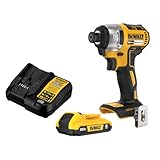
For a homeowner building one deck, a brushless 18V or 20V compact impact driver kit is usually the sensible purchase. It provides enough power for common structural fasteners without the bulk of a larger tool. Buy into a battery platform you already own when possible; the bare tool is much cheaper than starting a second battery system.
Power, Torque, and Speed
Manufacturers advertise torque in inch-pounds, but those numbers do not translate directly into driving performance. Chuck design, control electronics, battery condition, bit fit, and the wood itself all matter. A tool rated around 1,500 to 2,000 inch-pounds is generally comfortable with common deck framing screws. More output is useful, but it is not automatically better.
Use the lowest power setting that drives the fastener fully. High speed is useful for short screws, while a slower setting gives better control on 4-inch and longer screws. If the tool has a trigger with a broad speed range, feather it during the final part of the drive. The impact mechanism should do the work; pressing harder after the head is seated only increases the chance of stripping, snapping, or overdriving.
For large structural screws, consider a mid-torque brushless impact driver. The extra power is worthwhile when you are building a large platform or installing hundreds of fasteners. It is less attractive for occasional repairs, where the lighter compact tool is easier to carry on a ladder and less tiring overhead.
Battery Size and Runtime
A 2.0Ah battery keeps the tool light for ladder work and short fastening sessions. A 4.0Ah or 5.0Ah pack is usually the better choice for deck framing because it reduces interruptions and maintains performance under load. Large batteries add weight, however, and can make a compact driver feel top-heavy.
Plan on having at least two batteries if you are assembling a full deck. One can charge while the other is in use. Heat is a warning sign: if the battery or tool becomes uncomfortably hot, stop and let it cool. Repeatedly forcing a stalled driver drains batteries quickly and can shorten tool life.
Bits and Fastener Fit Matter
Structural screws commonly use Torx or another star-drive recess. Use impact-rated bits that match the fastener exactly. A worn bit causes cam-out, damages the recess, and makes the driver appear weaker than it is. Keep several fresh bits available; changing a bit after it starts slipping is cheaper than fighting a damaged screw.
A set of impact-rated Torx bits is a practical accessory purchase. Magnetic bit holders can help with long screws, but they also add length and wobble. For ledger connections or other critical joints, follow the screw maker’s instructions for bit type, washer use, spacing, and required embedment.
Common Failures and Buying Advice
Stripped heads usually come from a mismatched or worn bit, an angled driver, or excessive speed. Split framing often results from placing screws too close to an edge or skipping a pilot hole where one is recommended. A screw that spins without advancing may have broken through a void, hit a knot, or lost its threads. Back it out, inspect the hole, and use the specified replacement method rather than simply driving another screw beside it.
Look for a comfortable grip, a bright work light, a belt hook, and a short head length. These features matter more on a deck than an extreme torque claim. If you already have a compatible battery system, the bare-tool brushless impact driver is often the cheapest option. For one small deck or occasional maintenance, a less expensive brushed model can be perfectly adequate, provided it accepts impact-rated bits and has enough power for the specified fasteners.