What's inside
As an Amazon Associate I earn from qualifying purchases. This post may contain affiliate links at no extra cost to you.
What we cover
What an impact driver needs to do
Ledger screws are structural fasteners, not ordinary deck screws. They are often 1/4- or 5/16-inch diameter and several inches long, driven through a ledger board and into framing or masonry. The right driver should seat the screw without stripping its head, overheating, or driving it so hard that the screw or wood fails.
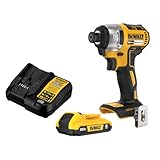
A cordless impact driver is a practical choice for wood framing because its pulsing rotation handles long screws with less wrist torque than a drill. Look for a 1/4-inch hex chuck, variable-speed trigger, and a low-speed or assist mode. A compact 18V/20V-class tool is generally enough for common ledger screws; battery size and control matter more than the highest advertised torque figure.
As an Amazon Associate we earn from qualifying purchases at no extra cost to you.



Impact driver or drill?
Use an impact driver for repetitive fastening into sound wood, especially when installing multiple screws. Its hammering action helps keep the bit turning under load, but it can make it harder to feel when a screw is seated. That lack of feedback is the main risk: keep the tool straight, start slowly, and stop as the head reaches the washer or specified seating depth.
A drill/driver is a better choice when the fastener manufacturer calls for a pilot hole, when working near a board edge, or when you need precise control. A hammer drill is not a substitute for an impact driver in wood; its hammer action is designed for drilling into masonry. For concrete or brick, follow the fastener maker’s instructions and use the specified anchor system rather than assuming a ledger screw can be driven directly into the material.
What to buy
For a one-off repair, an inexpensive cordless impact driver with a variable-speed trigger can be adequate. For a full deck ledger, choose a kit with at least two batteries or a fast charger so the work does not stop when one pack runs down. A 2.0Ah battery is lighter and usually fine for intermittent use; a 4.0Ah pack lasts longer but adds weight. If the tool will also be used overhead or in tight spaces, a compact body and a comfortable grip are useful advantages.
Compare a cordless impact driver kit with a drill/driver if you do not already own a compatible battery platform. Buying a bare tool only makes sense when you already have batteries and a charger in that system.
Impact driver features compared
| Option | Best for | Trade-off |
|---|---|---|
| Basic impact driver | Occasional ledger screws in wood | Less refined control; use a light trigger touch |
| Driver with low-speed or assist mode | Seating fasteners consistently | Costs more; modes still require a test drive |
| Drill/driver | Pilot holes and careful work near edges | More wrist reaction under heavy load |
| Impact wrench | Large sockets and heavy bolting | Usually unnecessary and too bulky for typical ledger screws |
Do not choose a tool based only on a maximum torque number. Manufacturers test and report torque differently, and a powerful driver can still damage a screw head if the bit does not fit or the user keeps driving after seating.
Choose the right bit and fastener
Use the drive bit specified for the screw—often a Torx-style bit—and keep a spare nearby. A worn or undersized bit cams out, rounds the recess, and can leave a screw stuck partway in. Seat the bit fully before starting. If the fastener maker supplies a bit, use it; otherwise buy a correctly sized impact-rated bit. A set of impact-rated bits is useful for replacement, but more bits do not compensate for the wrong size.
Follow the screw manufacturer’s requirements for length, spacing, edge distance, and pilot holes. Ledger connections are structural; do not substitute generic construction screws or assume that a longer fastener is automatically stronger. Where the instructions call for a pilot hole, drill it with the specified diameter and depth. Skipping that step near an edge can split the framing, while an oversized hole can reduce holding power.
Driving technique that prevents failures
Mark the layout and verify that each screw will hit the intended joist or framing member. Hold the driver in line with the screw, begin at low speed, and increase pressure only after the threads have started. Keep steady inward pressure so the bit stays engaged. Stop when the head is seated as directed; burying it too deeply can crush the ledger surface or damage the fastener.
If a screw stalls, spins without advancing, or begins to strip, stop rather than leaning harder on the trigger. Back it out if possible, inspect the bit and hole, and check for a knot, misalignment, or the wrong pilot-hole size. A screw that will not seat cleanly should not be treated as a sound connection. Replace damaged fasteners with the specified type and location, not by adding an arbitrary screw nearby.
For longer work, a cordless drill/driver can handle pilot holes while the impact driver handles fastening. That two-tool setup is faster and gives better control than changing bits constantly, but it is not essential for a small repair.
Make the purchase fit the job
For a typical wood ledger installation, buy a variable-speed impact driver with a compatible battery, a sound bit that matches the screw, and enough battery capacity for the planned work. A basic kit is fine for occasional use; extra modes and a larger battery are worthwhile mainly when you drive many fasteners or need more control. Check the fastener instructions before drilling or driving, and treat any stripped, split, or improperly seated screw as a reason to stop and correct the connection.