What's inside
As an Amazon Associate I earn from qualifying purchases. This post may contain affiliate links at no extra cost to you.
Soft brick and mortar are easy to damage with the wrong bit. A large hammer drill bit can blow out the back of a brick, widen a hole, or turn a sound mortar joint into loose grit. For common home jobs—hanging a light fixture, fitting a small wall anchor, or running a cable—the best bit is usually a sharp carbide-tipped masonry bit used with a steady drill and modest pressure.
As an Amazon Associate we earn from qualifying purchases at no extra cost to you.


What we cover
Choose the bit for the material
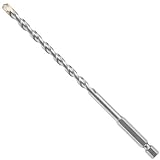
Masonry bits have a carbide tip, often brazed onto a steel body. That tip cuts brick, mortar, and concrete; the spiral flutes carry dust out of the hole. For soft brick and mortar, a standard two-cutter carbide bit is usually enough. A four-cutter bit is more useful in hard concrete or when drilling near reinforcing bar, but it costs more and may be unnecessary for a few small holes.
Start with the anchor manufacturer’s stated hole diameter. A common small wall plug may call for a 6 mm (about 1/4-inch) hole, but sizes vary, so do not assume. The bit should match the specified diameter, not the screw’s diameter. For a small job, a basic carbide-tipped masonry bit set is a sensible buy. Check that the set includes the exact sizes you need; very cheap sets sometimes skip common metric or fractional sizes.
Compare the main bit types
| Bit type | Best use | Trade-off |
|---|---|---|
| Standard carbide masonry bit | A few holes in soft brick or mortar with a regular drill or hammer drill | Can wander on a smooth surface; wears faster in hard concrete |
| Four-cutter carbide bit | Frequent drilling, harder masonry, or cleaner holes near embedded metal | Higher cost; more bit than most soft-brick jobs require |
| SDS-Plus bit | Hammer drilling with an SDS rotary hammer | Does not fit a conventional drill chuck; can be aggressive in fragile brick |
For a cordless drill with a standard chuck, buy a round-shank bit. For an SDS-Plus rotary hammer, buy an SDS-Plus bit; it will not clamp properly in a normal three-jaw chuck. A four-cutter masonry bit is worth considering if you drill regularly, but it is not a cure for using too much force or the wrong mode.
Use the right drill and mode
A regular cordless drill can handle soft brick and mortar with a sharp bit, especially for holes around 6 mm (1/4 inch) or smaller. Use the drill setting, not the screw-driving clutch setting. If progress is very slow, a hammer drill can help: its pulsing action breaks material ahead of the cutting edges. Begin without hammer action in soft brick, then switch it on only if the bit stalls or takes too long.
Hammer action is not automatically better. In crumbly brick it can make an oversized, ragged hole that will not hold an anchor. A rotary hammer with an SDS bit is powerful but often excessive for small fixings in soft masonry. If the hole is for a light load and the brick is fragile, slow rotary drilling is the safer starting point.
Drill a clean, usable hole
First check for wires and pipes, and avoid drilling near switches, outlets, or plumbing unless you know what is behind the wall. Mark the hole, hold the drill square, and start slowly so the tip does not skate. A small starter dimple made with a nail or punch can help, but do not strike a brick hard enough to crack it.
Use moderate pressure and let the bit cut. Pull it out every few seconds to clear dust, especially in deeper holes. For an anchor, drill slightly deeper than the plug—about 5 to 10 mm (roughly 3/16 to 3/8 inch)—so dust or the screw tip does not stop it seating. Vacuum or brush out the hole before fitting the anchor. Wear eye protection; masonry dust and flying chips are common failure hazards, not rare exceptions.
Mortar is often easier to drill than brick and can be a good fixing location for light loads because it is less likely to split the brick face. But old or sandy mortar may crumble and provide poor holding strength. For a heavy shelf, gate, or safety-critical fixing, do not rely on a loose mortar joint: choose sound brick or consult the anchor instructions for the required substrate and load.
Common problems and fixes
If the bit spins without advancing, it may be dull, clogged with dust, or in a drill mode that is too gentle for the material. Clear the flutes and try hammer mode if the brick is sound. If the hole comes out too wide, reduce pressure, switch hammer action off, and check that the bit is not bent. A loose anchor in an oversized hole is not fixed by forcing in a larger screw; use the correct anchor for the hole or move to sound material.
Heat can soften the braze holding a carbide tip, so do not lean hard on the drill or run the bit continuously for a long stretch. If the tip is chipped, the bit wanders, or drilling suddenly becomes much slower, replace it. For one or two small holes, a modestly priced bit is fine. If you are drilling many holes or repeatedly working in hard masonry, buy a better-rated carbide bit in the sizes you use most rather than replacing a bargain set every few jobs.