Our Top Picks


What's inside
As an Amazon Associate I earn from qualifying purchases. This post may contain affiliate links at no extra cost to you.
For most people drilling thin metal, the best overall pick here is the IRONANT spiral-flute titanium set: five spiral-grooved bits that together cover 50 hole sizes, which means you rarely have to hunt for a bit in the right range. If you only need a handful of common sizes, the single ten-step bits from ZELCAN and Anfrere are the simpler, lighter options. A step drill bit (also called a unibit) is a cone-shaped bit with stepped diameters, so one bit drills, enlarges and deburrs holes in sheet metal without swapping bits.
What we cover
Quick List
- ZELCAN 10-Step Titanium Bit – best for a single, compact bit that covers common conduit and grommet sizes
- COMOWARE 5-Piece Set with Center Punch – best for beginners who want a punch to start holes accurately
- IRONANT Spiral-Flute 5-Piece Set – best overall for variety and chip clearing in thin steel and aluminum
- ZELCAN 5-Piece 50-Size Set – best for the widest size range, starting from small 1/8 inch holes
- M2 4-Flute AlTiN 5-Piece Set – best for drill drivers and impact drivers that want a sturdier shank
- Anfrere 10-Step Bit – best as a spare bit in the tool bag for occasional sheet-metal jobs
Which One Is Right for You?
| If you… | Choose |
|---|---|
| want the most sizes and a cutting design that clears chips well | IRONANT Spiral-Flute 5-Piece Set |
| need very small starter holes from 1/8 inch up | ZELCAN 5-Piece 50-Size Set |
| are new to step bits and tend to wander off the mark | COMOWARE 5-Piece Set with Center Punch |
| run a drill driver or impact driver and want a larger shank | M2 4-Flute AlTiN 5-Piece Set |
| only drill the occasional electrical box or license-plate hole | ZELCAN 10-Step Titanium Bit |
| want one extra bit to keep in a vehicle or toolbox | Anfrere 10-Step Bit |
Two choices matter most: how many different hole sizes you drill, and how you power the bit. A single ten-step bit is plenty for a weekend of electrical or automotive work, while a multi-bit set pays off when you drill many different diameters or work in thicker stock. Cordless drivers are fine for sheet metal as long as you control speed and keep the bit lubricated.
All 6 Picks in Detail
1. ZELCAN 10-Step Titanium Bit – Best for a Compact Single-Bit Solution
As an Amazon Associate we earn from qualifying purchases at no extra cost to you.
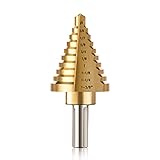
This is a single high-speed steel step bit with a titanium finish and ten step sizes running from 1/4 inch to 1-3/8 inches. It suits homeowners, hobbyists and electricians who punch holes in sheet metal for conduit fittings, cable glands, switches or ventilation. Because it is one bit, it takes up almost no room in a tool pouch, and a single bit means one shank, one tool and one thing to keep sharp.
Typical jobs for a bit like this include enlarging a knockout in an electrical panel, adding a grommet hole to a steel or aluminum shelf, opening a vent in a sheet-metal duct, or mounting hardware on a thin bracket. Keep in mind that one bit has one set of steps, so check that the diameters you use most appear on the cone before you commit to it.
- Ten step diameters, 1/4 inch to 1-3/8 inches
- High-speed steel body with a titanium finish
- Cone profile designed for sheet metal drilling and deburring
- Shank style and exact step increments: confirm on the product page
- Sold as a single bit per the listing name
Pros:
- Covers the most common hole sizes with one bit
- Light and easy to store
Cons:
- Cannot drill below 1/4 inch
- No spare if a step wears out
Compared with the Anfrere ten-step bit, the size range is identical, so choose between them on shank style and finish; compared with the multi-bit sets, you give up small starter sizes and variety in exchange for simplicity.
2. COMOWARE 5-Piece Set with Center Punch – Best for Beginners Who Need Accurate Starts

This titanium-coated high-speed steel set bundles five step bits with a center punch, and the listing describes two flutes and a tri-shank design with a range of 3/16 inch to 1-3/8 inches. A center punch is the part many beginners overlook: a small dimple at the hole location keeps the point from skating across smooth metal. If you have never used a step bit, having the punch in the box removes one common source of crooked holes.
To get the most from a set like this, set the bit on the punched dimple, start the drill slowly and let the first step bite before you increase speed. The tri-shank means you can chuck it in most standard drills without it spinning free, but still tighten the chuck firmly and recheck after the first hole.
- Five step bits covering 3/16 inch to 1-3/8 inches
- Titanium-coated HSS, two-flute design
- Tri-shank (three-flat) shank that resists slipping in a chuck
- Center punch included
- Number of sizes per bit and storage case: confirm on the product page
Pros:
- Punch included for accurate starts
- Tri-shank grips firmly in a standard chuck
Cons:
- Two-flute design can load up with chips in softer metals if you do not back out
- Smallest size is larger than the 1/8 inch starters in other sets
Next to the ZELCAN 50-size set, you trade the smallest sizes for the included punch and a simpler, more beginner-friendly kit.
3. IRONANT Spiral-Flute 5-Piece Set – Best Overall for Variety and Chip Control

The IRONANT kit is a five-bit set of spiral-flute step bits in titanium-aluminum-nitride (TiAlN) coated high-speed steel, offering 50 sizes across the five bits. Spiral flutes move chips up and away from the cut, which helps when you are drilling thicker or tougher sheet and want a cleaner hole. It suits the person who drills metal regularly and would rather own one set that handles nearly any job in thin stock.
Because the listing describes 50 sizes spread over five bits, you can treat the set like a graduated reamer: pick the bit whose range includes your target diameter and stop at the right step. Remember that spiral flutes cut aggressively, so clamp thin panels flat against a wooden backer to prevent them from lifting and spinning with the bit.
- Five bits, 50 sizes in total per the listing
- Spiral-groove flute design for chip evacuation
- TiAlN-coated high-speed steel
- Overall size range and carrying case: confirm on the product page
- Marketed as a unibit-style set for metal
Pros:
- Spiral flutes help clear chips
- Wide size coverage in one kit
Cons:
- Spiral edges can grab on very thin, unsupported sheet
- More bits to keep track of than a single-bit option
Against the M2 4-flute set, it has the same five-bit idea but a different cutting geometry, so the deciding factor is whether you want the extra shank strength of the M2 listing.
4. ZELCAN 5-Piece 50-Size Set – Best for the Widest Size Range

Here five titanium HSS step bits cover 50 sizes from 1/8 inch to 1-3/8 inches. The small starting size is the headline: 1/8 inch pilot holes are useful for sheet-metal screws, small rivets, wiring pass-throughs and for starting a larger hole in thicker material. If your work includes small electronics enclosures, hobby projects or automotive trim, this range is more useful than sets starting at 1/4 inch.
A set that begins at 1/8 inch is handy for the awkward in-between jobs: pilot holes for self-tapping screws, small holes for status lights and switches in an enclosure, and fine adjustments to an existing hole that is just slightly too small. The trade-off is that you will carry five bits and should keep them in order, so a case that holds each bit in a labeled slot is worth confirming on the product page.
- Five step bits, 50 sizes total
- 1/8 inch to 1-3/8 inches overall range
- Titanium-coated high-speed steel
- Flute count, shank style and case: confirm on the product page
- Designed for metal and other thin materials per the listing
Pros:
- Smallest starting size of the sets in this list
- Many fine increments for precise hole sizing
Cons:
- More steps mean smaller increments, so each step cuts a thin slice
- Not intended for thick plate
Compared with the IRONANT set, the size count matches, but this one commits to a 1/8 inch start, so pick it when small pilot holes matter more than a spiral flute.
5. M2 4-Flute AlTiN 5-Piece Set – Best for Drill Drivers and Heavier Use

This five-piece set is described as M2 high-speed steel with a four-spiral-flute design, an AlTiN coating and an upgraded 3/8 inch shank for higher torque, with a 1/4 inch hex option mentioned in the listing. It covers 1/8 inch to 1-3/8 inches. The larger shank is aimed at users who drive bits with powerful drills, where a thin shank can slip or flex. It suits contractors and fabricators who put real load on their bits.
If your main tool is a cordless drill driver or an impact driver, shank compatibility matters as much as the cutting edge. Check which bits in the kit use the 3/8 inch shank and which use a 1/4 inch hex, and make sure your chuck or driver accepts them. As with any step bit, keep the speed down and use cutting oil to protect the coating.
- Five bits spanning 1/8 inch to 1-3/8 inches
- M2 high-speed steel with AlTiN coating
- Four spiral flutes
- 3/8 inch shank for higher torque, with a 1/4 inch hex mentioned in the listing; confirm which bits use which
- Exact step counts per bit: confirm on the product page
Pros:
- Larger shank suits higher-torque drills
- Four flutes spread the cutting load
Cons:
- A 3/8 inch shank will not fit every small chuck
- Four flutes can be grabby in very thin sheet
Against the IRONANT set, it is the sturdier-shank choice; against the ZELCAN 50-size set, it trades an assortment-focused pitch for a torque-focused one.
6. Anfrere 10-Step Bit – Best as a Spare for Occasional Jobs

The Anfrere is a single ten-step high-speed steel cone bit running from 1/4 inch to 1-3/8 inches for hole drilling and cutting in metal sheet. It fits the do-it-yourselfer who only needs to open up a hole now and then and wants a dedicated bit in the vehicle or garage. It does the job of several twist bits, and for sheet-metal projects it is quicker than swapping bits repeatedly.
It works best as a convenience tool: keep it with the drill you grab for quick repairs, such as adding a hole through a thin steel bracket or enlarging a hole in a metal enclosure to fit a connector. For regular daily use or thicker stock, a bit with a clearly stated coating and a heavier shank is a better long-term investment.
- Ten step sizes, 1/4 inch to 1-3/8 inches
- High-speed steel construction
- Cone bit for sheet-metal drilling and deburring
- Coating type and shank style: confirm on the product page
- Single bit per the listing name
Pros:
- Simple single-bit kit
- Covers common knockout-style sizes
Cons:
- Coating not stated in the listing name
- Limited range compared with 50-size sets
It is the closest match to the ZELCAN ten-step bit, so the choice between them comes down to the finish and shank details on each product page.
Specs Compared
| Product | Pieces | Size range | Material / coating | Flutes / design | Shank |
|---|---|---|---|---|---|
| ZELCAN 10-Step Titanium Bit | 1 bit, 10 sizes | 1/4 to 1-3/8 in | HSS, titanium | Cone step bit | Confirm on listing |
| COMOWARE 5-Piece Set | 5 bits plus center punch | 3/16 to 1-3/8 in | HSS, Ti-coated | 2 flutes | Tri-shank |
| IRONANT Spiral-Flute Set | 5 bits, 50 sizes | Confirm on listing | HSS, TiAlN | Spiral flute | Confirm on listing |
| ZELCAN 5-Piece 50-Size Set | 5 bits, 50 sizes | 1/8 to 1-3/8 in | HSS, titanium | Confirm on listing | Confirm on listing |
| M2 4-Flute AlTiN Set | 5 bits | 1/8 to 1-3/8 in | M2 HSS, AlTiN | 4 spiral flutes | 3/8 in; 1/4 in hex mentioned |
| Anfrere 10-Step Bit | 1 bit, 10 sizes | 1/4 to 1-3/8 in | HSS | Cone step bit | Confirm on listing |
How We Chose These
We built this guide from desk research rather than from using the bits. We compared manufacturer-style product descriptions and listing titles for size range, number of pieces, base steel, coating and shank type, then checked those against general guidance on drilling sheet metal with step bits. We favored sets that clearly state their range, that include features beginners benefit from, such as a center punch, and that cover different use cases, from a single compact bit to a full five-piece kit. Where a listing does not state a specification, we say so and ask you to confirm it on the product page. The picks are ordered by the products as listed, with the overall pick flagged in the opening paragraph.
What to Look For
Material and coating
Most step bits are high-speed steel (HSS), which holds an edge better than plain carbon steel when drilling sheet metal. M2 is a common HSS grade known for balanced toughness and wear resistance. On top of that, a coating reduces friction and heat. Titanium nitride (TiN) is the familiar gold finish; titanium aluminum nitride (TiAlN) and aluminum titanium nitride (AlTiN) are darker coatings generally chosen for higher heat resistance. A coating is a surface layer, so it wears off with abuse long before the steel underneath does. Do not assume a coated bit can be run dry: lubricant still matters.
Flute design: straight, two-flute or spiral
Classic unibit-style bits have a single straight flute. Two-flute designs cut more evenly and tend to stay centered. Spiral-flute designs, like the IRONANT and the four-flute M2, move chips out of the hole, which helps in thicker stock and tends to produce a cleaner exit edge. On very thin sheet, a spiral bit can grab and distort the metal if you push too hard, so ease off as the bit breaks through.
Size range and step increments
Think about the holes you actually drill. Electrical work often needs 1/2 inch, 3/4 inch and 1 inch holes for conduit connectors, while hobby projects may need pilot holes from 1/8 inch. Check both the minimum and maximum diameters and the step increment. Smaller increments (for example 1/32 inch) give you finer control but make each step shallow. A 50-size set across five bits averages ten sizes per bit, so the steps are small and each bit overlaps its neighbor.
Shank type and drill compatibility
A round shank can spin in the chuck under load. A three-flat tri-shank resists slipping in standard chucks, and a hex shank locks into impact drivers. Larger shanks, like the 3/8 inch on the M2 set, carry more torque but need a chuck that opens that wide. Match the shank to your tool before you buy.
Technique and a worked example
Step bits are meant for thin material, generally up to about 1/8 inch, and thinner for the larger steps. Use a variable-speed drill and keep the speed low: guidance for coated bits commonly falls between roughly 200 and 800 rpm, lower for stainless steel and higher for aluminum or mild steel. Clamp the work, mark the spot with a center punch, add cutting oil, and let the bit do the work with steady pressure. Back out regularly to clear chips.
Worked example: to open a 7/8 inch hole in an aluminum enclosure, punch the center, start with the smallest step, and drill until the cone reaches the 7/8 inch step. Stop there; the next step up would enlarge the hole. A rule of thumb is that if you smell hot metal or see the bit discolor, you are running too fast or without enough oil.
Deburring, hole quality and care
One advantage of a step bit is that each step leaves a slightly chamfered edge, so the hole often needs little or no deburring. Even so, run a finger-safe deburring tool or a larger twist bit over a sharp edge before you pass wire through, because a burr can cut insulation. After use, wipe the bit clean of oil and chips, store it in a dry case or sleeve, and avoid tossing it loose in a tool bucket where the steps can chip against other tools. A chipped step cuts rough and may bind, so treat the bit like a precision tool.
It also pays to match your power tool to the job. A corded or cordless drill with variable speed and a trigger that starts slowly gives the most control, whereas a drill that jumps straight to full speed can skate off the mark and heat the bit. If the work is large, a drill press with a clamped vise produces rounder holes than any handheld method, because the bit stays perpendicular to the panel from start to finish.
Safety while drilling metal
Wear safety glasses and snug-fitting gloves or none at all near a spinning bit, tie back loose clothing and clamp the workpiece so it cannot spin up and cut you. Metal edges and chips are sharp, so brush chips away with a tool rather than your hand. Let the bit cool before you touch it, and unplug a corded drill or remove the battery before changing bits.
Questions
Can step drill bits cut stainless steel?
Thin stainless can be drilled, but it work-hardens and heats quickly, so use low speed, firm steady pressure and plenty of cutting oil. Cobalt or well-coated bits are usually preferred for stainless; confirm the listing allows it.
How thick a metal can a step bit handle?
Step bits are designed for sheet metal, generally in the range of up to about 1/8 inch for the larger steps. For thicker plate, drill a pilot hole with a twist bit first or use a bit designed for heavy stock.
Do I need a center punch?
It helps, especially on smooth steel where the tip can skate. Some bits have a self-starting tip, but a small punch dimple keeps the hole exactly where you marked it.
Can I sharpen a step drill bit?
Straight-flute step bits are difficult to sharpen by hand because each step has its own cutting edge. Most users replace a dull bit, so protecting the edges with lubricant and correct speed is the better approach.
Should I use cutting oil with a coated bit?
Yes. A coating lowers friction but does not remove the need to cool and lubricate the cut. A few drops of cutting oil extend bit life and leave a cleaner hole.
Which is better, a single bit or a set?
A single ten-step bit covers the most common sizes for occasional use. A set is worth it if you want small pilot sizes, spare bits, or a specific shank for a driver.
Update History
- October 20, 2026 – Initial publication; product set drawn from current catalog listings.
- Check the product page for current specifications and availability before buying.
Sources
- Retailer listing titles and specification fields for each product named above
- General step-drill-bit usage guidance from tool retailers and woodworking and metalworking reference sites (speed, lubrication, thickness limits)