We research everything we recommend. When you buy through our links, we may earn a commission. As an Amazon Associate we earn from qualifying purchases.
Best Carbide Hole Saw Kits for Metal and Hard Stock
Compare the best carbide hole saw kits for stainless steel, sheet metal and nail-embedded wood, with sizes, cutting depths and arbor fit explained.
As an Amazon Associate I earn from qualifying purchases. This post may contain affiliate links at no extra cost to you.
⭐ Key Takeaways
Quick answer: Our top pick is Diablo Demo Demon Carbide Teeth Rough-In Hole Saw Set, 8-Piece, with Klein Tools 31873 Master Electrician's Hole Cutter Kit, 8-Piece as a strong alternative.
Quick answer: The best carbide hole saw kits pair tungsten carbide teeth with the size range your work needs: the Klein Tools 31873 kit for precise holes in stainless and mild steel sheet, the Diablo Demo Demon 8-piece set for large rough-in openings in nail-embedded wood, and the GSTK 26-piece set for the widest spread of metal-cutting sizes in one case. Carbide teeth hold an edge in hard, abrasive stock long after bi-metal teeth dull, but demand low speed, steady feed, and no hammer mode.
As an Amazon Associate, we earn from qualifying purchases.
A bi-metal hole saw carries high-speed steel teeth welded to a flexible steel cup: forgiving, versatile, and the reason bi-metal kits dominate general work. Its weakness is heat and hardness. Repeated holes in stainless steel, fiber cement, or nail-embedded lumber dull the teeth quickly, and once the edge goes, the saw rubs instead of cutting.
A carbide hole saw replaces those steel teeth with tungsten carbide tips brazed onto the cup rim, or, in one-piece metal cutters, machines the cutting head around carbide edges. Carbide is far harder than high-speed steel and keeps its edge at temperatures that would soften steel teeth. Maker documentation rates carbide-tipped saws for stainless steel, hard metals, fiber cement board, and wood with embedded nails.
Two families sit inside the carbide label. Deep-cup carbide saws, such as the Diablo set, work on an arbor and cut wood-based and abrasive materials more than 2 inches deep. Shallow TCT metal cutters, such as the Klein, GSTK, DECKRKAT, and YOSIGHT sets, are built for sheet metal, with cutting depth around 1 inch or less. Picking the right family matters more than the biggest piece count.
Carbide has limits worth stating plainly. The teeth are hard but brittle, so side-loading, twisting in the cut, or hammer mode can chip them. Most TCT makers warn against materials with a Mohs hardness of 6 or greater, and metal cutters carry a maximum stock thickness, often 3/16 inch for stainless sheet.
How to Choose
Start with the material, because it decides the family. For stainless steel, mild steel, iron, copper, or brass sheet, choose a TCT metal cutter kit and confirm the listing names your material and a thickness limit that covers your stock. For rough-in openings in lumber and nail-embedded wood, choose a deep-cup carbide set with the diameters your fittings need.
Match sizes to the job instead of counting pieces. Electrical and panel work clusters around 7/8, 1-1/8, 1-3/8, 1-3/4, 2, and 2-1/2 inches. Plumbing rough-in needs larger cups, from about 2-1/8 up past 4 inches. A 24-saw set that skips your one critical diameter is worse than a small set that includes it.
Check cutting depth against your thickest stock. Deep cups around 2-3/8 inches pass through doubled framing lumber in one run. Metal cutters at about 1 inch of depth are made for sheet and plate: the wrong tool for boring a beam, the right tool for an enclosure.
Look at the arbor or shank system. Arbor-based kits swap cups on one mandrel, and quick-change systems such as Diablo’s Snap-Lock Plus cut changeover time. One-piece TCT cutters skip the arbor and resist spinning in the chuck. Either way, confirm the pilot bits are replaceable, because the pilot wears and bends first. Premium kits publish fuller specifications than budget sets, and where a maker does not publish a figure, the Specs blocks below say so rather than fill it in.
Diablo’s Demo Demon set is the deep-cup entry here, built for rough-in work where the saw must survive lumber, plywood, and the nails hiding inside them. Where a bi-metal cup loses its edge on fasteners and abrasive board, carbide tips keep cutting, and the 2-3/8 inch cutting length passes through thick framing stock in one run. The eight pieces span 2-1/8 to 4-5/8 inches, covering common drain, vent, and duct openings, on Diablo’s Snap-Lock Plus mandrel system for tool-free changes.
2. Klein Tools 31873 Master Electrician’s Hole Cutter Kit, 8-Piece
Runner-Up
2. Klein Tools 31873 Master Electrician’s Hole Cutter Kit, 8-Piece
Model: 31873
Pieces: 8
Cutters: 6 carbide-tipped hole cutters
Cutter sizes: 7/8, 1-1/8, 1-3/8, 1-3/4, 2, and 2-1/2 in
Klein’s 31873 is the precision metal entry: six carbide-tipped hole cutters in the sizes electricians reach for, plus two pilot bits, in a rust-proof molded plastic case. Klein rates the cutters for quick, precise holes in stainless steel, mild steel, iron, copper, and brass sheet up to 3/16 inch thick, covering enclosures and panels where bi-metal teeth dull fastest. The size run, 7/8 through 2-1/2 inches, maps to conduit and pipe sizes from 1/2 to 2 inches, lining up with knockout-style work while cutting a true round hole with a finished edge. The one-piece cutters chuck straight into the drill, and the case keeps carbide edges from chipping against each other.
3. GSTK Upgraded 26-Piece Heavy Duty Carbide Hole Saw Set
3. GSTK Upgraded 26-Piece Heavy Duty Carbide Hole Saw Set
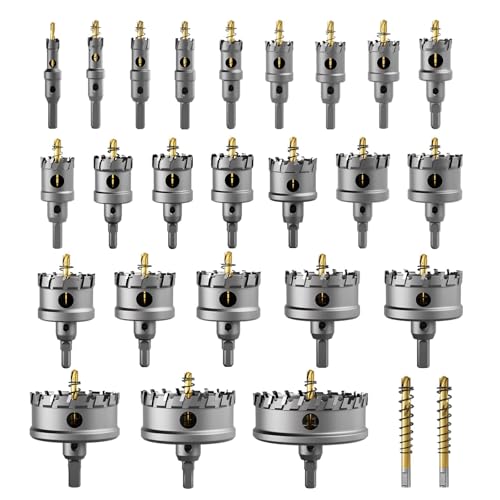
The GSTK set is the size-coverage play: 24 tungsten carbide tipped saws spanning 1/2 inch to 3-15/16 inches, plus two extra pilot center drills, for 26 pieces total. That range starts smaller and finishes larger than the Klein kit, suiting maintenance and fabrication work where the next hole size is hard to predict. The listing positions the cutters for stainless steel, iron, aluminum, and general metal work. Two notes come straight from the listing data: the spare pilot drills extend the kit’s useful life, because pilots are the highest-wear part; and GSTK does not publish a cutting depth figure in the listing data reviewed, so verify depth before relying on it for thick stock.
DECKRKAT’s set is a compact metal-cutting kit: seven tungsten carbide tipped saws from 3/4 inch (19 mm) to 2 inches (50 mm), with removable pilot bits and an Allen wrench bringing the count to nine pieces. The stated cutting depth is 1 inch, matching the sheet and light plate work these cutters are built for, and the listing names stainless steel, hard metals, plastic, and wood as working materials. The detachable pilot design matters at this tier: swapping a worn pilot instead of replacing the whole cutter keeps the set useful longer. The range tops out at 2 inches, covering small conduit, locksets, and panel holes rather than large rough-in openings.
The YOSIGHT kit is the budget metal option, a 9-piece carbide set built around triangular-shank cutters. The triangular shank gives the chuck three flat faces to grip, resisting the spinning round shanks can suffer when a carbide cutter bites into steel. The set includes a center drill and two L-wrenches for the set screws that lock the pilots, and the listing names metal, steel, iron, and alloy as target materials. One gap must be stated plainly: the individual saw sizes and cutting depth are not published in the listing data reviewed, so confirm the size list on the product page before ordering if you need one exact diameter.
Before You Buy: Fit and Compatibility Checks
Confirm the family matches the material first. Deep-cup carbide sets are for wood-based and abrasive materials; shallow TCT cutters are for sheet metal, and using a 1-inch-deep metal cutter in thick lumber, or a rough-in cup on stainless sheet, disappoints in both directions.
Check your drill. Carbide metal cutters want low speed, high torque, and steady feed, and they must never run in hammer mode, which can shatter the brazed teeth. A side handle helps on larger diameters, where a binding saw can twist the tool.
Verify the size list against your fittings, not the product title. Conduit, pipe, and lockset sizes follow their own conventions, and the hole a fitting needs is often one step off its nominal name. On sets that do not publish every diameter, confirm the exact list before ordering.
Plan for pilots and fluid. Replacement pilot bits keep a kit alive, and cutting fluid on steel and stainless extends tooth life. Included spares, such as the GSTK set’s extra center drills, are a genuine advantage.
FAQ
Can a carbide hole saw kit cut stainless steel?
Yes. The TCT metal cutter kits here list stainless steel among their rated materials. Stay within the stated thickness limit, run at low speed with firm, steady pressure, and use cutting fluid, because stainless work-hardens when a saw rubs instead of cuts.
What is the difference between carbide and bi-metal hole saws?
Bi-metal saws use high-speed steel teeth on a flexible steel cup: versatile and tolerant of rough handling, but the teeth dull quickly in stainless, abrasive board, and nail-embedded wood. Carbide saws use tungsten carbide teeth that hold an edge far longer in those materials, at the cost of being more brittle and less forgiving of twisting, side loads, and hammer mode.
Can I use a carbide hole saw in an impact driver or hammer drill?
Do not use hammer mode: TCT makers exclude it because hammering can chip or shatter carbide teeth. Use a standard drill or drill press in rotary mode, with a standard arbor for cup-style saws.
How deep can carbide hole saw kits cut?
It depends on the family. Deep-cup sets such as the Diablo reach a 2-3/8 inch cutting length. TCT metal cutters are shallow by design, around 1 inch on the DECKRKAT set, and the Klein cutters are rated by stock thickness instead, up to 3/16 inch of sheet.
Conclusion
Carbide hole saw kits earn their place when the material is the problem: stainless and hard sheet metal, abrasive board, and lumber full of nails. Choose the Klein Tools 31873 for fully specified, precise cuts in metal sheet up to 3/16 inch, the Diablo Demo Demon set for large, deep rough-in holes in wood-based stock, and the GSTK 26-piece set for the widest run of metal sizes in one box. The DECKRKAT and YOSIGHT sets bring the same carbide tooth advantage to smaller budgets and hole ranges, with the trade-off that fewer specifications are published. Match the family to the material, the sizes to your fittings, and the depth to your stock.
M
Miller the Driller Editorial Team
We compare specs, warranty terms, long-term owner feedback and street pricing before anything earns a spot. Rankings are never paid.
Affiliate disclosure. As an Amazon Associate we earn from qualifying purchases at no extra cost to you. Prices accurate as of the date shown.
Three wireless routers for small offices compared on device capacity, network separation, wired speed, and coverage, with specs taken from their Amazon listings.
Compare 5 mechanic tool sets for car repairs: a 247-piece DEWALT kit, a 450-piece CRAFTSMAN set, a drawer-box GEARWRENCH set, a 170-piece Crescent set and a 450-piece WORKPRO set.
Four splitting axes and mauls that actually split firewood: a long 36-inch axe for tall users, a shorter 28-inch option, and two 8 lb mauls for knotty rounds.
Learn whether a 20V rechargeable drill battery can be repaired, which faults you can check safely at home, and when replacing the pack is the safer choice.
A specs-based review of the officially licensed Retro-Bit Sega Saturn 2.4 GHz wireless controller: dual receivers, Genesis Mini and Switch support, battery, layout, limits, and FAQs.
Find the best drill battery for Power Wheels ride-on toys for families, with DeWalt, Milwaukee and Ryobi adapters, voltage and safety guidance in this guide.
Find the best hole saw for noching dom pipe: bi-metal saws, deep cups, and the right sizes for clean, tight notches in DOM tube for fabrication shops today.
Find the best diy tile saws for home tiling projects. Compare wet tile saws by blade size, cutting capacity, and features for ceramic and porcelain tile.


 4. DECKRKAT 9-Piece TCT Hole Saw Set
 5. YOSIGHT 9-Piece Carbide Hole Saw Kit









