We research everything we recommend. When you buy through our links, we may earn a commission. As an Amazon Associate we earn from qualifying purchases.
Best Pry Bars for Demolition, Renovations and Repairs
Compare the best pry bars for demolition, renovation and repair work, from wrecking bars and cat's paw pullers to capped striking bars and indexing heads.
Compare the best pry bars for demolition, renovation and repair work, from wrecking bars and cat's paw pullers to capped striking bars and indexing heads.
As an Amazon Associate I earn from qualifying purchases. This post may contain affiliate links at no extra cost to you.
⭐ Key Takeaways
Quick answer: Our top pick is Estwing Pro Claw Nail Puller, 9-Inch (PC210G), with Fiskars Pro IsoCore Demolition Wrecking Bar, 30-Inch (751410-1001) as a strong alternative.
Pry bars look simple, but the difference between a clean tear-out and a gouged, frustrating one usually comes down to having the right bar shape for the job. A long wrecking bar walks nailed framing apart with leverage alone, while a short cat’s paw digs out embedded nails without wrecking the wood around them. Renovators salvaging trim and flooring need thin, controlled bars; demolition crews need forged steel that tolerates hammer blows.
Before any prying starts, put on eye protection: nails under tension can pop free and fly, and splintered wood and masonry chips are hard on eyes. Work gloves help against splinters and sharp edges. When prying into walls, floors, or ceilings, assume hidden wiring and pipes may sit behind the surface, and pry shallow until you know what is back there. The five bars below cover the full range from delicate nail pulling to heavy demolition.
As an Amazon Associate, we earn from qualifying purchases.
For most demolition and renovation work, the Fiskars Pro IsoCore 30-inch wrecking bar delivers the leverage and shock control that long tear-out days demand. Nail-heavy salvage work calls for the Estwing Pro Claw, precision shop prying suits the TEKTON handled set, and the Mayhew Dominator Pro and GEARWRENCH indexing bar cover struck-cap force and awkward angles.
The best pry bars
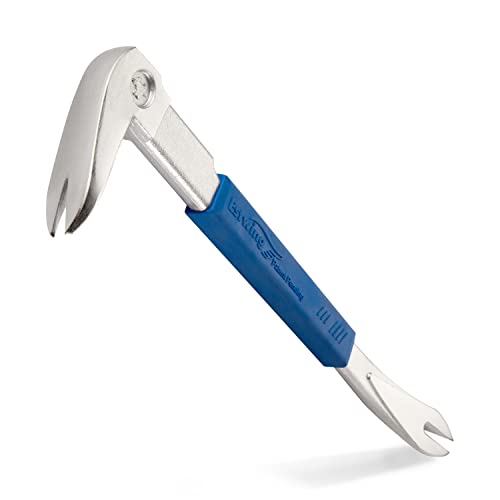
Estwing Pro Claw Nail Puller, 9-Inch (PC210G)
Top Pick
Estwing Pro Claw Nail Puller, 9-Inch (PC210G)
Best for: pulling nails during trim, flooring, and salvage work where the wood needs to survive.
The Estwing Pro Claw is a Japanese-style cat’s paw built around one job: removing nails, including headless and deeply embedded ones, with as little damage to the surrounding wood as possible. Both ends carry precision-ground claws, and the thin claw profile slips under nail heads a claw hammer cannot reach. The rounded head converts pulling force into a smooth rolling motion that walks stubborn fasteners out instead of snapping them off.
Estwing forges the tool from a single piece of fine tool steel, then tempers it for durability, and the molded cushion grip softens the shock that travels up the bar when a nail lets go suddenly. At nine inches it disappears into a tool belt pouch, so trim carpenters and floor installers keep it within reach all day. It is not a demolition bar and should not be struck with a hammer, but for controlled nail pulling almost nothing else is as effective.
Specs:
– Length: 9 inches
– Material: one-piece drop-forged, tempered tool steel
– Ends: two precision thin claws, Japanese style
– Grip: molded no-slip cushion grip
– Weight: about 6.6 ounces
– Finish: chrome
– Made for pulling headless and embedded nails cleanly
Fiskars Pro IsoCore Demolition Wrecking Bar, 30-Inch (751410-1001)
Runner-Up
Fiskars Pro IsoCore Demolition Wrecking Bar, 30-Inch (751410-1001)
Best for: deck, framing, and flooring demolition where leverage and vibration control matter.
The Fiskars IsoCore is the heavy lifter of this group, a 30-inch demolition bar combining a prying claw, a chisel edge, and a board bender jaw in one tool. The board bender slot grabs dimensional lumber so nailed boards can be twisted, lifted, and straightened for reuse, while the chisel end starts separations in flooring and tile. A striking face and struck face let you position the edge in a tight seam and drive it in with a hammer.
What separates it from a plain steel wrecking bar is the IsoCore shock control system in the handle, which Fiskars rates as transferring far less shock and vibration than a solid or wood-handled equivalent. Over a full day of deck or framing tear-out, that damping means noticeably less punishment in the hands and elbows. The SoftGrip texture keeps control when gloves are dusty, and the near six-pound heft helps once a seam starts to open.
Specs:
– Length: 30 inches
– Weight: about 5.8 pounds
– Head material: alloy steel
– Handle: IsoCore shock control system with SoftGrip texture
– Features: board bender jaw, chisel pry edge, striking and struck faces, demo edge
– Warranty: full lifetime warranty
– Model: 751410-1001
TEKTON Angled End Handled Pry Bar Set, 3-Piece (LSQ42103)
TEKTON Angled End Handled Pry Bar Set, 3-Piece (LSQ42103)
Best for: automotive, shop, and renovation prying where control beats brute force.
TEKTON’s set covers the middle ground that demolition bars overshoot: three handled pry bars in 12, 17, and 25-inch lengths, each with an angled end that generates leverage in confined spaces without a huge swing arc. The angled tips slide under seals, trim panels, bearings, and fasteners, and the handles give control and comfort a bare steel bar cannot match during careful prying.
The blades are chrome vanadium steel, and the set format means the right length is usually already in the drawer: the 12-inch bar for interior trim and light shop work, the 17-inch for general automotive and household prying, and the 25-inch when a stuck component needs real persuasion. These are levering tools rather than striking tools, so they suit mechanics and renovators doing controlled disassembly far more than tear-out crews.
Specs:
– Included lengths: 12, 17, and 25 inches
– Material: chrome vanadium steel
– Tip style: angled ends for leverage in tight spaces
– Handles: full grip handles on each bar
– Piece count: 3
– Model: LSQ42103
– Made in the USA
Mayhew Dominator Pro Curved Pry Bar, 25-Inch (14115BL)
Mayhew Dominator Pro Curved Pry Bar, 25-Inch (14115BL)
Best for: heavy prying where the blade needs to be hammer-driven into a seam before levering.
The Dominator Pro is built around a patented two-composite handle with a metal strike cap, which changes how a pry bar can be used: the blade can be set into a seam and driven home with hammer blows on the cap, and the handle absorbs that punishment without splitting. The curved blade profile multiplies leverage at the tip, so a moderate push on the handle becomes serious lifting force at the edge.
Mayhew hardens the alloy steel blade and finishes it in black oxide for corrosion resistance, and the 25-inch length hits a useful middle: long enough for flooring, decking, and heavy automotive work, short enough to maneuver inside a stud bay or engine compartment. It is made in the USA and belongs to the same Dominator family mechanics use for seal, bearing, and suspension work.
Specs:
– Length: 25 inches overall
– Blade: curved, hardened alloy steel, black oxide finish
– Handle: two-composite Dominator grip, metal strike cap
– Strikeable: yes, capped end is designed for hammer strikes
– Color: blue handle
– Model: 14115BL
– Made in the USA
GEARWRENCH Indexing Pry Bar, 10-Inch (82210)
GEARWRENCH Indexing Pry Bar, 10-Inch (82210)
Best for: tight engine bays, machinery, and awkward angles where a fixed bar cannot swing.
The GEARWRENCH indexing bar solves a geometry problem: in tight quarters, a fixed-angle bar often cannot get its tip under the part while leaving room to push the handle. Its head rotates through 180 degrees and locks into 14 positions, so the tip can be set flat, hooked, or anywhere between, and the bar still levers in whatever direction the space allows. The grooved head also grips fasteners and edges instead of skating off.
At ten inches it is a compact, one-hand tool aimed at automotive and machinery work: pulling seals, separating cases, and reaching fasteners buried behind brackets. The steel construction is rated to exceed ASME and ANSI pry bar strength requirements, so the indexing joint is not the weak point casual users might expect. Larger indexing versions exist in the same line, but the 10-inch earns a permanent spot in a general toolbox.
Specs:
– Length: 10 inches
– Head: indexing, rotates 180 degrees with 14 locking positions
– Head style: grooved for extra grip on parts and fasteners
– Strength: exceeds ASME and ANSI requirements
– Model: 82210
– Use style: one-handed prying in tight spaces
How to choose
Start by matching the bar family to the work. Flat bars and cat’s paw pullers, like the Estwing above, are nail and trim tools: thin edges, nail slots, and short lengths for control. Wrecking bars are demolition tools: long, heavy, and shaped to separate nailed framing and flooring. Handled and indexing bars belong to the shop, where prying means separating parts without destroying them. One bar from each family covers nearly everything; three wrecking bars do not.
Length is leverage: force at the tip multiplies with bar length, so a 30-inch wrecking bar delivers several times the prying force of a 9-inch puller at the same handle pressure. The tradeoff is swing room and finesse, since long bars crush drywall and splinter trim when the job only needed a nudge. Keep the longest bar you can swing safely for tear-out, and a short bar for anything you plan to reuse.
Check the ends before the handle. Nail slots should be beveled and sized for common fasteners, and a strike cap matters if you plan to drive the blade with a hammer: only bars with a metal capped end, like the Mayhew, are built for that, and uncapped plastic handles will crack under hammer blows. Forged one-piece steel tolerates the most abuse, while chrome vanadium and hardened alloy steels balance toughness with edge retention. For finish work, choose thin blades and wide, flat contact faces that spread force instead of denting the wood.
Who should skip
Skip the heavy wrecking bars if your projects are mostly furniture refinishing or light trim work; a small cat’s paw and a flat bar will do everything you need at a fraction of the weight. Skip handled shop pry bars if your work is true demolition, since composite handles are not built for full-force tear-out. And if your prying is mostly automotive interior panel work, look at non-marring plastic trim tools instead of any steel bar on this list.
FAQ
What size pry bar should I buy first?
A mid-length bar around 15 to 18 inches handles the widest mix of household prying. Add a 9 to 12-inch cat’s paw for nails and a 30-inch-plus wrecking bar only when a demolition project is actually on the calendar.
Can I hit any pry bar with a hammer?
No. Only bars with a metal strike cap on the handle end, or solid steel bars designed for striking, should be driven with a hammer. Striking an uncapped plastic or composite handle can shatter it, so match the tool to the task.
What is the difference between a pry bar and a wrecking bar?
Pry bar is the broad family name for levering tools. A wrecking bar is its heavy-duty member: longer, thicker, built for demolition, with a claw for large nails and a chisel end for separating framing and flooring.
How do I pull nails without damaging the wood?
Use a thin-claw puller or cat’s paw, slip a wood shim or putty knife under the bar to spread the pressure, and roll the nail out gradually instead of levering it straight up. For headless nails, a Japanese-style puller that bites the shank directly works best.
Final verdict
Most renovators end up owning three bars, and this list maps neatly onto that kit. The Fiskars IsoCore is the demolition anchor: long, heavy, and easier on the body than a plain steel bar. The Estwing Pro Claw handles the nails demolition leaves behind and the salvage work it should spare. Between those poles, the TEKTON set covers everyday shop prying, the Mayhew Dominator Pro adds hammer-driven force when a seam refuses to start, and the GEARWRENCH indexing bar reaches angles the others cannot. Buy the bar that matches your next project first; the rest of the kit can follow.
M
Miller the Driller Editorial Team
We compare specs, warranty terms, long-term owner feedback and street pricing before anything earns a spot. Rankings are never paid.
Affiliate disclosure. As an Amazon Associate we earn from qualifying purchases at no extra cost to you. Prices accurate as of the date shown.
Three wireless routers for small offices compared on device capacity, network separation, wired speed, and coverage, with specs taken from their Amazon listings.
Compare 5 mechanic tool sets for car repairs: a 247-piece DEWALT kit, a 450-piece CRAFTSMAN set, a drawer-box GEARWRENCH set, a 170-piece Crescent set and a 450-piece WORKPRO set.
Four splitting axes and mauls that actually split firewood: a long 36-inch axe for tall users, a shorter 28-inch option, and two 8 lb mauls for knotty rounds.
Learn whether a 20V rechargeable drill battery can be repaired, which faults you can check safely at home, and when replacing the pack is the safer choice.
A specs-based review of the officially licensed Retro-Bit Sega Saturn 2.4 GHz wireless controller: dual receivers, Genesis Mini and Switch support, battery, layout, limits, and FAQs.
Find the best drill battery for Power Wheels ride-on toys for families, with DeWalt, Milwaukee and Ryobi adapters, voltage and safety guidance in this guide.
Find the best hole saw for noching dom pipe: bi-metal saws, deep cups, and the right sizes for clean, tight notches in DOM tube for fabrication shops today.
Find the best diy tile saws for home tiling projects. Compare wet tile saws by blade size, cutting capacity, and features for ceramic and porcelain tile.



 Mayhew Dominator Pro Curved Pry Bar, 25-Inch (14115BL)
 GEARWRENCH Indexing Pry Bar, 10-Inch (82210)









