We research everything we recommend. When you buy through our links, we may earn a commission. As an Amazon Associate we earn from qualifying purchases.
Best Ear Protection for Workshops, Mowing and Loud Jobs
Compare the best ear protection for workshops, mowing, and loud jobs, with plain-English NRR guidance, fit tips, and five proven earmuff picks.
A table saw does not sound dangerous the way a chainsaw does, but hearing damage does not care how a noise feels. Sustained sound at or above 85 decibels — roughly a gas mower at the handle — slowly destroys the hair cells in the inner ear, and that damage is permanent and painless while it happens. Hearing protection is the cheapest safety gear in the shop, and a well-chosen earmuff turns a ringing-ear afternoon into a non-event.
This guide compares five proven earmuffs sold on Amazon, from a budget folder that lives in a toolbox drawer to an electronic muff that lets you hear a coworker’s warning and an industrial model built for the loudest plants. Every pick is a real, widely sold product with a published Noise Reduction Rating, and the How to choose section explains what that rating delivers in the real world — the number on the box is only half the story.
As an Amazon Associate, we earn from qualifying purchases.
For most workshops and yards, the 3M Pro-Grade earmuff is the safe default: NRR 30 dB, a steel headband, and cushions that stay comfortable through long jobs. Decibel Defense offers the highest passive rating here for the loudest tools, the ProCase folds flat on a budget, Walker’s Razor Slim adds electronic sound amplification, and the Peltor X5A tops the range for extreme noise.
The picks
3M Pro-Grade Noise-Reducing Earmuff
The Pro-Grade is 3M’s flagship retail earmuff, built around a steel wire headband with a rubber overmold instead of the all-plastic band found on cheaper muffs. That frame keeps its clamping force after years in a truck box, and the vented headband sheds heat through a whole mowing session. Its NRR of 30 dB is the highest figure 3M offers in a consumer earmuff.
Pivoting ear cups and soft, premium cushions spread pressure evenly, which matters: a muff that pinches gets taken off, and a muff that is off protects nothing. For a home shop running a table saw, a router, and a leaf blower in the same weekend, this one pair covers all of it.
Specs:
– Noise Reduction Rating: NRR 30 dB
– Type: passive over-ear earmuff
– Headband: steel wire with rubber overmold, vented
– Ear cups: pivoting, premium foam cushions
– Model: 90565-4DC-PS
– Color: red and black
Best for: all-day workshop and yard work where one dependable muff has to cover everything.
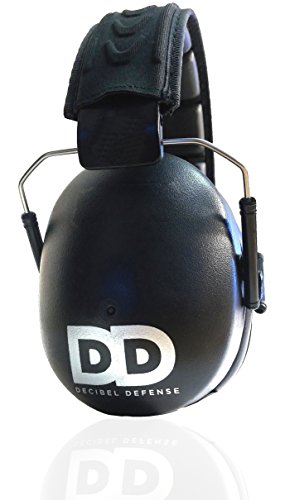
Decibel Defense Professional Safety Ear Muffs
Top Pick
Decibel Defense Professional Safety Ear Muffs
Best for: the loudest tools in the shop, chainsaw work, and range days where maximum passive blocking is the priority.
Decibel Defense built its name on one number: an NRR of 37 dB, the highest passive rating in this guide and one of the highest figures on any consumer earmuff. The rating is certified to ANSI S3.19 and CE EN 352-1. A padded headband and deep, foam-filled cups do the work, and the muff folds into a compact ball for storage.
Two sizes, regular and XL, solve the classic high-attenuation complaint: a band that runs small on larger heads. This is the pick for the loudest intermittent tools — chainsaws, angle grinders, hammer drills — and for the shooting range. Even so, fit still comes first: derating means a top number delivers less in the field.
Specs:
– Noise Reduction Rating: NRR 37 dB
– Type: passive over-ear earmuff
– Certification: ANSI S3.19 and CE EN 352-1
– Sizes: regular and XL
– Design: foldable, padded headband
– Weight: about 12.8 oz
ProCase Noise Reduction Safety Ear Muffs
Runner-Up
ProCase Noise Reduction Safety Ear Muffs
Best for: budget buyers, occasional mowing and DIY, and keeping a spare pair on hand for helpers.
The ProCase is the budget staple of this category: a solid ABS shell, thickened noise-dampening foam, and an NRR of 28 dB (SNR 34 dB) certified to ANSI S3.19. That covers mowing, blowing, and general power-tool work with room to spare, and the muff folds flat enough to live in a toolbox drawer.
Ear cups rotate a full 360 degrees and the adjustable metal headband fits most adults and older kids, which makes the ProCase an easy second pair for a helper, a spouse on the second mower, or a teenager learning the shop. It lacks the plush finish of the premium picks, but as honest, certified protection it earns its place here.
The Razor Slim is the electronic pick: two hi-gain omnidirectional microphones pick up voices, range commands, and a coworker approaching, and play them through HD speakers at a safe level. When a loud impulse hits, sound-activated compression reacts in 0.02 seconds and clamps it down. The passive rating underneath is an NRR of 23 dB.
The rubberized low-profile cups are the slimmest here, staying clear of a rifle stock, hard hat brim, or face shield. A 3.5 mm jack accepts an external audio feed, and the muff runs on two AAA batteries, included in the box. The trade-off is the lower NRR: for sustained loud tools rather than impulses, pair it with foam plugs underneath or step up to a higher-rated passive muff.
Specs:
– Noise Reduction Rating: NRR 23 dB
– Type: electronic earmuff with sound amplification
– Microphones: two hi-gain omnidirectional
– Compression: sound-activated, 0.02 second reaction time
– Power: 2 AAA batteries, included
– Extras: 3.5 mm audio input jack, folding design
3M PELTOR X5A Over-the-Head Earmuffs
3M PELTOR X5A Over-the-Head Earmuffs
Best for: sustained extreme noise, large stationary machinery, and pros who want the strongest single muff 3M sells.
The X5A is the top of 3M’s Peltor X series, with an NRR of 31 dB and a CSA Class AL rating — the strongest attenuation 3M builds into a single earmuff. It was designed for environments so loud that workers would otherwise be told to wear plugs and muffs together: big planers and jointers, machinery halls, and airport ground work.
A twin wire headband spreads weight and reduces heat buildup, and on this over-the-head version it is electrically insulated, a detail that matters around electrical work. The wide cushions are replaceable through the HYX5 hygiene kit, so a flattened muff can be refreshed instead of replaced. It is bulkier than the slim picks here — that bulk is what the extra protection costs.
Start with the NRR, but understand what it promises. The Noise Reduction Rating is measured in a laboratory, on trained subjects, with a perfect fit. Real ears, real hair, and real haste deliver less. OSHA’s field formula subtracts 7 from the NRR and halves the result; 3M itself advises cutting the printed figure in half for a realistic estimate. Plan on roughly half the number on the box, and every pick in this guide still lands in protective territory.
Next, put your noise on the exposure clock. The widely used recommended limit is 85 dBA averaged over 8 hours, and each 5 dB increase halves the safe time: 90 dBA allows about 4 hours, 95 dBA about 2 hours, and 100 dBA about 1 hour. A gas mower runs near 90 dBA, a table saw near 100 dBA, and a chainsaw near 110 dBA, where unprotected minutes count. Short jobs forgive a modest muff; long jobs do not.
Choose the style that matches the work. Passive earmuffs are simple, cheap, and easy to slip on for a two-minute cut. Earplugs weigh nothing and fit under any hat, but only protect when inserted properly, a step many people rush. Electronic muffs like the Razor Slim amplify quiet sounds and compress loud ones, so conversation and warnings come through; their passive ratings run lower, which is why they suit impulse noise better than all-day grinding.
Fit decides everything else. An earmuff works by sealing a cushion against the head, and anything crossing that seal leaks sound: glasses arms are the classic culprit and can cost several decibels, so thin frames or gel cushions help; hair under a cushion leaks too. For the loudest sustained noise, above roughly 105 dBA, wear foam plugs under muffs. Double protection adds only a few decibels over the better device alone, not the sum of both, but those decibels are the ones that matter most.
Finally, weigh comfort honestly. Clamping force, cushion size, weight, and heat buildup decide whether a muff stays on to the end of a job. A slightly lower rating worn throughout beats a maximum rating hanging on a nail.
Who should skip
Skip the premium end if your loud work is a few minutes of weekend drilling; the ProCase or any certified budget muff covers that honestly. Skip earmuffs entirely if you work under a hard hat all day and cannot fit a band underneath — look at helmet-mounted or neckband models instead. Anyone who needs two-way radio communication should shop for comms headsets rather than adapting these. And children need child-sized muffs: an adult cushion will not seal on a small head, so adult ratings do not apply.
Frequently Asked Questions
Is a higher NRR always the better buy?
Only if it gets worn. The printed NRR assumes a perfect seal, and a comfortable NRR 28 muff worn for a full afternoon protects more hearing than an NRR 37 muff that comes off after twenty minutes. Match the rating to your loudest tool, then choose the most comfortable muff that reaches it.
Can I listen to music under earmuffs?
Many people do, using earbuds under a passive muff, but keep the volume modest: the music has to compete with the tool noise leaking through, and turning it up re-creates the exposure the muff is removing. Music also masks warnings and approaching vehicles. Purpose-built audio muffs with built-in volume limits are the safer route for long jobs.
When should cushions be replaced?
When they flatten, crack, stiffen, or stop sealing with a gentle press, the muff is no longer delivering its rating. In daily professional use that can arrive within about six months; in a home shop it may take years. Models with hygiene kits, like the Peltor X5A and its HYX5 kit, make this a cheap refresh instead of a new purchase.
Are electronic muffs enough for a chainsaw?
For short sessions, a quality electronic muff is reasonable protection, but its passive rating is modest and a chainsaw at full throttle sits near 110 dBA. For bucking firewood or milling, add foam plugs underneath the electronic muff, or choose a high-rated passive muff like the Decibel Defense or X5A and treat hearing speech as secondary.
Final verdict
Buy for your loudest regular job, then check comfort. The 3M Pro-Grade is the default recommendation for a mixed workshop and yard: strong rating, durable steel headband, and all-day cushions. Decibel Defense wins on raw passive blocking, the ProCase wins on value and spare-pair duty, the Walker’s Razor Slim wins when hearing people matters, and the Peltor X5A is the heavy artillery for sustained extreme noise. Whichever lands in your cart, wear it for the whole job — that habit protects more hearing than any single spec.
Three wireless routers for small offices compared on device capacity, network separation, wired speed, and coverage, with specs taken from their Amazon listings.
Compare 5 mechanic tool sets for car repairs: a 247-piece DEWALT kit, a 450-piece CRAFTSMAN set, a drawer-box GEARWRENCH set, a 170-piece Crescent set and a 450-piece WORKPRO set.
Four splitting axes and mauls that actually split firewood: a long 36-inch axe for tall users, a shorter 28-inch option, and two 8 lb mauls for knotty rounds.
Learn whether a 20V rechargeable drill battery can be repaired, which faults you can check safely at home, and when replacing the pack is the safer choice.
A specs-based review of the officially licensed Retro-Bit Sega Saturn 2.4 GHz wireless controller: dual receivers, Genesis Mini and Switch support, battery, layout, limits, and FAQs.
Find the best drill battery for Power Wheels ride-on toys for families, with DeWalt, Milwaukee and Ryobi adapters, voltage and safety guidance in this guide.
Find the best hole saw for noching dom pipe: bi-metal saws, deep cups, and the right sizes for clean, tight notches in DOM tube for fabrication shops today.
Find the best diy tile saws for home tiling projects. Compare wet tile saws by blade size, cutting capacity, and features for ceramic and porcelain tile.



 3M PELTOR X5A Over-the-Head Earmuffs










