We research everything we recommend. When you buy through our links, we may earn a commission. As an Amazon Associate we earn from qualifying purchases.
Best Router Bits for Profiling, Joinery and Clean Cuts
Compare the best router bits for profiling, joinery and clean cuts, from premium Freud and Whiteside singles to Bosch, Yonico and Amana sets.
A router is only as good as the bit spinning in its collet. The same machine that leaves a crisp, sanding-free roundover with a sharp premium bit will burn, chatter and tear out with a dull bargain cutter, and the difference shows in the workpiece long before it shows in the tool. Choosing well is less about collecting profiles and more about matching carbide quality, shank size and geometry to your work.
This guide covers five picks that span the sensible ways to buy: two premium single bits for profiles that earn their keep every week, a large value set for discovering which profiles you reach for, a compact pro-grade collection for CNC and detail work, and a mid-size starter set from a mainstream brand.
As an Amazon Associate, we earn from qualifying purchases.
For most shops, start with premium singles in your most-used profiles: the Freud 34-110 Quadra-Cut roundover for edges and the Whiteside RFT5125 spiral flush trim for template work. Add the Yonico 70-piece set to explore occasional profiles, the Amana AMS-174 for CNC detail work, and the Bosch RBS010 as a balanced starter set.
Freud 34-110 Quadra-Cut Rounding Over Bit
The roundover is the bit most shops use more than any other, and the Freud 34-110 is the version worth owning. Its Quadra-Cut design uses four cutters instead of the usual two: two shear cutters do the heavy shaping while two finish cutters clean up behind them, so the profile comes off the bit needing little or no sanding on most hardwoods and sheet goods. The cutters are Freud’s own TiCo Hi-Density carbide, and a Perma-SHIELD non-stick coating sheds pitch and limits heat.
At a 1/4-inch radius on a 1/4-inch shank, this bit suits trim routers and mid-size machines alike, easing edges on table tops, drawer fronts and cabinet parts. The bearing-guided design follows the edge with no fence to set up. Buy this single in the radius you use most, then add other radii as projects demand them.
Flush trimming decides whether duplicated parts actually match, and the Whiteside RFT5125 is built for exactly that job. Instead of straight flutes that hammer the edge, its solid carbide spiral cutter shears the wood at a continuous angle, leaving a smoother surface with less tear-out on figured stock and tight template curves. The up-cut spiral pulls chips toward the router while the bearing rides the template, so parts come out faithful copies.
Whiteside machines its bits in North Carolina and is known for tight tolerances and balance, which matters at router speeds: a bit that runs true vibrates less and cuts cleaner. With a 1/2-inch cutting diameter, a 1-1/4-inch cutting length and a 1/2-inch shank, it handles thick stock and stacked templates in a table or full-size handheld machine. Bearings are replaceable, so a worn bearing does not retire the cutter.
Specs
– Profile: spiral flush trim, up cut
– Cutting diameter: 1/2 inch
– Cutting length: 1-1/4 inches
– Shank: 1/2 inch
– Construction: solid carbide, 2 flutes
– Guide: ball bearing, replaceable
– Maker: Whiteside, USA
Yonico 17702 70-Piece Router Bit Set
Runner-Up
Yonico 17702 70-Piece Router Bit Set
Best for: new router owners learning which profiles they use before buying premium singles.
A 70-piece set sounds like overkill until you price a single dovetail, lock miter or classical profile bit on its own. The Yonico 17702 spreads its cost across straight bits, edge-forming profiles and joinery cutters, all on 1/2-inch shanks, so a new router owner can attempt almost any common profile the day the box arrives. The bits use C3 micro-grain carbide tips on hardened steel bodies, with an anti-kickback design and a heat-resistant coating, sorted in a fitted wooden case.
View a set like this as a discovery tool. The straight and roundover bits do real work immediately, while the specialty profiles let you learn what a roman ogee or a cove looks like before committing to premium versions. When one profile becomes a weekly staple and starts to dull, that is the one to replace with a Freud or Whiteside single.
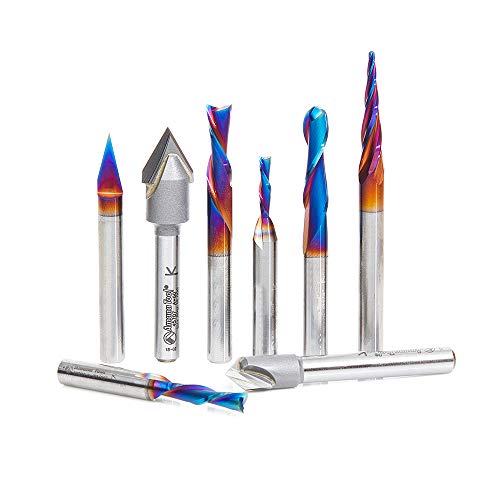
This slot was planned for a CMT Orange Tools set, but no CMT listing with a confirmable ASIN surfaced in Amazon’s listing data, so the pick goes to the other premium maker with a verifiable listing: Amana Tool. The AMS-174 is an eight-piece CNC collection of solid carbide and carbide-tipped cutters on 1/4-inch shanks, covering spiral plunge work, V-grooving, engraving and signmaking profiles. Amana’s industrial-grade carbide and tight grinding are why its bits are staples in production shops.
Although the set is aimed at CNC routers, nothing limits the bits to a gantry machine. The V-groove and engraving cutters do lettering and inlay work in a handheld plunge router, and the small spirals suit mortising and detail cuts. There are no bearing-guided roundovers here, so pair it with singles like the Freud above if your work mixes CNC carving with furniture edges.
Specs
– Pieces: 8 router bits
– Shank: 1/4 inch throughout
– Construction: solid carbide and carbide-tipped
– Coverage: spiral, V-groove, engraving, signmaking
– Intended machines: CNC routers; also plunge routers
– Maker: Amana Tool
Bosch RBS010 10-Piece Router Bit Set
Bosch RBS010 10-Piece Router Bit Set
Best for: first-time router owners who want mainstream-brand quality on essential profiles.
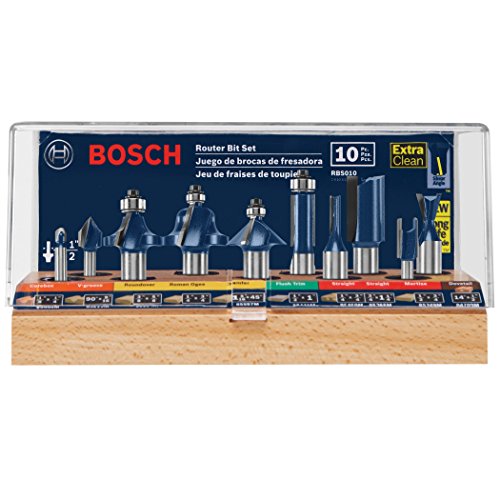
The Bosch RBS010 splits the difference between a giant value set and premium singles. Ten carbide-tipped bits cover the profiles a typical shop rotates through: straight cuts, trimming, decorative edging and dovetail joinery, in a mix of 1/4-inch and 1/2-inch shanks so the set works across trim routers and full-size machines. Bosch uses micrograin carbide, and the bits come in a protective case.
This is the set to hand someone who has just bought a router and wants to build real projects this month: a bookcase needs the straights and a roundover, drawers need the dovetail, and the trim bit earns its place on the first plywood job. Profiles you wear out can graduate to premium singles later, with less money parked in bits you may never chuck up.
Start with carbide. The cutting edge does all the work, and grades differ more than packaging suggests. Premium makers use dense, fine-grain carbide braze-welded to accurately machined bodies, which buys a keener edge that survives more board feet and more resharpenings. Budget carbide dulls sooner and can chip on knots or glue lines. For bits you use weekly, carbide quality is the whole purchase; for a profile you will cut twice a year, it matters far less.
Shank size comes next. A 1/2-inch shank has four times the cross-section of a 1/4-inch shank, so it flexes less, runs smoother and grips more securely. Choose 1/2-inch shanks whenever your router accepts them. Reserve 1/4-inch shanks for trim routers, which accept nothing else, and for small cutters whose heads are little wider than the shank. Large bits, such as raised-panel and big roundover profiles, should only ever run on 1/2-inch shanks.
On sets versus singles, be honest with yourself. A big set is a sampler: it teaches you which profiles your work calls for at a low cost per experiment. Singles cost more per bit but put premium carbide exactly where your hours go. Most mature shops end up hybrid: a value set for odd profiles plus premium singles for the straight, flush trim, roundover and chamfer bits that live by the router table.
Guidance style matters too. Bearing-guided bits follow the workpiece edge or a template and need no fence, which makes them fast freehand and ideal for curved work. Unguided bits, such as straights and V-grooves, rely on an edge guide, a straightedge or the table fence. Match guidance to the cut: templates for duplication, fences for joinery.
Finally, maintain what you buy. Most bits that seem dull are only dirty: pitch and resin build up until the edge plows instead of slices. Soak bits in a blade-and-bit cleaner, scrub with a soft brass or nylon brush, dry them well, and never use caustic oven cleaner on brazed cutters. Store bits upright in a drilled block or their case, and have genuinely dull premium bits professionally sharpened.
Safety deserves plain words. Match router speed to bit diameter: the larger the bit, the slower it must spin, and big panel-raising profiles belong in a variable-speed router mounted in a table, never handheld. Take several shallow passes instead of one deep one. Never use a bit that is dull, chipped, cracked or bent; a failing bit at full speed is a serious hazard. Unplug the router before every bit change, and wear eye and hearing protection every time it runs.
Who should skip
Skip the big sets if your work is narrow: a cabinetmaker who only eases edges and trims laminate gains nothing from 60 profiles in a box. Skip premium singles if you are still learning which profiles exist; burning an expensive bit through a setup mistake is a costly lesson. And skip every pick here if your router cannot safely run the bit: large profiles in a fixed-speed or trim router, and any shank your collet does not match, are combinations to walk away from.
FAQ
Should I buy 1/4-inch or 1/2-inch shank bits?
Choose 1/2-inch shanks whenever your router accepts them, because the stiffer shank runs truer and grips better. Keep 1/4-inch bits for trim routers and small cutters.
Are large router bit sets worth it?
As a learning tool, yes. A big set reveals which profiles your projects actually use, and its everyday bits do honest work. Plan to replace your most-used profiles with premium singles when they dull, rather than expecting every bit in the box to perform like a top-tier cutter.
How do I know when a bit is dull?
Feed pressure climbs, the cut burns, edges come out fuzzy or torn, and the router sounds strained. Clean the bit first, because pitch buildup mimics dullness. If a cleaned bit still burns, it needs professional sharpening or replacement.
Can I run large bits in a handheld router?
No. Large-diameter bits such as raised-panel cutters must run at reduced speed in a variable-speed router mounted in a table, fed in shallow passes. Handheld machines cannot control the forces involved, and trim routers should stay with small profiles only.
Final verdict
Buy the Freud 34-110 and the Whiteside RFT5125 first if your work is already defined: clean edges and accurate template work cover most of what routers do in a furniture shop. Add the Yonico 70-piece set or the Bosch RBS010 if you are still mapping out your profile needs, and the Amana AMS-174 for CNC or fine detail work. Keep bits clean, respect speed limits, and replace hard-working profiles with premium singles as they wear.
M
Miller the Driller Editorial Team
We compare specs, warranty terms, long-term owner feedback and street pricing before anything earns a spot. Rankings are never paid.
Affiliate disclosure. As an Amazon Associate we earn from qualifying purchases at no extra cost to you. Prices accurate as of the date shown.
Three wireless routers for small offices compared on device capacity, network separation, wired speed, and coverage, with specs taken from their Amazon listings.
Compare 5 mechanic tool sets for car repairs: a 247-piece DEWALT kit, a 450-piece CRAFTSMAN set, a drawer-box GEARWRENCH set, a 170-piece Crescent set and a 450-piece WORKPRO set.
Four splitting axes and mauls that actually split firewood: a long 36-inch axe for tall users, a shorter 28-inch option, and two 8 lb mauls for knotty rounds.
Learn whether a 20V rechargeable drill battery can be repaired, which faults you can check safely at home, and when replacing the pack is the safer choice.
A specs-based review of the officially licensed Retro-Bit Sega Saturn 2.4 GHz wireless controller: dual receivers, Genesis Mini and Switch support, battery, layout, limits, and FAQs.
Find the best drill battery for Power Wheels ride-on toys for families, with DeWalt, Milwaukee and Ryobi adapters, voltage and safety guidance in this guide.
Find the best hole saw for noching dom pipe: bi-metal saws, deep cups, and the right sizes for clean, tight notches in DOM tube for fabrication shops today.
Find the best diy tile saws for home tiling projects. Compare wet tile saws by blade size, cutting capacity, and features for ceramic and porcelain tile.


 Bosch RBS010 10-Piece Router Bit Set