We research everything we recommend. When you buy through our links, we may earn a commission. As an Amazon Associate we earn from qualifying purchases.
Best Benchtop Drill Presses for Metalworking: 5 Picks
Compare the best benchtop drill presses for metalworking by low-speed range, spindle taper, chuck capacity and table clamping, with five picks.
As an Amazon Associate I earn from qualifying purchases. This post may contain affiliate links at no extra cost to you.
⭐ Key Takeaways
Quick answer: Our top pick is Quick Picks at a Glance, with WEN 4214T 12 Inch Variable Speed Benchtop Drill Press — The Mid-Range… as a strong alternative.
Drilling metal on a benchtop press is a different job from drilling wood, and the spec sheet tells you so. Steel wants slow spindle speeds, a rigid column that does not flex under feed pressure, a chuck that grips hard enough to keep a bit from spinning in the jaws, and a table you can bolt a vise to. Most benchtop presses are marketed at woodworkers, so the metal buyer has to read past the headline swing size and look at the bottom of the speed range, the spindle taper, and the weight of the castings. This guide compares five benchtop drill presses that are currently sold on Amazon and judges them on metal criteria first: how slow they can run, how deep the spindle travels, how work gets clamped, and how much iron is in the machine.
The short answer is that the Shop Fox W1668 is the strongest metal pick here, because its belt drive reaches down to 250 RPM and its 13-1/4 inch swing is the widest of the group. The JET JWDP-12 is the pick for anyone who wants Morse taper tooling, since its MT2 spindle accepts taper-shank drills and arbors that a Jacobs taper chuck cannot. The WEN 4214T and WEN 4212T cover the middle ground with mechanical variable speed, digital readouts, and cast iron tables at two sizes, and the BUCKTOOL DP25016A2 is the budget route into a heavy little 10 inch press with a simple five-step belt drive. Every figure below comes from the maker’s published specifications and the Amazon listing for each machine, and where those two sources disagree, the disagreement is flagged in the section rather than smoothed over.
As an Amazon Associate, we earn from qualifying purchases.
Tier key: the Shop Fox and the JET sit in the premium tier of this group, the two WEN presses are mid-range, and the BUCKTOOL is the budget pick. Tier here describes where each machine sits in this lineup on build weight, speed range, and spindle equipment, not a promise about what any seller charges on a given day.
How to Choose a Benchtop Drill Press for Metalwork
Start with the slowest speed, not the fastest
Cutting speed in metal is set by the bit diameter and the material, and the math runs against big bits. A small bit in aluminum can spin happily at a few thousand RPM, but a half inch bit in mild steel wants only a few hundred RPM, and a step bit opening a large hole in sheet steel wants to run slower still. A press whose slowest setting is 900 or 1,000 RPM forces you to run large bits too fast, which overheats the cutting edges, work-hardens stainless, and dulls bits early. For metal work, treat the bottom of the speed range as the headline number: a floor of 250 to 350 RPM covers nearly every bit a benchtop chuck can hold, a floor around 530 to 580 RPM covers small and mid-size bits well, and a floor of 650 RPM or higher is a real limitation for larger holes in steel. Top speed matters far less, because any press here spins fast enough for small bits in soft metals.
Spindle taper decides your tooling options
Most benchtop presses carry a Jacobs taper spindle, usually JT33, which accepts a chuck and little else. That is fine for straight-shank bits up to the chuck capacity. A Morse taper spindle, MT2 on the JET in this guide, opens a second drawer: taper-shank drills for larger holes, MT2 arbors, and replacement chucks that seat on the taper itself. If you expect to drill holes larger than the chuck can grip, or you already own taper-shank tooling, the Morse taper machine is worth its premium. If your work is straight-shank bits in plate, bar, and tubing, a good JT33 chuck does the same job for less money, and chuck quality, meaning grip and runout, matters more than the taper behind it.
Chuck capacity and grip
Chuck capacity sets the largest straight shank the press can hold: 1/2 inch on the two 10 inch presses here, 5/8 inch on the Shop Fox, the JET, and the WEN 4214T. Metal bits are more likely than wood bits to slip in an undersized or worn chuck, and a slipped bit scores the shank and the hole. A keyed chuck lets you bear down on all three key positions for a firm grip, which is why every press in this guide uses one. Silver and deming bits, with reduced shanks, let a 1/2 inch chuck drive larger holes, and they are the standard workaround when a compact press meets a big hole.
Spindle travel and the depth stop
Spindle travel is how far the quill moves in one stroke of the feed handle. Drilling through thick plate, stacked parts, or a part sitting in a tall vise eats travel quickly, and running out of stroke mid-hole means repositioning the table or the work. Three inches or more of travel, as on the Shop Fox, the JET, and the WEN 4214T, is comfortable for metal work. Two inches, as on the WEN 4212T and the BUCKTOOL, is workable but asks you to set table height carefully before each hole. Pair travel with a repeatable depth stop, because batch drilling, countersinking to a consistent depth, and blind holes for tapped threads all depend on stopping the quill at the same point every time.
The table is a clamping surface first
For metal, the table’s job is to hold a drill press vise, and everything else is secondary. Look for a cast iron table with slots that accept the vise’s mounting bolts or strap clamps, enough flat area around the center hole for the vise base, and a rack-and-pinion or crank height adjustment that stays put under load. A tilting table earns its keep for angled holes in brackets and fittings, as long as it locks firmly at zero and returns to square; check the zero stop after any tilt session. Coolant and cutting oil will pool in table slots and stain unfinished iron, so a wipe-down habit matters more on a metal press than on a wood press. Table size also sets a practical limit on part size: a wide plate can hang off a small table, but the vise still has to sit flat and fully supported.
Weight is a feature
Rigidity is what separates a metal press from a wood press that happens to drill metal. Feed pressure on a half inch bit in steel is substantial, and a light machine flexes at the column, chatters, and produces oversized, rough holes. Cast iron heads, tables, and bases, and total weights from the high fifties up past one hundred pounds, are the visible signs of that rigidity. The Shop Fox in this guide weighs about 113 pounds, and that mass is a large part of why it leads the list. A heavy press also needs a bench that can carry it and a plan for bolting the base down, because a press that walks under vibration is worse than a lighter one that is anchored.
Variable speed versus belt steps
Mechanical variable speed, as on the JET and both WEN presses, changes RPM with a lever while the machine runs, and a digital readout tells you where you landed. That convenience matters in metal work because you change speeds often, sometimes for every bit change. Belt-step drives, as on the Shop Fox and the BUCKTOOL, ask you to open the pulley cover and move the belt, which is slower but mechanically simple, durable, and, on the Shop Fox, the route to the lowest speeds in this guide. Neither system is wrong for metal; the question is whether you value the 250 RPM floor or the thirty-second speed change more.
Swing, throat, and the parts you actually drill
Swing is twice the distance from the spindle centerline to the column, so a 12 inch press drills the center of a 12 inch wide part. Metal parts are usually smaller than wood panels, which is why a 10 inch press is a realistic metal machine in a way it might not be for furniture work. What matters more is the distance from the spindle to the table at working height, since a vise, parallels, and the part itself all stack up under the bit. Measure your tallest vise-and-part stack against the press’s spindle-to-table range before you buy, not after.
The 5 Best Benchtop Drill Presses for Metalworking
1. Shop Fox W1668 13-1/4 Inch Oscillating Benchtop Drill Press — The Slow-Speed Metal Pick
The Shop Fox W1668 leads this guide because it wins the two arguments that matter most in metal: it runs the slowest and it swings the widest. Its twelve belt speeds start at 250 RPM, a full step below every other press here, and that low gear is where half inch and larger bits in mild steel live. The 13-1/4 inch swing centers holes in plate and brackets that would hang off a 10 or 12 inch machine, and at roughly 113 pounds it is the heaviest press in the group, with the column and head mass to absorb feed pressure without chatter. Woodstock International, the company behind Shop Fox, publishes a full specification sheet for this model, which makes it one of the better-documented machines in the class.
Specs
Swing: 13-1/4 in
Motor: 3/4 HP, 110V, motor speed 1,725 RPM
Speeds: 12 belt speeds, 250 to 3,050 RPM
Chuck: 5/8 in keyed chuck
Spindle taper: JT33
Spindle travel: 3-1/4 in (see the note below)
Table: tilting work table
Extra: oscillating spindle with a 3-piece sanding drum kit, drums 1 in, 1-1/2 in, and 2 in
Weight: about 113 lb
One documentation note, stated plainly: the Amazon listing and the maker’s own manual give spindle travel as 3-1/4 inches, while the Woodstock specification sheet PDF lists 3-1/8 inches. Either figure is the deepest stroke in this guide alongside the JET and the WEN 4214T, so the disagreement does not change the ranking, but if your work depends on the last eighth of an inch of stroke, measure the machine rather than trusting either document.
For metal work, the twelve-step belt drive is the story. Belt changes take a minute and an open pulley cover, but the steps are mechanical and repeatable, and the 250 RPM bottom end lets a 5/8 inch bit turn at a sane cutting speed in steel instead of screaming. The 5/8 inch keyed chuck swallows full-size jobber bits without reduced-shank workarounds, and the tilting table handles angled holes in brackets and clevis-style parts. The oscillating spindle and sanding drum kit are a woodworking inheritance: the spindle can oscillate for drum sanding, which metal buyers will rarely use, though the same drums do deburr and shape nonferrous parts in a pinch. Treat that feature as a bonus for a mixed shop rather than a reason to buy the machine for metal alone.
The honest limitations are the belt drive’s inconvenience and the JT33 taper. Twelve speeds means stopping the machine and moving the belt for every material or bit change, and in a session that alternates between a small pilot bit and a large finish bit, that ritual adds up. The JT33 spindle takes chucks and straight-shank tooling only, so taper-shank drills are off the table; if your hole sizes regularly exceed the chuck, the JET below is built for you. The machine also needs a serious bench: 113 pounds of cast iron on a wobbly stand wastes the rigidity you paid for.
Best for: fabrication benches drilling plate, bar, and bracket stock; buyers who need genuinely slow speeds for larger bits in steel; mixed metal and wood shops that can use the sanding drums.
Think twice if: you change speeds constantly and want a lever and a readout instead of a belt; you own or plan to buy Morse taper tooling.
2. JET JWDP-12 12 Inch Benchtop Drill Press — The Morse Taper Pick
The JET JWDP-12, stock number 716000, is the only press in this guide with a Morse taper spindle, and that single specification reshapes what the machine can do in metal. The MT2 spindle accepts taper-shank drills, MT2 arbors, and chucks that mount directly on the taper, so tooling options extend well past the 5/8 inch chuck that ships with the press. Around that spindle, JET builds a variable speed machine running from 530 to 3,100 RPM with a digital RPM readout, an X-pattern laser for hole placement, an LED work light, and a cast iron table, backed by a five-year warranty that is the longest coverage in this group.
Specs
Swing: 12 in
Motor: 1/2 HP, 115V, 5-amp (see the note below)
Speeds: variable, 530 to 3,100 RPM, with digital RPM readout
Chuck: 5/8 in keyed chuck
Spindle taper: MT2
Spindle travel: 3-1/8 in
Table: cast iron work table
Extras: X-pattern laser guide, LED work light
Warranty: 5 years
A second documentation note: the Amazon listing headline rates this motor at 1/2 HP, while the specification table in JET’s own operating manual for the JWDP-12 lists the motor at 1/3 HP and 5.0 amps. Both documents agree on the 5-amp draw. The practical difference between the two ratings is small at the bit, but buyers comparing motors across brands should compare the amp figure and check the motor plate on the machine they receive, since the two published horsepower figures cannot both be right.
The variable speed system suits metal sessions well. You set a pilot bit speed, read it on the display, then dial down for the finish bit without opening a pulley cover, and the readout removes the guesswork that belt charts leave. The 530 RPM floor is not as deep as the Shop Fox’s 250, so the largest bits in steel still run faster than ideal, but it covers the small and mid-size bits that make up most bench metal work, and the MT2 spindle partly compensates: a taper-shank bit mounted directly in the spindle runs truer and grips harder than the same bit in a chuck. JET’s dealer and parts network is the deepest of any brand in this guide, which matters for a machine with an electronic speed control and a digital display, the two components most likely to need service a decade in.
The compromises are cost tier and that 530 RPM floor. This is a premium-tier benchtop press, priced in the market alongside small floor models, and buyers who never touch taper tooling are paying for a spindle they will not use. The chuck that ships with the press is a 5/8 inch keyed unit on the MT2 arbor, so everyday drilling feels conventional; the taper advantage only appears when you buy the extra tooling. And while the cast iron table is sized for vise work, confirm your vise footprint against the table before ordering, because 12 inch presses pair best with 4 and 5 inch drill press vises rather than the largest 6 inch models.
Best for: metalworkers who own or want taper-shank tooling; shops that value a digital readout and long warranty coverage; buyers drilling mixed bit sizes in one session.
Think twice if: your work is straight-shank bits only, where the same money buys the wider, slower Shop Fox; you need speeds below 500 RPM for large bits in steel.
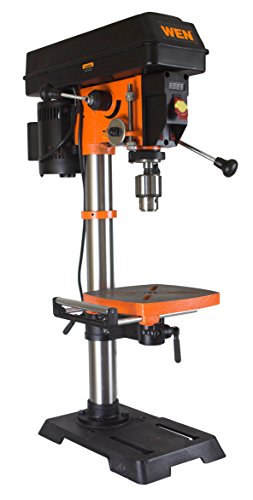
3. WEN 4214T 12 Inch Variable Speed Benchtop Drill Press — The Mid-Range All-Rounder
Top Pick
3. WEN 4214T 12 Inch Variable Speed Benchtop Drill Press — The Mid-Range All-Rounder
Swing: 12 in
Motor: 5-amp induction motor
Speeds: mechanical variable speed, 580 to 3,200 RPM, with digital readout
The WEN 4214T is the press most metal buyers in this guide will land on, because it pairs a 12 inch swing and a 5/8 inch chuck with the convenience of mechanical variable speed at a mid-range tier. The 5-amp induction motor drives the spindle from 580 to 3,200 RPM through a mechanical variable speed system, so speed changes happen with a lever while the machine runs, and a digital readout shows the selected RPM. The cast iron table measures 9-1/2 x 9-1/2 inches and bevels 45 degrees in both directions, the spindle travels 3-1/8 inches, and a laser guide plus a work light are built in. At 85 pounds it is heavy enough to stay composed under feed pressure in steel, yet still movable by two people when the bench needs rearranging.
Judged on metal criteria, the 4214T’s strengths are the chuck and the table. A 5/8 inch keyed chuck covers the full range of straight-shank bits most benches own, and the square cast iron table gives a 4 or 5 inch drill press vise a flat, fully supported seat with room for strap clamps on larger work. The 3-1/8 inches of spindle travel matches the JET and clears a vise, parallels, and a typical part stack without table adjustments between holes. The depth stop supports the repetitive side of metal work: countersinks at a consistent depth, blind holes drilled to a set depth before tapping, and batch runs of identical brackets.
The limitation is the 580 RPM floor, the highest bottom end among the variable speed presses here. For bits up to about 3/8 inch in mild steel, that floor is workable with cutting oil and a patient feed. Beyond that size, you are running faster than the bit wants, and the correct response is a reduced-shank bit at the slowest setting with light feed pressure, or a different machine. The spindle is a chuck-only arrangement, so there is no Morse taper tooling path. Buyers whose metal work centers on larger holes should read the Shop Fox section again; buyers drilling the usual run of clearance, pilot, and tap-drill holes will find this press covers the work with the least daily friction of any machine here.
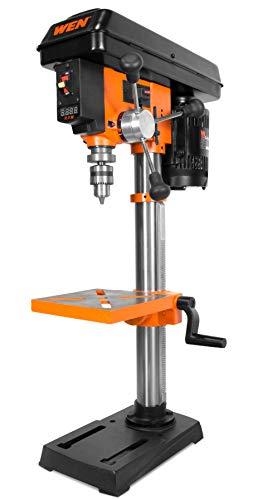
4. WEN 4212T 10 Inch Variable Speed Benchtop Drill Press — The Compact Variable Speed Pick
Runner-Up
4. WEN 4212T 10 Inch Variable Speed Benchtop Drill Press — The Compact Variable Speed Pick
Swing: 10 in
Motor: 5-amp induction motor
Speeds: mechanical variable speed, 530 to 3,100 RPM
The WEN 4212T shrinks the variable speed formula into a 10 inch press that fits crowded benches and smaller metal jobs. Its 5-amp motor and mechanical variable speed system span 530 to 3,100 RPM, a floor slightly lower than its bigger sibling, and the spindle carries a 1/2 inch keyed chuck on a JT33 taper. The cast iron table measures 8 x 7.5 inches and bevels 45 degrees, a crosshair laser marks the hole location, and the whole machine weighs 57 pounds, light enough to move between a bench and storage in a way the heavier presses here are not. WEN backs it with a two-year warranty.
The documentation note for this model: the Amazon listing describes 2 inches of spindle travel in its feature copy, while a comparison chart published by WEN on a sibling model’s listing credits the 4212T with 2-3/8 inches. Plan your vise and part stack around the shallower figure, and treat anything beyond it as a bonus. Even at the deeper figure, travel is this press’s tightest metal specification: a tall vise plus parallels plus a thick part can consume the stroke, so table height setup becomes part of every job in a way it is not on the 3-1/8 inch machines.
Within those limits, the 4212T is a sensible small-parts metal press. The 530 RPM floor handles pilot bits and mid-size bits in steel and aluminum at reasonable cutting speeds, the variable drive makes the pilot-to-finish bit change a lever move, and the 1/2 inch chuck matches the bit collections most small shops already own, with silver and deming reduced-shank bits extending its reach for occasional larger holes. Its natural work is electrical enclosures, model engineering parts, brackets, jigs, and repair drilling in stock up to moderate thickness. What it is not is a plate drill: the 10 inch swing, the short stroke, and the lighter column all argue for the bigger machines when the parts get large or the holes get deep.
5. BUCKTOOL DP25016A2 10 Inch Benchtop Drill Press — The Budget Belt-Drive Pick
5. BUCKTOOL DP25016A2 10 Inch Benchtop Drill Press — The Budget Belt-Drive Pick
Swing: 10 in
Motor: 6.2-amp, 3/4 HP
Speeds: 5 belt speeds, 650, 1,100, 1,700, 2,300, and 3,100 RPM
The BUCKTOOL DP25016A2 is the simplest machine in this guide and the budget tier’s representative: a 6.2-amp motor rated at 3/4 HP, a five-step belt drive, a 1/2 inch keyed chuck, and a cast iron base under a tilting table with a built-in LED work light. The five belt speeds, 650, 1,100, 1,700, 2,300, and 3,100 RPM, cover the small-bit end of metal work and general shop drilling, speed changes are a belt move inside the pulley cover, and the machine stands 30 inches tall on the bench. It carries CSA certification, and removable switch keys keep the press from starting in the wrong hands.
The metal case for this press is narrow but real. The motor is the strongest on paper among the 10 inch machines here, the cast iron base and table give a small vise a proper seat, and the belt drive has nothing electronic to fail. For sheet metal, aluminum, brass, and small steel parts drilled with bits up to about 3/8 inch, the speed steps land close enough to correct cutting speeds, especially with cutting oil doing part of the work. A fence is included for repeat positioning in lighter stock, which suits the small-batch drilling this class of press usually sees.
The limits are equally clear. The 650 RPM slowest speed is the highest floor in this guide, and it is simply too fast for larger bits in steel; forcing a half inch bit at 650 RPM in mild steel will overheat the bit and harden the work. Two inches of spindle travel matches the WEN 4212T’s constraint, so tall vise stacks need the same careful table setup. And a five-step belt means the right speed is often the nearest step rather than the exact figure, a compromise metalworkers manage with feed pressure and cutting fluid but should choose knowingly. Buy this press for light metal and mixed shop duty at the lowest tier, not as a fabrication machine.
Mistakes to Avoid When Drilling Metal on a Bench Press
Running large bits at small-bit speeds. The most common metal mistake on a benchtop press is leaving the speed where the last job set it. A bit’s cutting speed rises with its diameter, so the setting that suited a 1/8 inch pilot will cook a 1/2 inch bit. Set the speed for the bit in the chuck, every time, and when the press cannot go slow enough for the bit, reduce feed pressure, use cutting oil, and peck to clear chips rather than forcing the cut.
Holding work by hand. Metal grabs. When a bit breaks through the far side of a part, it can catch and spin the workpiece out of a bare grip faster than you can react. Clamp every metal part, in a drill press vise or directly to the table, with no exceptions for quick holes. The vise is not an accessory for metal work; it is part of the machine setup, and its cost and footprint belong in the purchase plan from the start.
Skipping cutting fluid. Oil on the bit and the work reduces heat, improves the finish of the hole, and extends bit life, especially in steel and stainless. A small squeeze bottle of cutting oil at the press covers most bench work. Aluminum prefers its own lubricants, and cast iron is usually drilled dry, but the default for steel is oil, applied before the cut and refreshed as the hole deepens.
Feeding too hard or too timidly. A steady, firm feed keeps the bit cutting; dwelling in one spot rubs the edges dull and work-hardens stainless and some alloys until the bit skates. Too much force on a small press flexes the column and snaps small bits. Learn the feed by the chips: continuous, curled chips mean the bit is cutting; dust and squeal mean it is rubbing.
Trusting the laser over a punch mark. Lasers and readouts help, but hole location in metal starts with layout and a center punch. The punch mark gives the bit a physical seat that a projected crosshair cannot, and it costs nothing. Use the laser to confirm alignment, then start the hole at low pressure until the bit establishes its own center.
Forgetting the breakthrough. The moment a bit exits the far side is when grabbing, burrs, and oversized exits happen. Support the part on parallels or a sacrificial block inside the vise, ease the feed as the point approaches the far face, and deburr the exit before the part leaves the setup.
Care, Setup, and Safety Checks
Setup checks before the first hole. Bolt the base to the bench, confirm the table sits square to the spindle by sweeping a known square part or using the press’s own zero stop, and run the chuck empty to watch for visible wobble. Check belt tension on the belt-drive presses and confirm the variable speed lever moves through its full range on the others. Seat the chuck on its taper firmly at first assembly, following the maker’s manual, because a chuck that loosens in metal work usually traces back to a taper that was never fully seated.
Recall check for this product class. A search of United States recall records turns up no CPSC recall covering benchtop drill presses from Shop Fox, JET, WEN, or BUCKTOOL, and none of the five presses in this guide is a recalled product. One adjacent record is worth knowing with its scope stated precisely: Australia’s product safety regulator lists a recall of Woodman DP-CH-18/1 floor and bench drill presses, sold by Gregory Machinery, over exposed wires and terminals on the limit switch inside the pulley cover that created an electric shock risk. That recall covers a different brand in a different market, and no pick here is affected. Its lesson still applies at home: the wiring inside the pulley cover is worth a visual inspection on any press, especially a used one, before the cover goes back on after a belt change.
Working safety habits. Unplug the press before belt changes, chuck swaps, and any work inside the pulley cover. Remove the chuck key before starting the spindle, every time, without exception. Keep gloves, sleeves, and hair away from the rotating spindle, clamp the work rather than holding it, and wear eye protection, because metal chips leave the cut hot and sharp. Let the spindle stop fully before brushing chips away, and use a brush rather than a hand.
Ongoing care. Wipe cutting oil and chips off the table and column after metal sessions, because oil left standing traps grit and stains cast iron. Keep the column and quill lightly oiled where the maker specifies, check the belt for glazing or cracks at each speed-change session on belt models, and verify chuck grip by tugging a mounted bit before drilling anything valuable. A press that is cleaned and checked on this rhythm holds its accuracy for years, and most accuracy complaints about older benchtop presses trace back to a dry, dirty quill rather than worn bearings.
Frequently Asked Questions
What spindle speed should I use for drilling steel on a benchtop press?
Match the speed to the bit diameter: small bits in mild steel can run at 1,500 RPM and above, mid-size bits around 3/8 inch want roughly 600 to 900 RPM, and a 1/2 inch bit wants only a few hundred RPM. That is why the bottom of a press’s speed range matters more for metal than the top. Of the presses here, the Shop Fox reaches 250 RPM for the largest bits, the JET and the smaller WEN start at 530 RPM, and the BUCKTOOL’s 650 RPM floor suits it to smaller bits in steel. When in doubt, run slower, add cutting oil, and let the chips tell you whether the bit is cutting or rubbing.
Why does a Morse taper spindle matter for metalworking?
A Morse taper spindle, MT2 on the JET JWDP-12 in this guide, accepts tooling that mounts directly in the spindle: taper-shank drills for larger holes, arbors, and chucks seated on the taper itself. That gives harder grip and better concentricity than a chuck alone, and it extends the press past its chuck capacity for occasional large holes. A Jacobs taper spindle such as JT33, used by the Shop Fox, the WEN 4212T, and most benchtop presses, is a chuck-only system: entirely adequate for straight-shank bits within the chuck’s capacity, but closed to taper tooling. Choose the taper if large holes or existing taper tooling are part of your work.
Can I drill metal on a drill press without a vise?
No, not safely. A bit that catches at breakthrough can spin a hand-held metal part instantly, and metal edges are sharp enough to cut deeply when they spin. Clamp the work in a drill press vise sized to the table, or clamp it directly to the table with strap clamps for large flat parts. Every press in this guide has a table that accepts a vise; budget for a 4 or 5 inch drill press vise alongside the machine, mount it before the first hole, and treat an unclamped setup as a stopped job rather than a shortcut.
Is a 10 inch benchtop press enough for metal fabrication work?
For small-parts fabrication, yes: brackets, enclosures, linkage parts, jigs, and repair work in bar and plate of moderate thickness all fit a 10 inch press, provided the speed range reaches low enough and the work is clamped in a vise. The 10 inch presses here, the WEN 4212T and the BUCKTOOL, trade away swing, spindle travel, and column mass, so deep holes, tall vise stacks, and large bits in steel push past their comfort zone. If your parts regularly exceed a hand span in width or your bits regularly exceed 1/2 inch in steel, the 12 and 13-1/4 inch presses in this guide are the more honest tools.
Conclusion
Metal work rewards the buyer who reads a drill press spec sheet from the bottom of the speed range up. The Shop Fox W1668 is the most capable metal machine here, with a 250 RPM floor, the widest swing, the heaviest castings, and a deep stroke, and it earns the top spot for fabrication benches. The JET JWDP-12 is the specialist’s pick, the only Morse taper spindle in the group, wrapped in a variable speed machine with a digital readout and the longest warranty. The WEN 4214T is the balanced mid-range answer, and the WEN 4212T compresses the same variable speed idea into a compact press for small parts and small benches. The BUCKTOOL DP25016A2 closes the list as the budget belt-drive route into light metal work. Pick by the largest bit you drill in steel and the tallest stack you clamp in your vise, and any of the five will drill metal honestly within the limits its spec sheet admits.
M
Miller the Driller Editorial Team
We compare specs, warranty terms, long-term owner feedback and street pricing before anything earns a spot. Rankings are never paid.
Affiliate disclosure. As an Amazon Associate we earn from qualifying purchases at no extra cost to you. Prices accurate as of the date shown.
Three wireless routers for small offices compared on device capacity, network separation, wired speed, and coverage, with specs taken from their Amazon listings.
Compare 5 mechanic tool sets for car repairs: a 247-piece DEWALT kit, a 450-piece CRAFTSMAN set, a drawer-box GEARWRENCH set, a 170-piece Crescent set and a 450-piece WORKPRO set.
Four splitting axes and mauls that actually split firewood: a long 36-inch axe for tall users, a shorter 28-inch option, and two 8 lb mauls for knotty rounds.
Learn whether a 20V rechargeable drill battery can be repaired, which faults you can check safely at home, and when replacing the pack is the safer choice.
A specs-based review of the officially licensed Retro-Bit Sega Saturn 2.4 GHz wireless controller: dual receivers, Genesis Mini and Switch support, battery, layout, limits, and FAQs.
Find the best drill battery for Power Wheels ride-on toys for families, with DeWalt, Milwaukee and Ryobi adapters, voltage and safety guidance in this guide.
Find the best hole saw for noching dom pipe: bi-metal saws, deep cups, and the right sizes for clean, tight notches in DOM tube for fabrication shops today.
Find the best diy tile saws for home tiling projects. Compare wet tile saws by blade size, cutting capacity, and features for ceramic and porcelain tile.