We research everything we recommend. When you buy through our links, we may earn a commission. As an Amazon Associate we earn from qualifying purchases.
Best Outside Micrometers for Machinists and Metalworkers
Compare the best micrometers for machinists and metalworkers, from digital 0-1 inch models to analog vernier mics with ratchet stops and carbide faces.
Compare the best micrometers for machinists and metalworkers, from digital 0-1 inch models to analog vernier mics with ratchet stops and carbide faces.
A caliper gets you close; a micrometer tells you the truth. When a shaft has to press into a bearing, a journal needs checking against a spec, or a turned part must land within a thousandth, the outside micrometer is the tool that settles the question. Each one covers a single inch of range and depends on consistent measuring force, which is why ratchet stops and carbide faces matter as much as the numbers on the sleeve.
This guide covers five outside micrometers spanning the main buying paths: an affordable digital 0 to 1 inch model with a large display, a classic analog vernier mic that never needs a battery, a four-piece analog set covering up to 4 inches, a digital 4 to 5 inch model with data output, and a Mitutoyo analog mic in the 2 to 3 inch range. Between them they suit students, home-shop machinists, reloaders, and working metal shops.
As an Amazon Associate, we earn from qualifying purchases.
For most buyers, the iGaging digital 0 to 1 inch micrometer is the easiest path to reliable tenths work: it resolves to a half-tenth, converts between inch and metric, and has an extra-large display. Machinists who prefer a mechanical tool should choose the Anytime Tools 0 to 1 inch vernier micrometer, and anyone who measures beyond an inch should buy the Beaiguna four-piece set instead.
How to Choose
Range comes first, because a micrometer only measures within its frame size. The 0 to 1 inch size handles most shop work: shaft diameters, stock thickness, wire, and small turned parts. Once your work includes 2 inch journals, larger bar stock, or engine parts, you need the next frames up, which is why sets bundling four frames are popular. Sizes above 1 inch must ship with a setting standard, the rod used to check zero, so confirm one is included.
Digital versus analog is the second decision. Digital models read instantly, convert between inch and metric, and eliminate the sleeve-reading errors that catch beginners; the better ones resolve to 0.00005 inch and offer data output. Analog models read from sleeve and thimble graduations, with a vernier reaching 0.0001 inch on finer tools. They never need batteries and shrug off coolant and chips. Neither is inherently more accurate at the same quality level; buy the readout you will read correctly at speed.
Resolution is not accuracy. A digital mic displaying 0.00005 inch may be rated accurate to plus or minus 0.00015 inch, and that rated figure is the one to compare. Also look at the measuring faces: carbide-tipped anvils and spindles resist the wear that slowly opens up readings on plain steel faces. A ratchet stop or friction thimble applies the same closing force every time, which is the biggest factor in repeatable readings between users.
Finally, consider sealing and support. Coolant-proof digital models with an IP65 rating survive wet machining environments that kill unsealed electronics. Check what comes in the case: a setting standard for larger sizes, a spanner for zero adjustment, and a spare battery for digital tools. A micrometer is a decades-long purchase, so a maker with a real calibration channel is worth weighing too.
The iGaging 0 to 1 inch digital micrometer is the budget digital done right. Its extra-large LCD reads to 0.00005 inch with a rated accuracy of plus or minus 0.00015 inch, and a single button converts between inch and metric, which makes it a natural fit for mixed-dimension work like 3D printing, reloading, and hobby machining. A data connection port serves shops that log measurements.
Carbide measuring faces and a hardened, ground spindle put it ahead of the no-name digitals in its price bracket, and the ratchet stop keeps closing force consistent between readings. It runs on included button cells and ships in a fitted case. The honest framing is that the last displayed digit is finer than the rated accuracy, so treat it as a trend indicator rather than gospel. Within that understanding, it delivers genuine tenths-level work for home shops.
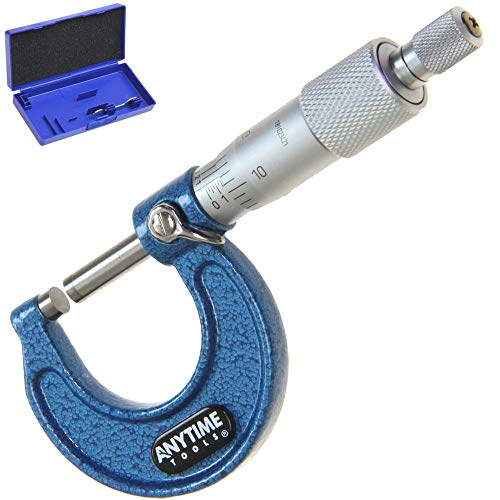
The Anytime Tools 0 to 1 inch micrometer is the analog starter that machinist forums keep recommending, because it reads to 0.0001 inch on a vernier scale at a price that lets a student or home machinist own a real mic instead of borrowing one. It is fully mechanical: sleeve and thimble graduations, a ratchet stop for consistent force, and a spindle lock for holding a reading.
Carbide-tipped measuring faces come standard, the feature that separates durable budget mics from disposable ones, since face wear is what sends cheap micrometers out of calibration. The satin finish cuts glare under shop lights and the graduations are etched rather than printed. It needs no battery, tolerates coolant splash and metal dust, and rewards the small effort of learning to read a vernier. For lathe work in a home shop, this is the traditional pick.
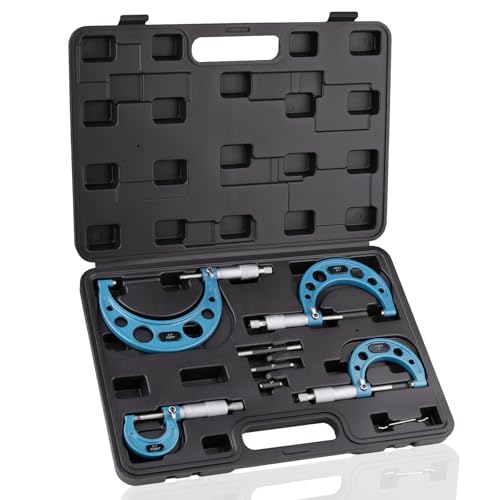
The Beaiguna set solves that limitation in one case: four analog mics spanning 0 to 1, 1 to 2, 2 to 3, and 3 to 4 inches, each graduated to 0.0001 inch. For an engine builder checking journals, or a home shop turning larger stock, that coverage removes the dead zone a single 0 to 1 inch tool leaves.
Each mic carries a ratchet stop for consistent measuring force and comes with the setting standards needed to zero the three larger frames, plus adjusting wrenches, all in a storage case. The measuring faces are carbide tipped. A set like this asks more of the user than a digital single: you must read vernier scales and check zero against the standards before critical work. In exchange, it delivers four inches of tenths-capable coverage for roughly the commitment of one name-brand digital mic.
Specs
Spec
Detail
Range
0 to 4 in across four micrometers
Graduation
0.0001 in
Type
Analog, mechanical
Included
Setting standards, wrenches, fitted case
Features
Ratchet stop on each micrometer
iGaging Digital Micrometer with Data Output 4-5 Inch
iGaging Digital Micrometer with Data Output 4-5 Inch
The iGaging 4 to 5 inch digital micrometer covers the size band that press-fit shafts, big bearing seats, and heavy turned parts live in. It keeps the family’s 0.00005 inch resolution and adds a data output port, so readings can feed a computer for inspection documentation rather than being transcribed by hand. Inch and metric conversion is built in, as on the smaller model.
A micrometer this size is only as good as its zero, so check zero against the setting standard before a measuring session, especially after temperature changes, because a frame this large moves measurably with hand heat. The digital readout earns its place here: reading a vernier at arm’s length on a big frame is slow, while the LCD gives an unambiguous number.
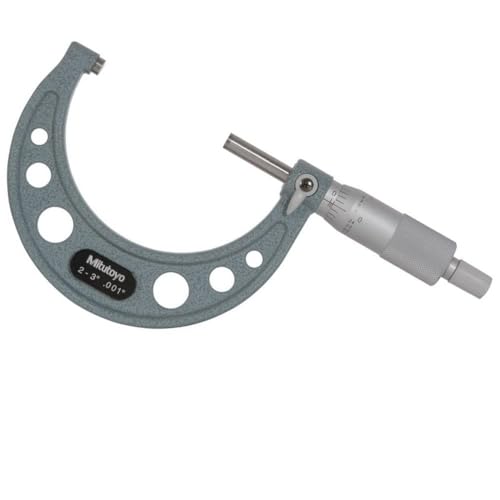
The Mitutoyo 103 series is the analog line working machinists measure other mics against, and the 103-179 covers the 2 to 3 inch range with 0.001 inch graduations. Its baked-enamel frame, satin chrome sleeve, and etched graduations are built for decades of daily handling, and the ratchet stop delivers the consistent measuring force Mitutoyo built its reputation on. Rated accuracy is plus or minus 0.0001 inch.
Carbide-tipped measuring faces come standard, and the frame balances stiffness with the lighter weight that keeps a mic this size usable one-handed at the machine. There is no vernier on this model, so it reads to a thousandth directly, which suits production checking where tolerances are written in thousandths. Alongside a 0 to 1 inch mic, the 103-179 is the long-term anchor.
Specs
Spec
Detail
Range
2 to 3 in
Graduation
0.001 in
Accuracy
Plus or minus 0.0001 in
Type
Analog with ratchet stop
Finish
Baked-enamel frame, carbide faces
Who Should Skip It
Skip a micrometer if your tolerances live in hundredths rather than thousandths: a decent caliper is faster, covers six inches in one tool, and measures inside and depth features a mic cannot reach. Skip digital models if your shop work is drenched in coolant and you will not maintain seals and batteries; a mechanical mic is the tougher tool there. If you need certified measurements, confirm a calibration certificate is available before ordering.
FAQ
What is the difference between resolution and accuracy on a micrometer?
Resolution is the smallest step the tool displays or graduates: 0.00005 inch on the digital models here. Accuracy is how close the reading can be trusted to the true size, and it is always coarser: plus or minus 0.00015 inch on the iGaging digital, for example. Shop to the accuracy figure, and treat the final digital digit as a trend guide rather than an absolute value.
Why does every micrometer only cover one inch of range?
The precision screw inside is ground for a short travel, and keeping it to one inch holds accuracy high and cost reasonable. Measuring a 3 inch shaft therefore means owning the 2 to 3 inch frame, which is why sets like the Beaiguna four-piece exist. Each frame above 0 to 1 inch needs its own setting standard to establish zero at its starting size.
What does a ratchet stop actually do?
It caps the force used to close the spindle onto the workpiece. Squeeze a mic by the thimble alone and two users can disagree by several ten-thousandths on the same part; the ratchet slips at a set torque, so every user lands on the same force and the same reading.
Should a beginner buy digital or analog first?
Digital is easier to read correctly on day one, and inch-to-metric conversion removes a whole class of mistakes, which is why the iGaging 0 to 1 inch is the common first recommendation. Analog teaches the underlying skill and never dies mid-job from a flat battery.
Final Verdict
Start with the iGaging 0 to 1 inch digital if you want tenths readings without a learning curve, or the Anytime Tools vernier mic if you prefer a mechanical tool. The Beaiguna four-piece set is the smart buy when your parts span several inches, the iGaging 4 to 5 inch digital extends coverage to large work with data output, and the Mitutoyo 103-179 is the premium analog anchor for the 2 to 3 inch range. Whichever you choose, check zero often and let the ratchet stop do the squeezing.
M
Miller the Driller Editorial Team
We compare specs, warranty terms, long-term owner feedback and street pricing before anything earns a spot. Rankings are never paid.
Affiliate disclosure. As an Amazon Associate we earn from qualifying purchases at no extra cost to you. Prices accurate as of the date shown.
Three wireless routers for small offices compared on device capacity, network separation, wired speed, and coverage, with specs taken from their Amazon listings.
Compare 5 mechanic tool sets for car repairs: a 247-piece DEWALT kit, a 450-piece CRAFTSMAN set, a drawer-box GEARWRENCH set, a 170-piece Crescent set and a 450-piece WORKPRO set.
Four splitting axes and mauls that actually split firewood: a long 36-inch axe for tall users, a shorter 28-inch option, and two 8 lb mauls for knotty rounds.
Learn whether a 20V rechargeable drill battery can be repaired, which faults you can check safely at home, and when replacing the pack is the safer choice.
A specs-based review of the officially licensed Retro-Bit Sega Saturn 2.4 GHz wireless controller: dual receivers, Genesis Mini and Switch support, battery, layout, limits, and FAQs.
Find the best drill battery for Power Wheels ride-on toys for families, with DeWalt, Milwaukee and Ryobi adapters, voltage and safety guidance in this guide.
Find the best hole saw for noching dom pipe: bi-metal saws, deep cups, and the right sizes for clean, tight notches in DOM tube for fabrication shops today.
Find the best diy tile saws for home tiling projects. Compare wet tile saws by blade size, cutting capacity, and features for ceramic and porcelain tile.

 iGaging Digital Micrometer 0-1 Inch
 Anytime Tools Outside Micrometer 0-1 Inch
 Beaiguna 4-Piece Outside Micrometer Set
 iGaging Digital Micrometer with Data Output 4-5 Inch
 Mitutoyo 103-179 Outside Micrometer









