We research everything we recommend. When you buy through our links, we may earn a commission. As an Amazon Associate we earn from qualifying purchases.
Best Chainsaw Sharpeners for Fast, Even, Repeatable Edges
Compare the best chainsaw sharpeners, from pro bench grinders to manual file guides, with chain pitch coverage, key specs and practical buying advice.
As an Amazon Associate I earn from qualifying purchases. This post may contain affiliate links at no extra cost to you.
⭐ Key Takeaways
Quick answer: Our top pick is Oregon Professional Compact 120-Volt Bench Grinder (410-120), with Buffalo Tools Electric Chainsaw Sharpener (ECSS) as a strong alternative.
A dull chain announces itself quickly: the saw starts making fine dust instead of chips, it pulls to one side in the cut, and the operator ends up pushing instead of letting the chain work. Sharpening restores the edge, and the right sharpener makes every tooth the same length and angle, which is what keeps a saw cutting straight and fast.
The five sharpeners here cover the realistic range of methods. Two Oregon bench grinders handle volume work in the shop, a Buffalo Tools electric sharpener covers the budget bench role, a Sharp Pebble handheld electric kit sharpens the chain right on the bar, and the STIHL 2 IN 1 Easy File handles field touch-ups with no power at all. Every pick is a real listing with a verified model, and the specs below come from listing and catalog content. The method matters more than the brand: match the sharpener to how many chains you maintain and where you sharpen them.
As an Amazon Associate, we earn from qualifying purchases.
The Oregon 520-120 is the best bench grinder here for anyone maintaining several chains, with universal pitch coverage and a proper clamping vise. The Oregon 410-120 brings the same approach to a smaller bench, the STIHL 2 IN 1 Easy File is the field pick, and the Sharp Pebble kit is the portable electric option for quick on-bar touch-ups.
How to Choose
Everything starts with chain pitch. The file diameter or grinding wheel thickness must match the chain: common pairings are 5/32-inch files for 3/8-inch low-profile chain, 3/16-inch for .325-inch pitch, and 7/32-inch for 3/8-inch and .404-inch pitch. A sharpener that covers several pitches with included wheels or files is worth more to a household with two or three different saws than a single-size tool.
Next, choose the format. Bench grinders clamp the chain in a vise and grind each tooth at a set angle, which gives the most consistent results and revives neglected chains; they need bench space and power. Bar-mounted and handheld tools work with the chain still on the saw, which suits touch-ups in the field and keeps a working edge between full sharpenings. Manual file guides are the slowest option but the most portable, and a good guide removes the guesswork from filing angles.
Also consider the depth gauges, the small rakers ahead of each cutter. A sharpener system that addresses them, or a routine that includes a flat file and gauge tool, keeps cutting speed up as teeth are filed shorter over the chain’s life. Finally, think about volume: one saw used for firewood needs little, while a property owner with several saws benefits from a grinder that resets a whole chain in minutes.
The 520-120 is Oregon’s full-size professional bench grinder and the heavy-duty pick of this guide. It grinds every common chain pitch, from 1/4-inch and 3/8-inch low profile through .325, 3/8, and .404 inch, so one machine serves a whole fleet of saws. The package includes three grinding wheels, a dressing brick for keeping the wheel profile true, and a quick-check grinding template. The chain sits in a proper vise and each tooth is ground at the same set angle, which is how a badly dulled or uneven chain gets brought back to uniform, factory-style geometry. It is a stationary shop tool that rewards a permanent bench spot. For firewood operations, rental fleets, and anyone sharpening weekly, this is the machine that ends sharpening as a chore.
Specs
Spec
Detail
Model
520-120
Type
Bench grinder, 120-volt corded
Chain pitches
1/4, 3/8 low profile, .325, 3/8, .404 inch
Includes
Three grinding wheels, dressing brick, template
UPC
036577563631
Oregon Professional Compact 120-Volt Bench Grinder (410-120)
Top Pick
Oregon Professional Compact 120-Volt Bench Grinder (410-120)
The 410-120 applies the same bench-grinder logic in a compact body that mounts to a bench or a wall. A manual chain-clamping vise holds the chain while the wheel works, and the grinder covers the same pitch range as its bigger sibling: 1/4-inch, 3/8-inch low profile, .325, 3/8, and .404 inch. Two grinding wheels, a dressing brick, and a profile guide come in the box, and at 13.2 by 6.3 by 10 inches it fits shops where the 520-120 would crowd the bench. The trade-off is throughput and heft rather than capability; it sharpens the same chains, just in a lighter frame. Homeowners with two or three saws who want consistent, repeatable edges without freehand filing will find this the sweet spot of the Oregon line.
Specs
Spec
Detail
Model
410-120
Type
Bench or wall mount grinder, 120-volt
Vise
Manual chain-clamping
Chain pitches
1/4, 3/8 low profile, .325, 3/8, .404 inch
Includes
Two grinding wheels, dressing brick, profile guide
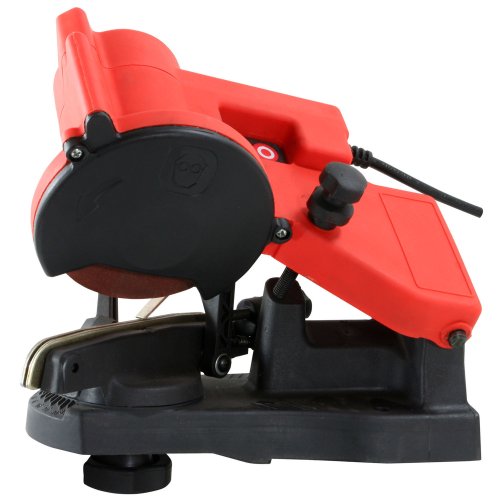
The ECSS is the budget bench option. It mounts to a bench or wall, clamps the chain in an adjustable vise, and spins its wheel at 4,200 RPM, which puts it in the same working category as the Oregon grinders at a simpler level of build. At roughly seven pounds it is light enough to move between a garage bench and a tailgate if needed. The design has been sold for years, which means replacement wheels and advice are easy to find. It lacks the refinement and accessory kit of the Oregon models, and its adjustments reward a patient setup, but for an occasional firewood cutter who wants powered consistency without paying professional-grinder money, it does the core job: every tooth ground at the same angle, chain after chain.
The Sharp Pebble kit takes a different route: a corded handheld electric sharpener that works on the chain while it is still on the bar. The kit includes four diamond sharpening wheels in the standard file sizes, 5/32, 3/16, 7/32, and a second 7/32 inch, plus an angle attachment that rides the bar to hold the filing angle, a wrench, and an eBook guide. Power comes from a standard 120-volt outlet, so it suits the garage, the barn, or a generator at a woodlot. Because the operator guides it tooth by tooth, it is slower than a bench grinder across a whole chain, but it is far faster than hand filing and needs no bench, vise, or chain removal. For quick touch-ups between bigger sharpenings, it is a genuinely handy middle path.
Specs
Spec
Detail
Type
Handheld electric sharpener, 120-volt corded
Wheels
Four diamond wheels: 5/32, 3/16, 7/32, 7/32 inch
Includes
Angle attachment, wrench, eBook
Use
Sharpens chain on the bar
STIHL 2 IN 1 Easy File Chainsaw Sharpener for .325-Inch Chain
STIHL 2 IN 1 Easy File Chainsaw Sharpener for .325-Inch Chain
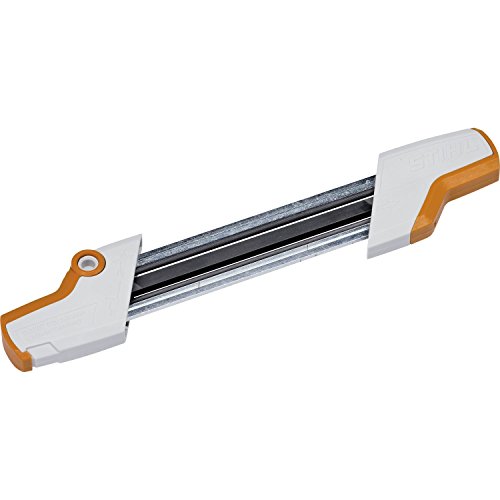
The STIHL 2 IN 1 Easy File solves the two-step problem of manual sharpening. Its holder carries a round file for the cutter and a flat file for the depth gauge at the same time, so one pass sharpens the tooth and sets the raker height together, keeping the relationship between them correct as the chain wears. This version is sized for .325-inch pitch chain, and the tool is light, at about twelve ounces, with no power requirement of any kind. It lives happily in a saw case or a truck box and keeps a working edge in the field in minutes. It will not rescue a rock-damaged chain as quickly as a grinder, but for routine maintenance it is the simplest tool here, and the one most likely to actually get used.
Specs
Spec
Detail
Part number
56057504304
Type
Manual 2-in-1 file guide
Chain pitch
.325 inch
Function
Files cutter and depth gauge in one pass
Weight
About 12 ounces
Who Should Skip It
Skip sharpeners entirely if you cut once a year and your dealer sharpens cheaply; a spare chain swapped in minutes may serve you better. Skip the bench grinders if you have no permanent bench space or maintain a single small saw, where a file guide covers the need. Skip manual guides if you maintain many chains or frequently hit dirt and fencing, because grinding back damaged teeth by hand is slow, miserable work. And skip handheld electric kits if your priority is resetting a neglected chain to exact geometry; that is bench-grinder work.
FAQ
How do I know which file or wheel size my chain needs?
Find the pitch stamped on the chain or listed in the saw’s manual, then match it: 5/32-inch for 3/8-inch low-profile chain, 3/16-inch for .325-inch pitch, and 7/32-inch for 3/8-inch and .404-inch pitch. Using the wrong diameter changes the tooth profile and weakens the edge, so confirm before the first sharpening.
Do these sharpeners also handle the depth gauges?
The STIHL 2 IN 1 files the depth gauge in the same pass as the cutter, which is its main advantage. Bench grinders focus on the cutters, so depth gauges are checked separately with a gauge tool and a flat file. Either way, neglected depth gauges are the usual reason a freshly sharpened chain still cuts slowly.
How often should a chain be sharpened?
Touch up the chain at the first signs of dullness: fine dust instead of chips, extra downward pressure needed, or smoke and burning smells in hardwood. A light touch-up every tank or two of fuel is far quicker than rescuing a chain that was run dull for hours, and it removes less metal overall.
Is a bench grinder more accurate than a file guide?
A bench grinder holds angle and tooth length most consistently because the chain is clamped and indexed, which matters most when restoring an uneven chain. A good file guide like the STIHL maintains angles well for routine upkeep. The practical answer is that the tool you use regularly beats the theoretically better tool sitting in its box.
Final Verdict
Choose the Oregon 520-120 if sharpening is a regular shop task across several saws; nothing else here matches its combination of vise, wheel selection, and universal pitch coverage. The 410-120 delivers the same method in a compact frame for smaller benches, and the Buffalo ECSS covers the budget bench role. For field and garage touch-ups, the Sharp Pebble kit adds power without removing the chain, while the STIHL 2 IN 1 remains the simplest way to keep cutters and depth gauges correct together. Match the tool to your chain count and your habits, and keep the chips flying.
M
Miller the Driller Editorial Team
We compare specs, warranty terms, long-term owner feedback and street pricing before anything earns a spot. Rankings are never paid.
Affiliate disclosure. As an Amazon Associate we earn from qualifying purchases at no extra cost to you. Prices accurate as of the date shown.
Three wireless routers for small offices compared on device capacity, network separation, wired speed, and coverage, with specs taken from their Amazon listings.
Compare 5 mechanic tool sets for car repairs: a 247-piece DEWALT kit, a 450-piece CRAFTSMAN set, a drawer-box GEARWRENCH set, a 170-piece Crescent set and a 450-piece WORKPRO set.
Four splitting axes and mauls that actually split firewood: a long 36-inch axe for tall users, a shorter 28-inch option, and two 8 lb mauls for knotty rounds.
Learn whether a 20V rechargeable drill battery can be repaired, which faults you can check safely at home, and when replacing the pack is the safer choice.
A specs-based review of the officially licensed Retro-Bit Sega Saturn 2.4 GHz wireless controller: dual receivers, Genesis Mini and Switch support, battery, layout, limits, and FAQs.
Find the best drill battery for Power Wheels ride-on toys for families, with DeWalt, Milwaukee and Ryobi adapters, voltage and safety guidance in this guide.
Find the best hole saw for noching dom pipe: bi-metal saws, deep cups, and the right sizes for clean, tight notches in DOM tube for fabrication shops today.
Find the best diy tile saws for home tiling projects. Compare wet tile saws by blade size, cutting capacity, and features for ceramic and porcelain tile.

 Oregon Professional Compact 120-Volt Bench Grinder (410-120)
 Buffalo Tools Electric Chainsaw Sharpener (ECSS)
 Sharp Pebble Electric Chainsaw Sharpener Kit
 STIHL 2 IN 1 Easy File Chainsaw Sharpener for .325-Inch Chain









