We research everything we recommend. When you buy through our links, we may earn a commission. As an Amazon Associate we earn from qualifying purchases.
Best Hammer Drills for Concrete, Masonry and Tough Jobs
Compare the best hammer drills for concrete, brick and block, with torque, BPM and chuck guidance plus corded and cordless picks for anchor work.
As an Amazon Associate I earn from qualifying purchases. This post may contain affiliate links at no extra cost to you.
⭐ Key Takeaways
Quick answer: Our top pick is DEWALT 20V MAX XR Hammer Drill/Driver (DCD996B), with Milwaukee M18 FUEL Hammer Drill/Driver (2904-20) as a strong alternative.
A hammer drill adds a rapid pulsing action to normal rotation, so a carbide-tipped bit grinds through brick, block and poured concrete instead of polishing a shallow dent. That makes it the right tool for setting sleeve anchors and concrete screws, mounting ledger boards and handrails, and fixing cabinets or conduit to masonry walls — jobs a standard drill/driver simply cannot finish. The five models below cover the major pro cordless platforms plus one corded option, and all switch back to drill and driver duty for wood and metal.
Whichever model you choose, treat masonry drilling as a two-handed job. Wear eye protection against flying chips, ear protection against the sustained hammering noise, and a dust mask when drilling concrete indoors. Clamp or otherwise secure the workpiece so it cannot shift mid-hole, keep the side handle fitted when using larger bits, and fit only carbide-tipped masonry bits rated for percussion drilling — a standard twist bit will overheat and fail. If a bit binds, release the trigger and back it out rather than forcing the tool sideways.
As an Amazon Associate, we earn from qualifying purchases.
For most buyers, the DEWALT DCD996B is the safest all-round pick, with the Milwaukee 2904-20 close behind for M18 owners who want maximum torque in a compact body. The Bosch GSB18V-1330CN adds kickback control for bind-up-prone work, the Makita XPH14Z suits LXT users, and the corded DEWALT DWE5010 covers long drilling sessions without battery swaps.
The picks
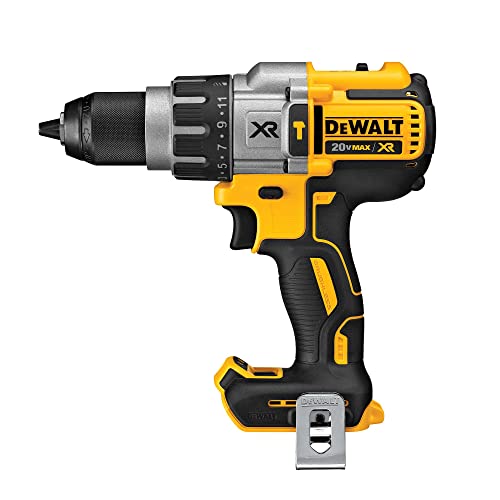
DEWALT 20V MAX XR Hammer Drill/Driver (DCD996B)
Top Pick
DEWALT 20V MAX XR Hammer Drill/Driver (DCD996B)
Best for: DEWALT 20V MAX owners who want one drill for framing, driving and regular anchor work.
The DCD996B is DEWALT’s long-running flagship hammer drill/driver, built around a brushless motor and a three-speed all-metal transmission. That extra gear range is its defining advantage: low speed delivers the torque for large hole saws and self-feed bits in timber, the middle gear handles general driving, and high gear reaches 38,250 blows per minute for fast anchor holes in block and brick. With 820 unit watts out, it sits at the top of the 20V MAX line for sustained heavy drilling.
The half-inch metal ratcheting chuck uses carbide inserts for strong grip on round-shank masonry bits, and a three-mode LED with a spotlight setting covers dark cabinets and crawl spaces. A 360-degree side handle is included for when a bit grabs. As a bare tool, it suits anyone already running 20V MAX batteries, ideally larger-capacity packs for repeated concrete work.
Specs:
– Power source: 20V MAX battery (bare tool)
– Motor: Brushless
– Max power: 820 UWO
– Speed settings: 3 (0-450, 0-1,300 and 0-2,000 RPM in drill mode)
– Hammer rate: Up to 38,250 BPM
– Chuck: 1/2 in metal ratcheting, keyless
– Included: 360-degree side handle, belt hook
Milwaukee M18 FUEL Hammer Drill/Driver (2904-20)
Runner-Up
Milwaukee M18 FUEL Hammer Drill/Driver (2904-20)
Best for: M18 users who want maximum torque in the most compact body available.
Milwaukee’s 2904-20 packs the highest torque figure in this roundup — 1,400 in-lbs from its POWERSTATE brushless motor — into a head length of just 6.9 inches. That short body fits between studs and inside cabinets where full-size drills cannot go, while the two-speed gearbox reaches 2,100 RPM and up to 33,000 BPM for anchor holes in brick and block.
The all-metal half-inch ratcheting chuck has carbide teeth for bit retention under hammering, and the AutoStop control mode is designed to shut the tool down when it senses over-rotation in a bind-up, reducing the wrist-twisting kick that makes large bits risky. An LED at the foot lights the work area without chuck shadow. As a bare tool, it suits users who already own M18 packs and a charger.
Specs:
– Power source: M18 battery (bare tool)
– Motor: POWERSTATE brushless
– Max torque: 1,400 in-lbs
– Speed settings: 2 (0-500 and 0-2,100 RPM)
– Hammer rate: Up to 33,000 BPM
– Chuck: 1/2 in all-metal ratcheting, keyless
– Length: 6.9 in
The Bosch entry here is the current PROFACTOR model, a step up from the older Compact Tough line. Its BITURBO brushless motor delivers 1,330 in-lbs of torque, with two speeds up to 2,100 RPM and a hammer rate of 31,500 BPM. That output puts it in the same heavy class as the DEWALT and Milwaukee flagships.
KickBack Control is the headline feature: sensors detect a sudden bind-up and shut the motor down to limit the tool swinging out of the user’s hands. It is also connected-ready, accepting an optional module for app-based settings and tracking, and its all-metal chuck and 25-position clutch cover precise driving with hammer mode off. It is sold as a bare tool for the Bosch 18V platform.
Specs:
– Power source: Bosch 18V battery (bare tool)
– Motor: BITURBO brushless
– Max torque: 1,330 in-lbs
– Speed settings: 2 (0-550 and 0-2,100 RPM)
– Hammer rate: Up to 31,500 BPM
– Chuck: 1/2 in all-metal, keyless
– Safety: KickBack Control anti-rotation shutdown
Makita 18V LXT Hammer Driver-Drill (XPH14Z)
Makita 18V LXT Hammer Driver-Drill (XPH14Z)
Best for: Makita LXT owners who want flagship torque without the bulkiest body.
Makita’s XPH14Z delivers 1,250 in-lbs of max torque from a brushless motor in a body only 7 inches long, which keeps it manageable overhead and in tight framing bays. The mechanical two-speed transmission covers 0-550 and 0-2,100 RPM, and hammer mode runs from 0-8,250 up to 0-31,500 BPM, giving it a rated masonry capacity of 5/8 inch, enough for most residential anchor sizes.
The all-metal half-inch ratcheting chuck holds bits securely under percussion, and the broad LXT platform means existing Makita owners likely already have suitable batteries. A built-in LED light helps in dark joist bays and service spaces. As a bare tool, it is aimed at users adding to an LXT kit rather than starting from scratch.
Specs:
– Power source: 18V LXT battery (bare tool)
– Motor: Brushless
– Max torque: 1,250 in-lbs
– Speed settings: 2 (0-550 and 0-2,100 RPM)
– Hammer rate: 0-8,250 and 0-31,500 BPM
– Chuck: 1/2 in metal ratcheting, keyless
– Masonry capacity: 5/8 in
DEWALT Corded Hammer Drill (DWE5010)
The DWE5010 is the corded outlier in this group, and it earns its place on runtime alone. Its 7.0-amp motor never fades the way a battery does, driving a single-speed range up to 2,800 RPM and the highest hammer rate here, 47,600 BPM. For a workshop or garage where an outlet is always within reach, it drills anchor holes all afternoon with no charger rotation or second battery to budget for.
A mode selector switches between drill-only and hammer drilling for wood, steel and masonry, and the kit includes a 360-degree side handle and a depth rod for repeatable hole depths. One honest trade-off: the half-inch chuck is keyed rather than keyless. It grips firmly, but bit changes are slower, and the chuck key is one more small part to keep track of.
Specs:
– Power source: Corded, 7.0-amp motor
– Speed settings: 1 (0-2,800 RPM, variable-speed trigger)
– Hammer rate: Up to 47,600 BPM
– Chuck: 1/2 in keyed
– Modes: Drill and hammer drill
– Included: 360-degree side handle, depth rod
Best for: Home workshops and garages where an outlet is always nearby and runtime matters more than mobility.
How to choose
Start by separating a hammer drill from a rotary hammer. A hammer drill uses a mechanical cam action: very fast, light blows suited to holes up to about half an inch in concrete, and any size in brick and block. A rotary hammer uses a pneumatic piston that hits far harder per blow and takes SDS-Plus bits. If the work regularly means large holes in reinforced concrete, many big anchors, or any chiseling, the job has outgrown a hammer drill and a rotary hammer is the step up.
Read BPM and torque as a pair, not as rival numbers. Blows per minute drive drilling speed in masonry, so higher BPM generally means faster anchor holes. Torque matters more with the hammer switched off, when the tool is boring wood with hole saws and auger bits or driving large fasteners. A two- or three-speed gearbox lets one tool cover both ends of that range.
Chuck quality decides how well bits survive hammering. A keyless metal ratcheting chuck — ideally with carbide inserts, as on the DEWALT, Milwaukee and Makita picks — grips round-shank masonry bits hard and allows fast bit changes. Plastic chucks flex and slip under percussion. A keyed chuck, like the one on the corded DWE5010, grips firmly but slows every swap.
Cordless models offer total freedom of movement, but runtime in masonry depends heavily on battery capacity; packs of 4.0 Ah and up are the sensible floor for repeated concrete drilling, and bare tools only make sense if those packs are already on the shelf. A corded drill delivers constant power indefinitely, at the cost of managing a cord and needing an outlet.
Do not overlook the side handle and depth rod. The side handle is essential leverage when a large bit binds, and anti-rotation systems like Milwaukee’s AutoStop and Bosch’s KickBack Control are electronic backstops, not replacements for it. A depth rod pays off when a row of anchors needs one consistent depth.
Who should skip
Anyone whose drilling is limited to wood, metal and drywall should skip this category entirely — a standard drill/driver is lighter, smaller and cheaper to run, and the hammer mechanism only adds unused weight. Anyone regularly drilling holes larger than half an inch in reinforced concrete, or doing any chiseling, should skip straight to an SDS-Plus rotary hammer instead. First-time tool buyers should also skip the bare tools above and look at kits that bundle batteries and a charger, and the occasional user hanging a single picture on a brick wall may be better served by a compact 12V hammer drill than a flagship model.
FAQ
Can a hammer drill work as a regular drill?
Yes. Every model here has a drill-only mode, and their strong motors and metal gearboxes make them capable everyday drills and drivers for wood and metal.
Which bits does a hammer drill need for concrete?
Carbide-tipped masonry bits with round shanks, rated for percussion drilling. Standard twist bits dull almost immediately in concrete, and SDS-Plus bits do not fit the three-jaw chucks on these tools.
How large a hole can a hammer drill make in concrete?
Comfortably up to about half an inch, which covers most anchor and concrete-screw work. Beyond that, a rotary hammer drills faster and strains the tool and user far less.
Is a bare tool a sensible purchase?
Only when compatible batteries and a charger are already in the toolbox. Without them, a kit that bundles the drill with packs and a charger is the more sensible route onto a new platform.
Final verdict
Pick by platform first and power second. DEWALT users get a proven all-rounder in the DCD996B, Milwaukee users get the strongest and shortest tool in the 2904-20, and Bosch users get comparable muscle plus KickBack Control in the GSB18V-1330CN. Makita’s XPH14Z matches them closely in a trim body. Anyone drilling near a permanent outlet, or unwilling to invest in batteries, is well served by the simple, tireless DWE5010. Match the tool to the masonry on the schedule — anchor holes in brick and block are exactly what these five are built for.
M
Miller the Driller Editorial Team
We compare specs, warranty terms, long-term owner feedback and street pricing before anything earns a spot. Rankings are never paid.
Affiliate disclosure. As an Amazon Associate we earn from qualifying purchases at no extra cost to you. Prices accurate as of the date shown.
Three wireless routers for small offices compared on device capacity, network separation, wired speed, and coverage, with specs taken from their Amazon listings.
Compare 5 mechanic tool sets for car repairs: a 247-piece DEWALT kit, a 450-piece CRAFTSMAN set, a drawer-box GEARWRENCH set, a 170-piece Crescent set and a 450-piece WORKPRO set.
Four splitting axes and mauls that actually split firewood: a long 36-inch axe for tall users, a shorter 28-inch option, and two 8 lb mauls for knotty rounds.
Learn whether a 20V rechargeable drill battery can be repaired, which faults you can check safely at home, and when replacing the pack is the safer choice.
A specs-based review of the officially licensed Retro-Bit Sega Saturn 2.4 GHz wireless controller: dual receivers, Genesis Mini and Switch support, battery, layout, limits, and FAQs.
Find the best drill battery for Power Wheels ride-on toys for families, with DeWalt, Milwaukee and Ryobi adapters, voltage and safety guidance in this guide.
Find the best hole saw for noching dom pipe: bi-metal saws, deep cups, and the right sizes for clean, tight notches in DOM tube for fabrication shops today.
Find the best diy tile saws for home tiling projects. Compare wet tile saws by blade size, cutting capacity, and features for ceramic and porcelain tile.



 Makita 18V LXT Hammer Driver-Drill (XPH14Z)









