What's inside
As an Amazon Associate I earn from qualifying purchases. This post may contain affiliate links at no extra cost to you.
The right anchor depends on the post base’s hole size, the slab’s condition, and how much load the post will carry. For a typical steel base on sound concrete, a properly sized concrete screw or wedge anchor can work. For a post supporting a roof, railing, gate, or other safety-critical structure, use the anchor type and embedment specified by the base manufacturer or a qualified designer—not a guess based on what fits the hole.
As an Amazon Associate we earn from qualifying purchases at no extra cost to you.


What we cover
Choose the anchor for the job
Concrete screws are convenient for lighter-duty bases and straightforward installation. They cut threads into a correctly sized pilot hole, are removable, and need no setting tool. Their capacity depends on the screw diameter, embedment, concrete strength, edge distance, and installation quality. A screw that spins in an oversized or dusty hole may not hold as intended.
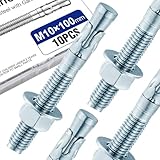
Wedge anchors expand against the sides of a drilled hole as you tighten the nut. They suit many heavier-duty connections in solid, sound concrete, but require adequate embedment and distance from slab edges. They can split or spall concrete if installed too close to an edge or over-tightened.
Adhesive anchors use threaded rod set in a hole filled with approved anchoring adhesive. They can be useful where expansion forces are undesirable or where a design calls for them, but installation is less forgiving: hole cleaning, temperature, curing time, and adhesive instructions matter. Do not load the rod before the specified cure time.
| Anchor type | Good fit | Trade-off |
|---|---|---|
| Concrete screw | Light to moderate loads; removable installs | Needs an accurate, clean pilot hole; capacity varies by size and concrete |
| Wedge anchor | Many heavier-duty connections in solid concrete | Expansion can damage concrete near edges; installation is less reversible |
| Adhesive anchor | Designs calling for threaded rod without expansion anchoring | More steps, careful hole cleaning, and cure time required |
Match size and layout to the base
Start with the post-base instructions. Check the hole diameter, anchor diameter, minimum embedment, washer requirements, and any stated concrete strength or edge-distance limits. A common mistake is choosing an anchor by overall length alone: part of that length may be needed for the base plate, washer, and nut, leaving less embedment in the slab than required.
Measure the slab thickness and mark the anchor locations through the base. Confirm that the holes are far enough from slab edges, corners, cracks, and control joints for the anchor’s instructions. If the base holes do not line up with a safe drilling pattern, do not simply enlarge or relocate them without checking the base requirements. A thin slab or a narrow edge may not be suitable for the anchor you had in mind.
For a nonstructural post, a smaller concrete screw may be adequate if the base manufacturer permits it and the loads are modest. For guardrails, elevated decks, carports, gates subject to wind, or posts carrying overhead loads, anchor selection is a structural decision. Use an engineered detail or get qualified advice; no generic anchor recommendation can account for every slab and load.
Drill and install without weakening the connection
Use a hammer drill with a carbide masonry bit for most holes in cured concrete. A regular drill may work for a small number of holes in softer concrete, but it is slower and can overheat. Match the bit diameter to the anchor maker’s instructions; for example, many concrete screws require a pilot hole specified by the package rather than a bit chosen by eye. Check the required hole depth and allow a little extra depth for dust, without drilling through the slab.
Before drilling, scan for embedded utilities and reinforcement where possible. Keep the drill square to the slab, use steady pressure, and avoid wobbling the bit, which can make the hole too wide. A hammer drill is not the same as a rotary hammer: a rotary hammer is faster in hard concrete and for many holes, but is often unnecessary for a few small anchors.
Clean every hole as directed by the anchor manufacturer. Dust left in a concrete-screw hole can prevent proper thread engagement; for adhesive anchors, inadequate cleaning can sharply reduce bond strength. Use the specified brush and blow-out method where required. Set the anchor to the stated depth and tighten to the specified torque if one is provided. More torque is not extra safety: it can strip a screw, damage threads, or crack concrete.
What to buy
For a small project using a base approved for concrete screws, compare concrete screws in the diameter and material specified for your base. Stainless steel can help with corrosion resistance, but use a grade suitable for the exposure and compatible with the base; coated or zinc-plated hardware may be inappropriate in wet, coastal, or chemically exposed locations.
For a heavier connection that calls for expansion anchors, look at wedge anchors matching the required diameter and embedment. Buy from a supplier that provides installation specifications, and check whether the anchor is approved for cracked concrete if the design requires that condition. A low-cost, unmarked anchor is a poor bargain when the connection is structural.
Failure signs and when to stop
Stop if a hole breaks out at an edge, the slab cracks during drilling, an anchor spins without tightening, or the base rocks after installation. Do not fill a bad hole with debris or move the anchor a small distance without checking minimum spacing. A failed hole may need a different anchor layout or a repair detail, not a larger fastener.
Also reconsider the job if the concrete is badly cracked, hollow, very thin, or breaking apart. Anchors only transfer load into the concrete that is actually there. When the post could injure someone or damage a structure if it loosens, have the slab and connection checked before buying hardware.