What's inside
As an Amazon Associate I earn from qualifying purchases. This post may contain affiliate links at no extra cost to you.
A small wall-mounted organizer—a key rack, mail holder or lightweight tool caddy—usually does not need a heavy-duty toggle. The right anchor depends on the organizer’s loaded weight, how far it stands off the wall and whether you can hit a stud. For most installations in sound, 1/2-inch drywall, a properly installed self-drilling anchor or a plastic expansion anchor is enough. For a deeper organizer, heavier contents or a wall that may get bumped, use a stud or a metal toggle instead.
As an Amazon Associate we earn from qualifying purchases at no extra cost to you.


What we cover
Check the load and the wall
Estimate the total weight: organizer, contents and anything likely to be added later. A 2-pound organizer holding 3 pounds of keys and mail puts roughly 5 pounds on the fasteners. If it projects several inches from the wall, pulling something off it also creates leverage, so the fasteners can see more force than the scale weight suggests. Choose hardware with a comfortable margin rather than relying on its maximum package rating.
Find out whether the wall is drywall, plaster or masonry. The advice below is for drywall; plaster and lath can crack around anchors, and masonry needs a different fastener. Check for electrical cables and plumbing before drilling, particularly above outlets, switches and sinks. A stud finder can locate framing, though you should confirm a stud’s position before driving a screw.
Which anchor suits the job?
| Anchor type | Best use | Advantages | Trade-offs |
|---|---|---|---|
| Plastic expansion anchor | Very light organizer in sound drywall | Cheap, small hole, easy to remove | Can loosen or pull out if overloaded or installed in a hole that is too large |
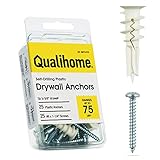
| Self-drilling plastic anchor | Light to moderate loads with no stud | Installs with a screwdriver or drill; no separate pilot hole in many products | Can strip, spin or break if driven too fast or into damaged drywall |
| Self-drilling metal anchor | Moderate loads and repeated use | More resistant to stripping than many plastic versions | Still depends on the drywall; its sharp tip can damage hidden wiring if used carelessly |
| Toggle or snap-toggle anchor | Heavier, projecting or frequently loaded organizer | Spreads load behind the panel | Larger hole; installation and removal are less convenient |
| Wood screw into a stud | Any load where a stud lines up | Strong, simple and dependable | Organizer hole spacing may not match stud spacing |
Best choices by situation
For a light organizer holding a few pounds, plastic expansion anchors are the low-cost choice if the wall is intact and the included screw fits. They are less suitable for items that get tugged daily or for a mount with a long stand-off. Avoid using them in crumbly, patched or previously enlarged holes.
For a typical small organizer that will hold mail, charging cables or a handful of tools, a self-drilling drywall anchor kit is a practical step up. Many are rated for loads in the tens of pounds per anchor, but ratings vary by anchor, drywall thickness and test conditions. Follow the package rating and instructions, and do not assume two anchors safely double a single-anchor rating.
Choose a metal self-drilling anchor when the organizer may be removed and reinstalled or its fasteners will see regular handling. It is not a substitute for a toggle if the load is heavy or pulls outward. If the organizer is bulky, holds concentrated weight or is likely to be yanked, use a snap-toggle anchor sized for the wall and screw holes. Toggles spread the load behind the drywall, but a large hole can be harder to repair if you later move the organizer.
If a stud lands behind one mounting point, fasten into it with a suitable wood screw and use an anchor for the other point if necessary. A stud is often the best option, but do not force the organizer onto a crooked screw or leave one side inadequately supported.
Install without damaging the wall
Read the anchor package before drilling. Hole size and screw size are not universal. Mark the organizer’s holes with a level, then check for framing and hidden services. With self-drilling anchors, keep the drill at low speed and use light pressure. A cordless drill with a clutch is easier to control than an impact driver, which can overdrive the anchor, spin it in the wall or snap a plastic body. Stop when the anchor flange sits flush; do not bury it in the paper face.
For a conventional plastic expansion anchor, drill the specified pilot hole straight and clear out loose dust. Tap the anchor in gently until its rim is flush, then drive the screw. If it spins while the screw goes in, the hole may be oversized or the drywall may be damaged. Remove it and move the mounting point rather than trying to tighten it harder.
For a toggle, drill the stated hole, insert the folded toggle and seat it behind the drywall before tightening the screw. Keep the bracket flat against the wall as you tighten. Do not use the screw to pull a loose bracket into place; that can crush the drywall surface and weaken the mount.
Avoid common failures
Use all the mounting holes provided when possible, and keep the organizer close to the wall. If it wobbles, the screw heads do not clamp the bracket, or the drywall face starts to dent, unload it and inspect the installation. Repeatedly tightening a loose anchor usually makes the hole worse. Move the fastener to fresh drywall or use a toggle if the location and load call for one.
For a small organizer with modest contents, an inexpensive plastic anchor is often entirely adequate. Spend more on a toggle only when the load, leverage or daily handling justifies the larger hole and extra installation steps. When the organizer is important, heavy or frequently pulled, a stud-mounted screw—or a properly sized toggle—offers a more reliable fix than stretching a light-duty anchor beyond its intended job.