What's inside
As an Amazon Associate I earn from qualifying purchases. This post may contain affiliate links at no extra cost to you.
Sleeve anchors and wedge anchors both expand inside a drilled hole to hold fixtures in concrete. Neither is automatically stronger in every installation: the right choice depends on the fixture, concrete condition, edge distance, load direction, and anchor size. For a typical homeowner mounting a bracket or railing, the key practical difference is that a sleeve anchor can work in several solid masonry materials, while a wedge anchor is intended for solid concrete and is often favored for heavier, higher-demand attachments.
As an Amazon Associate we earn from qualifying purchases at no extra cost to you.



What we cover
How the two anchors grip
A sleeve anchor has a threaded bolt or stud surrounded by an expansion sleeve. Tightening the nut pulls a tapered cone into the sleeve, pushing it outward against the sides of the hole. Many sleeve anchors have a nut and exposed stud; others use a bolt head. Their sleeves can expand along a relatively long section of the hole, which helps them work in materials such as brick and concrete block when the anchor is approved for that substrate.
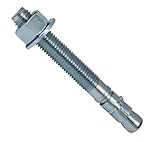
A wedge anchor has a threaded stud, a clip near its embedded end, and a tapered section. As the nut is tightened, the stud draws the wedge into the clip, forcing the clip outward against the concrete. Wedge anchors are made for solid concrete, not hollow block or brick. They are commonly used for fixed plates, equipment, and structural attachments where the anchor manufacturer’s data supports the intended load.
Sleeve anchors vs. wedge anchors
| Factor | Sleeve anchor | Wedge anchor |
|---|---|---|
| Typical substrate | Concrete and, where rated, solid brick or block | Solid concrete |
| Installation | Set anchor, then tighten nut or bolt | Set stud to required depth, then tighten nut |
| Common use | Light to moderate fixtures; some masonry applications | Fixed attachments in concrete, including heavier-duty uses when properly specified |
| Adjustment after setting | Usually limited; removal may leave an expansion sleeve in the hole | Not readily removable; stud remains in the concrete |
| Main limitation | Capacity varies considerably by substrate and anchor design | Not suitable for hollow masonry; concrete condition and edge distance matter |
Do not compare anchors by diameter alone. A 3/8-inch anchor’s capacity depends on its embedment, the concrete strength, spacing from other anchors, distance to an edge, and whether the load pulls outward or pushes sideways. Check the manufacturer’s load tables and installation instructions for the exact anchor, rather than relying on a generic claim that one type is “stronger.”
Which one should you buy?
For a shelf bracket, small utility rack, or other modest fixture on sound concrete, a correctly sized sleeve anchor may be a practical, less expensive choice. It is also the more flexible option if the mounting surface is brick or solid block—but verify the anchor is approved for that material. A sleeve anchor is not a safe workaround for hollow block; the sleeve can expand into a void and fail to grip the face shell reliably.
For a base plate, machinery, or a railing post anchored into solid concrete, look at a wedge anchor when its published ratings meet the load and installation conditions. If a failure could injure someone or cause significant damage, follow the fixture or structural design requirements and use a qualified installer. A more robust-looking anchor is not a substitute for a specified design.
Compare length as well as diameter. The anchor must pass through the fixture and still achieve its required embedment in sound concrete. Account for washers, plate thickness, and any non-structural finish; do not count tile, mortar, or loose surface material as effective embedment. If the required embedment would put the hole too near a slab edge, choose a design and layout supported by the manufacturer’s data instead of simply drilling deeper.
For general concrete work, shop a rated concrete sleeve-anchor assortment for modest fixtures, or compare concrete wedge anchors for solid-concrete installations. Match diameter and length to the instructions; avoid choosing an assortment solely because it contains many sizes.
Drilling and setting without weakening the hold
Use the drill bit diameter specified for the anchor. A hammer drill with a sharp masonry bit is usually the practical tool for ordinary concrete holes; for repeated or larger holes, an SDS-plus rotary hammer can drill faster and with less effort. Keep the hole perpendicular to the surface and avoid wobbling the tool, which can enlarge the hole. A hole that is too wide may prevent the anchor from developing its intended grip.
Drill to the required depth, allowing room for dust below the anchor. For example, if the specified embedment is 2 inches, the hole generally needs additional depth for debris and the anchor’s tip; follow the product instructions rather than assuming the embedment equals the drill depth. Clear dust with the method the manufacturer specifies—a hole brush and vacuum are common. Dust left in the hole can interfere with seating and expansion.
Set the anchor straight and tighten the nut to the specified torque when one is given. Over-tightening can damage threads, strip the fastener, or crush weaker masonry; under-tightening can leave the expansion mechanism short of its intended setting. Avoid impact drivers for final tightening unless the anchor instructions permit them. An impact driver can apply torque abruptly, making it easy to overshoot. A hand wrench or controlled socket wrench gives better feedback.
Warning signs and common failure modes
Stop if drilling reveals a void, crumbling concrete, or a hole that suddenly wanders. Do not install a wedge anchor in hollow masonry, and do not reuse an oversized or badly damaged hole by driving in a larger anchor without checking its required edge distance and capacity. Concrete can also crack or spall when anchors are too close to an edge or too close together. Follow the specified minimum spacing and edge distances; these vary by anchor and load.
Before mounting the fixture, check for electrical wiring, plumbing, and reinforcing steel. A rebar hit is not a reason to force the bit through or shift the hole a few millimeters toward an edge. Reassess the layout first. For a noncritical fixture, the cheaper sleeve anchor is often enough when it is approved for the substrate and installed correctly. For a safety-critical or heavily loaded attachment, use the anchor type and installation details supported by the design—not guesswork.