What's inside
As an Amazon Associate I earn from qualifying purchases. This post may contain affiliate links at no extra cost to you.
What we cover
Choosing a cordless drill for composite wood
Composite wood covers several materials, including wood-plastic decking, composite trim, and particleboard or MDF panels. They do not all drill the same way. Decking can be dense and abrasive; MDF and particleboard can crumble or swell if a hole is oversized or the surface gets wet. For most household jobs, a standard cordless drill/driver is enough. A hammer drill’s impact mode is for masonry, not composite, and can damage the hole.
Look for a drill with a variable-speed trigger, a clutch, and a chuck that accepts the bit sizes you need. A 3/8-inch chuck handles many common bits; a 1/2-inch chuck offers more room for larger bits and is common on heavier drills. For occasional pilot holes and small screws, an inexpensive 12-volt drill is often adequate. For repeated drilling, larger holes, or long runs of decking, an 18- or 20-volt drill gives more reserve and usually a larger battery.
As an Amazon Associate we earn from qualifying purchases at no extra cost to you.
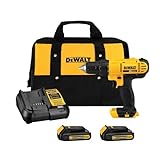


Drill options at a glance
| Option | Best for | Trade-off |
|---|---|---|
| 12-volt drill/driver | Small pilot holes, light assembly, occasional repairs | Compact and cheaper, but can slow down with large bits or dense boards |
| 18- or 20-volt drill/driver | Decking, frequent use, and holes up to roughly 1/2 inch | More power and battery capacity, with added weight and cost |
| Right-angle drill | Drilling in tight spaces between framing or near corners | Useful for access, but unnecessary for open, straightforward work |
| Impact driver | Driving compatible screws after drilling pilot holes | Fast at fastening, but poor choice for controlled, clean holes |
Choose a cordless drill/driver based on the work you actually expect to do. A premium drill is not automatically better for a few holes in a planter or a short repair. If you already own batteries from a tool platform, a bare tool from that same platform may be the better buy.
Bits, speed, and drilling technique
Use a sharp bit suited to the hole: a standard twist bit for small holes, a brad-point bit for cleaner entry in wood-based panels, or a suitable hole saw for large openings. For composite decking, check the manufacturer’s instructions; some products call for predrilling near board ends or in cold weather. A dull bit creates heat, wanders, and can leave a ragged exit. Replace it or sharpen it rather than leaning harder on the drill.
Start at low speed so the bit does not skate across the surface, then increase pressure gradually. Keep the drill square to the board and let the cutting edges do the work. For a 1/8-inch pilot hole, use a light touch and avoid forcing the bit. Larger holes generate more heat and torque: withdraw the bit periodically to clear chips, especially in MDF or a deep hole. If the drill stalls, release the trigger; repeatedly squeezing it against a stuck bit can overheat the motor or twist your wrist.
For holes near an edge, test on a scrap piece first. Composite can split or chip when the hole is too close to the edge, while MDF may break out at the back. Clamp the work where practical and place scrap wood behind it to support the exit side. Wear eye protection, and keep loose clothing and hair away from the rotating chuck.
Battery, torque, and clutch control
Voltage alone does not tell you how well a drill will perform. Battery condition, gear ratio, and drill design also matter. A healthy 12-volt battery can handle small holes comfortably; an older, partly discharged pack may bog down sooner. If you have many holes to make, two batteries let one charge while you work. Higher-capacity batteries generally run longer but add weight, which matters when drilling overhead or at arm’s length.
Use the clutch for screws, not for drilling holes. Set it low and test on scrap when fastening into composite; excessive torque can strip the material, break a screw, or pull the head below the surface. A drill’s low gear gives more control for large bits and driving, while high gear is useful for smaller bits when the drill can maintain speed. If your work is mainly small holes and short screws, a 12-volt drill kit can save money and reduce fatigue.
When another tool makes sense
An impact driver is designed to drive fasteners, not to replace a drill for accurate holes. It can work with hex-shank drill bits, but its pulsing action makes careful, clean drilling harder. For a deck project, use a drill for pilot holes and an impact driver for screws if you already have both. If buying only one tool, choose a drill/driver for a mix of drilling and light fastening. A cordless impact driver is a sensible second tool when fastening is the main task.
Do not switch on hammer mode for composite, even if your drill has it. The hammering action is intended for masonry and may crush the material around the hole. For a large hole saw or repeated holes in thick, dense stock, step up to a stronger drill if your current one repeatedly stalls. But for ordinary pilot holes, a basic drill with a sharp bit and steady technique is usually the cheaper, more practical choice.