What's inside
As an Amazon Associate I earn from qualifying purchases. This post may contain affiliate links at no extra cost to you.
What we cover
The basic difference
A keyless chuck and a quick-change hex collet both hold drill bits, but they are built around different shanks and priorities. A keyless chuck grips round or hexagonal shanks with three jaws; twist the chuck sleeve by hand to tighten or release them. A quick-change hex collet accepts bits with a 1/4-inch hex shank and locks them with a spring-loaded sleeve or internal detent.
For ordinary drilling with a cordless drill, a keyless chuck is usually the more versatile choice. A hex collet is quicker for swapping compatible bits and suits impact drivers, which commonly use that interface. The right pick depends less on which holder sounds faster and more on the bits, tool, and material you plan to use.
As an Amazon Associate we earn from qualifying purchases at no extra cost to you.
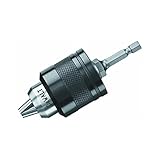

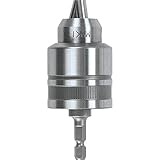
Keyless chuck vs. hex collet
| Feature | Keyless chuck | Quick-change hex collet |
|---|---|---|
| Typical fit | Round and hex shanks, within chuck capacity | Usually 1/4-inch hex shanks |
| Common tool | Cordless drill or hammer drill | Impact driver; some drills have a collet |
| Bit changes | Turn the sleeve to open and tighten the jaws | Pull the sleeve, insert or remove the bit |
| Best suited to | General drilling and varied bit sizes | Frequent changes among hex bits and drivers |
| Main limitation | Slower changes; jaws can loosen if poorly tightened | Many round-shank bits will not fit directly |
Choose a keyless chuck for drilling versatility
A chuck gives you more choice in drill bits. A common 3/8-inch chuck accepts shanks up to 3/8 inch; a 1/2-inch chuck accepts larger shanks, provided the bit and tool are rated for the task. Check the actual chuck capacity before buying a bit. A 1/2-inch chuck does not mean the drill can comfortably bore a 1/2-inch hole in every material.
Round-shank twist bits, many masonry bits, and a wide range of specialty bits are made for chucks. A chuck is also useful when the job calls for a bit that is not available with a 1/4-inch hex shank. For a homeowner drilling pilot holes, clearance holes, or anchor holes with different bit types, a cordless drill with a keyless chuck is generally the most flexible first tool.
Tightening matters. Open the jaws enough to seat the shank straight, then tighten firmly by hand. If the bit slips, stops turning, or starts wobbling, stop and reseat it; continuing can score the shank or enlarge the hole. Keep the shank clean, and avoid clamping on a fluted section when there is a smooth shank available. A chuck is not a substitute for a drill press when precise, repeatable alignment is required.
Choose a hex collet for fast bit changes and fastening
A 1/4-inch quick-change collet makes sense when most of your work involves screwdriver bits, nut drivers, short hex-shank drill bits, or switching repeatedly between drilling and driving. Insert a compatible bit until the detent engages, then tug lightly to check it is seated. To remove it, pull back the sleeve and withdraw the bit.
That speed is useful for jobs such as drilling pilot holes and driving screws in sequence. It is also why impact drivers use hex collets: they are designed for driving fasteners and deliver repeated rotational impacts. For deck screws or other demanding fastening, use an impact-rated driver bit. Ordinary drill bits are not automatically suitable for impact-driver use, even if their hex shanks fit.
The trade-off is bit compatibility. A collet-only tool will not directly accept most round-shank drill bits. Adapters can help, but they add length and another connection that may introduce wobble or slip. A hex-shank drill bit can also be shorter or less common in some diameters than its round-shank equivalent. If your work includes larger holes, specialty bits, or masonry drilling, a collet alone may be limiting.
Match the holder to the job
For hanging a shelf in drywall, a chuck-equipped drill can make the pilot hole and drive screws with a bit change. In brick or concrete, use a hammer drill with the correct masonry bit when the tool and anchor instructions call for hammer drilling. Do not use an impact driver as a substitute for a hammer drill: their impact actions are different. For many plastic wall anchors, drilling a straight hole to the specified diameter matters more than changing bits at top speed.
For assembly work with many screws, a hex-collet impact driver is convenient, especially when paired with a separate drill for holes. If you want one tool for occasional drilling and fastening, a drill with a chuck is often the simpler purchase. A drill-and-impact-driver combo costs more, but it avoids using an adapter or forcing one tool to do every task.
Before buying, compare the holder with the bits you already own. If most have round shanks, keep a chuck. If they are mostly 1/4-inch hex, and your jobs are largely screw driving, a collet tool may be all you need. A cordless drill with a keyless chuck is a sensible general-purpose option; for frequent fastening, consider a cordless impact driver with a 1/4-inch hex collet.
Adapters and common mistakes
A hex-to-chuck adapter lets an impact driver turn a chuck, but it does not turn the impact driver into a standard drill. The added chuck can wobble, and repeated impacts may loosen a low-quality adapter or damage a non-impact-rated bit. Use one for light, occasional drilling only when the adapter and bit are rated for the tool. For regular drilling, use a drill.
Likewise, do not assume that every quick-change holder accepts every hex accessory. Some compact holders, extensions, and collets have different locking details. Check that the bit locks securely and does not slide out under hand pressure. With either system, stop if the bit binds: release the trigger, switch off the tool, and free the bit rather than twisting the tool against a stuck bit. That reduces the risk of a damaged workpiece, a bent bit, or a sudden wrist twist.
Paying extra for a collet makes little sense if you rarely swap bits and need round-shank drills. Paying extra for a large chuck makes little sense if all you drive are screws. Buy for the shanks and tasks you actually use, and keep a dedicated drill or driver for any job your chosen holder cannot handle safely.