What's inside
As an Amazon Associate I earn from qualifying purchases. This post may contain affiliate links at no extra cost to you.
An impact driver can run pocket-hole screws quickly, but speed is not the main buying criterion. For this work, control matters more: the tool must drive a long screw without stripping its head, overdriving the joint, or splitting the workpiece. A compact 18V or 20V-class cordless driver is a good fit for frequent projects; a basic 12V model can be enough for occasional furniture and cabinets.
As an Amazon Associate we earn from qualifying purchases at no extra cost to you.



What we cover
What matters for pocket-hole work
Pocket-hole screws are commonly driven with a square-drive bit, often a #2 square bit. Check the screw maker’s recommendation and use a bit that fits snugly; a worn or loose bit cams out easily. Most impact drivers accept standard 1/4-inch hex-shank bits, so compatibility is straightforward. Keep a spare bit on hand, especially for a larger batch of screws.
Look for a variable-speed trigger and, ideally, multiple speed or assist modes. A low-speed setting makes it easier to seat the screw gently in the last part of the drive. Bright work lights, a belt hook, and a short body are useful in cabinet corners, but they matter less than predictable trigger control. Brushless motors can improve efficiency and runtime, but they are not essential for occasional pocket-hole assembly.
Impact drivers deliver rotational impacts when resistance rises. That helps drive long screws, but the tool can also keep turning after the screw head reaches the material. The resulting failure may be a stripped recess, a buried head, a split board, or a joint pulled out of alignment.
Choosing a driver
| Driver type | Best fit | Trade-off |
|---|---|---|
| 12V compact impact driver | Occasional projects, smaller screws, tight spaces | Light and easy to handle, but may run out of torque or battery sooner in dense hardwood or long assembly sessions |
| 18V/20V-class impact driver | Regular shop use and mixed materials | More capable and widely supported, but heavier and easy to overpower the joint if used carelessly |
| Drill/driver | Maximum control and occasional fastening | Less impact action; may be slower on long screws, but its clutch can help prevent overdriving |
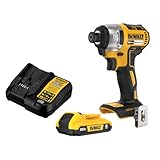
For a first cordless tool, a compact cordless impact driver kit is a practical all-around choice. Compare the included battery capacity and charger, not just the tool price. A small battery is lighter for a few joints; a second battery is more useful than a large one if you are assembling a project in several short sessions.
If you already own a compatible battery platform and work mostly with softwood or plywood, buying a bare tool may be cheaper. A less expensive brushed model is also fine for occasional use. Pay more for brushless performance or extra modes only if you will use the tool often enough to value the added runtime, control options, or platform investment.
Impact driver or drill/driver?
An impact driver is compact and effective at driving pocket screws, particularly long screws into hardwood. It does not usually have the adjustable clutch found on a drill/driver, so it requires a lighter touch. A drill/driver’s clutch can slip once resistance reaches a chosen setting, reducing the chance of burying the head. It may be the better choice for a beginner, delicate material, or a small number of joints.
If you want one tool mainly for drilling pocket holes and assembling them, a cordless drill/driver with an adjustable clutch is versatile. For a shop that already has a drill, an impact driver adds speed for fastening. Avoid buying a heavy high-torque tool just for pocket-hole screws: extra power does not improve the joint, and it can make mistakes happen faster.
Drive pocket screws with control
Clamp the pieces flush before driving. A pocket-hole jig helps position the holes, but it does not hold the joint aligned; the screw can shift a rail or frame member as it tightens. Use a face clamp or another suitable clamp, and test the setup on scrap from the same material. Confirm that the screw length suits the stock thickness and that the tip will not break through the far side.
Start on a low setting and pull the trigger gradually. Stop when the head is seated as intended, not when the tool has driven as far as it can. If the bit jumps out, stop rather than continuing to run the driver against a damaged recess. Re-engage with a fresh bit if needed. For a joint that moves during tightening, release the trigger, realign and clamp it again instead of trying to force it into position.
Hardwood, end grain, and long screws raise the risk of splitting or excessive resistance. Check the pocket-hole system’s guidance for screw and material combinations; a pilot hole or a different screw may be appropriate when the material is especially dense. Plywood can be more forgiving, but thin stock is still easy to overdrive. If a screw repeatedly stalls or strips, inspect the bit, screw length, alignment, and material before reaching for a more powerful tool.
Batteries and bits
Battery voltage labels alone do not predict how comfortably a driver handles the job. For occasional assembly, a compact battery is usually adequate. For a run of cabinets or furniture with many screws, a second battery reduces interruptions. Keep batteries and tools on one platform where practical, but do not pay for a larger system if the driver will be used only a few times a year.
Use a quality square-drive bit with the correct tip, and replace it when its edges round over. A #2 square-drive impact bit set can provide spares for repeated assembly. “Impact-rated” bits are designed to tolerate impact-driver use, though fit and condition still matter. A worn bit can damage screw heads even in a premium driver.
Before buying, handle the tool if possible. Check that the grip feels secure, the trigger is easy to feather, and the tool can reach the pocket holes you expect to use. For most pocket-hole work, those practical details—and a steady driving technique—matter more than headline torque figures.