What's inside
As an Amazon Associate I earn from qualifying purchases. This post may contain affiliate links at no extra cost to you.
On thin steel, the choice between a self-drilling screw and a screw installed in a pilot hole comes down to the materials, the sheet thickness, and how much control the job needs. Self-drilling screws save a step by cutting their own hole. Pilot-hole screws can be a better fit when the sheet is very thin, the connection must be tidy, or the screw’s drill point is too large for the job.
As an Amazon Associate we earn from qualifying purchases at no extra cost to you.


What we cover
How the screw types differ
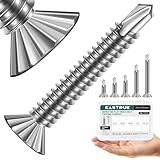
A self-drilling screw has a drill-shaped point that cuts through the steel before its threads engage. It needs no separate pilot hole, provided its drill point is rated for the material thickness. These are often called TEK screws, though point sizes and capacities vary.
A pilot-hole screw has a conventional pointed tip and forms or engages threads in a hole drilled first. In thin sheet, it may be a sheet-metal screw with sharp threads; in thicker steel, a machine screw may need a tapped hole or a nut. A pilot hole helps guide the screw, but it does not automatically make a connection stronger. Hole size, screw diameter, sheet thickness, and the load all matter.
Quick comparison
| Factor | Self-drilling screw | Pilot-hole screw |
|---|---|---|
| Extra drilling step | Usually none | Yes |
| Best fit | Repeated fastening in steel within the point’s rated capacity | Very thin sheet, controlled placement, or a specified hole size |
| Main risk | Overdriving, stripped sheet, or a point that cannot cut the stack | Oversized or misplaced hole; extra setup time |
| Typical tool setup | Drill or impact driver with the correct bit | Drill and bit, then a driver for the screw |
| Cost trade-off | Higher screw cost, fewer steps | Often cheaper screws, but more labor and tooling |
Choose by thickness and stack-up
Check the screw maker’s drilling-capacity range against the total steel thickness the point must penetrate—not just one sheet if the screw passes through two. A self-drilling point that is too small or under-rated can spin, heat up, and polish the steel without breaking through. A point that is unnecessarily large can remove more material than a thin sheet can support.
For light-gauge sheet, especially around 0.5 mm (about 0.020 in.) or thinner, test the actual screw and material before committing. In very thin steel, the drill point may make a hole wider than the threads can grip securely. A correctly sized pilot hole and a suitable sheet-metal screw may give more predictable results, but the specified hole diameter is critical. Too large, and the threads have little material to bite; too small, and the screw may distort the sheet or break.
For thicker steel within the screw’s stated capacity, self-drilling screws are usually faster for repeated work. If the steel is beyond that capacity, use a suitable drill bit and a fastening method designed for the application—such as a pilot hole with a specified screw, or a tapped hole and machine screw. Do not assume a more powerful impact driver will make an unsuitable drill point work.
Tools and technique that prevent failures
Use a drill or impact driver with the correct driver bit, and keep the fastener square to the surface. A drill gives better control for delicate sheet and is often the safer choice near the point of breakthrough. An impact driver can speed up repetitive fastening, but impacts can make it easier to overdrive a small screw and strip thin steel. If using one, start gently and stop as soon as the head seats.
Choose a clutch setting or speed that lets you control the screw. Avoid leaning hard on the tool; pressure can deflect a small screw or buckle unsupported sheet. Support the work near the fastening point where practical. For pilot holes, clamp the pieces so they cannot shift, use a sharp bit, and remove chips before driving the screw. A hand drill can be useful for short runs; for frequent metal work, compare cordless drills with variable speed and a clutch.
Common failures have visible clues. A screw that spins without tightening has likely stripped its grip, often from overdriving or an oversized hole. A screw that stalls before the threads engage may have an undersized or damaged drill point, a dull tip, or a stack thicker than its rating. A raised ring or torn sheet around the head can mean the screw was driven too hard or the material was unsupported. Stop rather than repeatedly running a stalled screw; that adds heat and can ruin the hole.
What to buy for the job
For dozens or hundreds of fasteners in compatible steel, self-drilling screws usually repay their higher unit price in saved drilling time. Match the point capacity, thread style, head, and coating to the materials and environment. A range of self-drilling sheet-metal screws is useful for comparing point styles and pack sizes, but verify the manufacturer’s capacity rather than choosing by appearance alone.
For a few fasteners, thin sheet, or a connection where hole placement must be controlled, ordinary pilot-hole screws can be the cheaper and more sensible choice. Buy the drill bit size specified for the screw, not a rough estimate. If the screw requires a pilot hole through steel, a metal-rated drill-bit set can cover common sizes; cobalt bits are useful for heat-resistant alloys and repeated work, but are often unnecessary for a small amount of mild steel.
Test before installing the full run
Drive one fastener in a scrap piece or an inconspicuous spot. Check that it cuts cleanly, seats without crushing the sheet, and holds when gently tested. For structural, overhead, exterior, or safety-critical connections, follow the specified fastener, spacing, and installation method rather than substituting based on convenience. Thin steel offers little thread engagement, so a neat-looking head is not proof of a dependable joint.