What's inside
As an Amazon Associate I earn from qualifying purchases. This post may contain affiliate links at no extra cost to you.
Stair treads put unusual demands on an impact driver. The screws are often long, the hardwood can split near an edge, and a slipping bit can leave a visible scar. You want enough power to seat the fastener without treating every screw like a test of maximum torque. A compact 18V or 20V brushless driver is a sensible choice for a full stair rebuild; a basic 12V driver can be enough for a few screws if you drill pilot holes.
As an Amazon Associate we earn from qualifying purchases at no extra cost to you.



What we cover
What matters in an impact driver
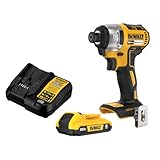
For stair work, prioritize speed control, a comfortable grip, and a reliable quick-change chuck over the highest advertised torque number. A variable-speed trigger lets you start slowly and keep the bit engaged. Three speed or assist modes are useful, too: the lower setting helps avoid burying a screw head or snapping a small fastener, while a higher setting is available for long structural screws.
Brushless motors tend to run more efficiently and are common in midrange cordless tools, but they are not essential for occasional tread repairs. Battery compatibility may matter more: if you already own tools in a battery platform, buying a bare driver can keep the cost down. For a large staircase, a 2.0Ah battery is lighter, but a 4.0Ah pack usually means fewer interruptions.
Impact driver options compared
| Option | Best for | Trade-off |
|---|---|---|
| Compact 12V impact driver | Small repairs and a few screws | Less reserve for long screws; pilot holes matter |
| Brushless 18V/20V driver with speed modes | Installing multiple treads or a full flight | More tool than needed for occasional light work |
| Basic brushed 18V/20V driver | Budget-conscious buyers already on the battery platform | Usually bulkier or less efficient; fewer control features |
| Drill/driver used instead | Short screws and careful, low-volume fastening | Can stall on long screws; slower when the wood is dense |
For a new tool, compare a brushless 18V or 20V impact driver kit if you expect to use it beyond one stair project. If you already have compatible batteries, a bare-tool impact driver with variable speed is often the economical route. A 12V impact driver kit is a reasonable pick for a small repair, especially if you value low weight.
Choose the screw and prepare the wood
Use screws intended for structural or finish carpentry, as appropriate to the tread design and the manufacturer’s instructions. Ordinary drywall screws are brittle and are not a substitute for wood screws. Check the required length against the tread thickness and the material beneath it; a long screw can emerge through a riser or hit something you did not intend to penetrate.
In hardwood, near an edge, or with a screw around 2 inches or longer, drill a pilot hole rather than relying on impact force to drive it. Select the pilot diameter using the screw’s solid core diameter, not the outside thread diameter; the screw maker’s guidance is best. A clearance hole through the tread can also help when fastening the tread tightly to a support below. Keep holes far enough from the edge to avoid splitting—if the tread design permits, roughly 1 inch or more is a safer starting point than placing a screw close to the corner.
Use a sharp, correctly sized bit that fully fits the screw recess. A worn or undersized bit cams out, damaging the head and potentially the tread. Keep a spare bit nearby; impact drivers can wear bits quickly when the bit is not seated straight.
Drive screws without damaging the tread
Mark the screw locations and drill the pilots before driving. Hold the driver in line with the screw, press firmly enough to keep the bit seated, and begin at low speed. Once the screw is well engaged, increase speed as needed. Stop when the head is flush or reaches the intended seating depth. An impact driver can sink a screw below the surface in a fraction of a second, especially in softer wood.
For a visible tread, test the setting on scrap of similar material. If the screw head must be recessed, use a countersink or a depth-controlled approach instead of forcing the driver to make a crater. Do not continue hammering on a screw that has stopped moving: back it out, inspect for a wrong pilot size, a knot, a dull bit, or a screw that is too long. Forcing it can strip the recess, break the screw, or split the tread.
Noise and vibration are another trade-off. Impact drivers are effective but loud and less refined than a drill/driver. For a handful of short screws, a drill/driver with a clutch may offer better control. For many long screws, an impact driver saves effort, but it still benefits from pilots and a careful trigger finger.
Which one should you buy?
Choose a brushless 18V/20V driver with at least two speed settings if you are fastening a whole staircase or expect regular construction use. Its power reserve and control are a practical combination, not a guarantee against splitting or overdriving. Choose a budget brushed model if you already own its batteries and only need it occasionally; the savings can be more useful than extra features. For a couple of repairs, a 12V tool—or a drill/driver with pilot holes—may be entirely adequate.
Before buying, check whether the listed price includes a battery, charger, belt clip, and case. Kit prices can look higher than bare-tool prices, but a bare driver is no bargain if you have no compatible battery. Whatever you choose, the right screw, a suitable pilot hole, and controlled driving will matter more to the finished tread than a peak-torque figure on the box.