What's inside
As an Amazon Associate I earn from qualifying purchases. This post may contain affiliate links at no extra cost to you.
What we cover
The best high-end espresso machine for home baristas: quick picks
The best high end espresso machine for home baristas is the Decent DE1 if you want software-guided control and adjustable pressure profiles; choose a La Marzocco Linea Mini for a more traditional, durable dual-boiler setup, or a Lelit Bianca V3 for hands-on flow profiling at a lower general market price.
These machines suit different kinds of home baristas. The key decision is not simply how many features a machine has: it is whether you want repeatable temperature control, manual control over extraction, powerful milk steaming, or a compact footprint. A good grinder is essential regardless of your choice.
As an Amazon Associate we earn from qualifying purchases at no extra cost to you.



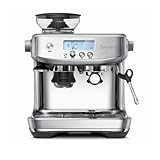
At a glance: three high-end choices
| Machine | Boiler and control | Pressure profiling | Approx. size (W × D × H) | Best fit |
|---|---|---|---|---|
| Decent DE1 | Thermoblock-based heating with electronic temperature control | Programmable profiles with real-time monitoring | About 33 × 42 × 37 cm | Data-minded baristas who want to experiment and repeat recipes |
| La Marzocco Linea Mini | Separate brew and steam boilers; electronic brew-temperature settings | No built-in manual paddle profiling | About 36 × 45 × 38 cm | Frequent milk drinks and a classic, serviceable workflow |
| Lelit Bianca V3 | Dual boiler; PID temperature control | Manual flow control with a paddle | About 29 × 49 × 40 cm | Hands-on profiling without moving to a fully software-led system |
Dimensions are approximate and can vary slightly by model generation and measurement method. Allow extra room for the portafilter handle, water-tank access, ventilation, and opening any top-mounted reservoir. Confirm current specifications before buying.
Choose by the way you make coffee
| Your situation | Best match | Why |
|---|---|---|
| You enjoy adjusting recipes and comparing shot data | Decent DE1 | Its software-based controls make pressure and temperature experiments easier to document and repeat. |
| You make several milk drinks in a row | La Marzocco Linea Mini | Its separate boilers let brewing and steaming happen without waiting for one boiler to change temperature. |
| You want manual control with a familiar espresso-machine workflow | Lelit Bianca V3 | The paddle gives direct flow control, while the dual-boiler layout supports simultaneous brewing and steaming. |
| You have limited counter depth | Lelit Bianca V3, subject to measuring | It is relatively narrow, but its depth is substantial. Compare the full machine footprint with your available counter, not just its width. |
What matters in daily use
Boilers, temperature stability, and warm-up
A dual-boiler machine has separate boilers for brewing and steam. It is usually the convenient choice for back-to-back espresso and milk drinks because the two tasks can run at once. The trade-off is a larger, more complex machine with more components to maintain. The Linea Mini and Bianca V3 follow this approach.
The Decent DE1 uses a different heating design and relies on electronic control rather than a conventional large brew boiler. Its temperature can be adjusted through the interface, but warm-up is not just the time until a screen says the machine is ready: the group, portafilter, and cup also need to heat. Budget roughly 5–15 minutes for initial readiness, depending on machine, room temperature, and workflow; a fully heat-soaked setup may take longer. Smart plugs or scheduled startup can help, but follow the manufacturer’s guidance and do not leave equipment running unattended if that conflicts with its instructions.
PID control helps maintain a chosen temperature, but it cannot compensate for stale beans, uneven grinding, or inconsistent puck preparation. For repeatability, keep the dose and yield steady before changing brew temperature.
Pressure profiling versus dependable repetition
Pressure profiling changes how water pressure is delivered during a shot. It can help explore lighter roasts or reduce harshness in a particular recipe, but it is not an automatic upgrade to every espresso. A profile that is difficult to repeat can make diagnosis harder.
The DE1 is the most software-oriented option here: profiles and shot information are central to its design. The Bianca’s paddle offers a more tactile approach, allowing the barista to adjust flow manually. The Linea Mini favors a conventional, consistent brew style rather than built-in user-operated pressure profiling. Pick profiling because you expect to use it, not because the feature list is longer.
Steam power and milk workflow
For cappuccinos and lattes, steam performance affects how quickly you can prepare drinks and how easy it is to texture milk. Dual boilers generally make repeated milk service more practical than machines that must switch between brewing and steaming. Still, boiler size and heating design are only part of the story: steam-tip design, wand movement, pitcher size, and practice matter too.
Before buying, check whether the machine’s steam controls and wand reach suit your preferred pitchers. If you mostly drink straight espresso, paying extra for high-volume steaming may not be worthwhile.
Do not overlook the grinder or the counter
All three machines need a capable espresso grinder that can make small, consistent adjustments to grind size. A machine cannot fix channeling caused by an inconsistent grind or poorly distributed coffee. Set aside a substantial part of the overall budget for the grinder, scale, and basic cleaning supplies rather than spending everything on the machine.
Measure the counter in three dimensions. Include space behind the machine for water access and plumbing if applicable, room above it if you plan to use the cup tray, and clearance for the portafilter handle. The Bianca is comparatively narrow but deep; the Linea Mini is wider; the DE1 is compact in width but still needs practical working space. Also consider where the grinder, knock box, and milk pitcher will go. A crowded station can be more frustrating than a slightly less feature-rich machine.
Ownership and cleaning: the routine that protects the investment
- After each session: purge and wipe the steam wand immediately, rinse the portafilter and basket, and flush the group briefly. Dried milk is harder to remove and can block the steam tip.
- Regularly: clean the shower screen and group area, and backflush only if the manufacturer’s instructions call for it and the machine supports it. Use the specified detergent and procedure.
- Water matters: use water within the manufacturer’s recommended hardness and mineral range. Very hard water raises scale risk; unsuitable soft or purified water can also cause problems in some machines.
- Over time: gaskets, screens, and other service parts wear. Seals can leak or lose pressure, while scale buildup can impair heating and water flow. Keep up with maintenance and choose a machine with accessible parts and qualified service in your area.
A common mistake is descaling on a fixed schedule without checking the manufacturer’s guidance. Some machines require a particular water strategy, and an incorrect descaling procedure can create problems. Follow the manual rather than assuming that more frequent descaling is always safer.
Bottom line
Choose the Decent DE1 if programmable profiles and shot data will genuinely shape how you make coffee. Choose the Linea Mini if your priority is an established dual-boiler workflow and frequent milk drinks. Choose the Lelit Bianca V3 if you want a dual boiler and manual flow profiling in a narrower machine. Before ordering, verify the current model’s dimensions, electrical requirements, water recommendations, and service support—and reserve room in the budget for a grinder that can keep pace.